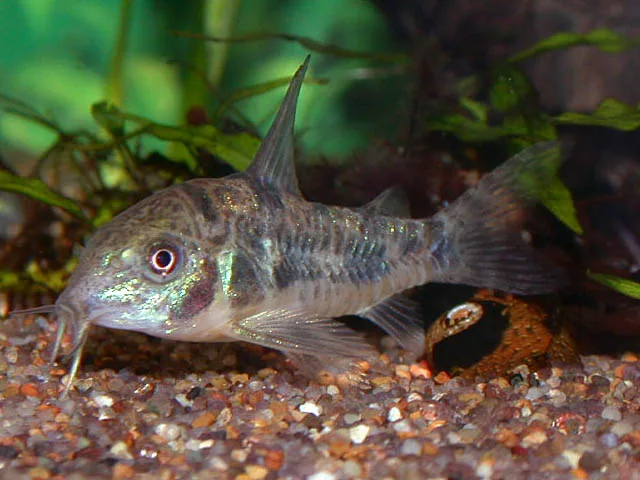
Clown killifish
Epiplatys annulatus
21 views
A small killifish from Guinea, Liberia and Sierra Leone. Pseudepiplatys annulatus is the other genus placement.
- Temperature
- 20 – 26 °C
- pH
- 5.5 – 7 pH
- General hardness
- 1 – 8 °dH
- Maximum size
- 4 cm
- Minimum tank size
- 30 L
3 min read · 437 words
Fresh water
Quick facts
Place in the aquarium
Highlighted are the water layer and the spots where the species usually stays in the tank.
- Water surface Stays just below the surface. The top needs a calm current and a cover.
- Dense plants Looks for dense planting as cover, retreat or grazing ground.
Shrimp in the tank
Shrimplets at risk
- Not shrimp safe
- Dwarf shrimp at risk
- Shrimplets at risk
- Shrimp safe
- Adult dwarf shrimp
- Safe
- Shrimplets
- Get eaten
- Safe from shrimp size
- about 1.5 cm
Adult dwarf shrimp are safe from the clown killi. It grows to only about 4 cm and lurks under floating plants at the surface for small insects and invertebrates. Shrimp from about 1.5 cm on the bottom do not interest it.
It can, however, catch baby shrimp that climb towards the surface or drift in the water. Because it stays almost only in the upper water, young on the bottom among moss and leaves are largely spared. It therefore suits dwarf shrimp in calm, soft-water tanks.
Home & range
Hatched countries are where the species occurs. It lives in particular waters there, not across the whole country. The points name known waters for orientation, not collection sites.
- Country of origin
- Water for orientation
Native
Overview
In captivity to 4 cm. Pike-like, superior mouth, three broad black-blue bars. Males larger, fins pointed and red-yellow. Females with rounded, mostly colourless fins, the tail without red.
Features
The clown killi has a pike-like body with an upturned mouth and grows to 4 cm in aquaria. Three broad blue-black crossbands lie on a silvery ground and continue into the fins. The dorsal fin sits far back and starts only after the middle of the anal fin. Males are larger and have pointed, bright red or yellow fins, while females have rounded fins that are colourless except for the tail and lack red.
Boulenger described the species in 1915 as Haplochilus annulatus, and the type locality is probably Maka at the mouth of the Moa in Sierra Leone. Whether it belongs in Epiplatys or in its own genus Pseudepiplatys is disputed. Annulatus refers to the ring-like pattern. The IUCN lists it as least concern.
Origin & habitat
This describes the origin, not how to furnish the aquarium.
Small pools, sunny plant-rich banks. The three countries stay coarse.
The species lives in Guinea, Liberia and Sierra Leone in small waters of rainforest and savanna. It keeps to sunny, plant-rich shore zones and shallows, among floating plants and rarely in open water.
Care
No adult keeping temperature. Breeding names 25 to 26 °C, 1 to 3 °dGH and pH 5 to 5.5. That applies to breeding, not to adult fish.
For breeding 25 to 26 °C, very soft water of 1 to 3 °dGH, pH 5 to 5.5 and added peat are given. The species is very peaceful towards other fish. It reached Germany in 1965 through Kretschmer, Roloff and Clausen.
Diet
Small insects and invertebrates from the surface.
The clown killi lurks under floating plants at the surface and darts at small insects and other invertebrates.
Behavior
Peaceful, an ambush hunter under floating plants.
Names and placement
The genus name Epiplatys combines Greek epi, above, and platys, flat or broad. Synonyms are Aplocheilus annulatus and Panchax annulatus. The species belongs to the Nothobranchiidae. In English it is called the clown killi or banded panchax. It is probably a relict form restricted to small waters in rainforest and savanna.
Reproduction
Mature at five to six months. Eggs about 1 mm at the foot of plants. Hatch after eight to ten days. At 20 to 22 °C almost only males, at 25 to 28 °C a balanced ratio. That concerns rearing.
The fish mature at five to six months. The eggs, about 1 mm in size, are laid on peat at the base of plants, and the young hatch after eight to ten days. They first eat infusoria and grow very slowly. The sex ratio depends on temperature: at 20 to 22 °C almost only males develop, at 25 to 28 °C about equal numbers.
Gallery
More species in this group
Similar water needs
Species with a similar temperature, a similar pH and a comparable adult size. Whether their behaviour fits as well is what the compatibility check is for.