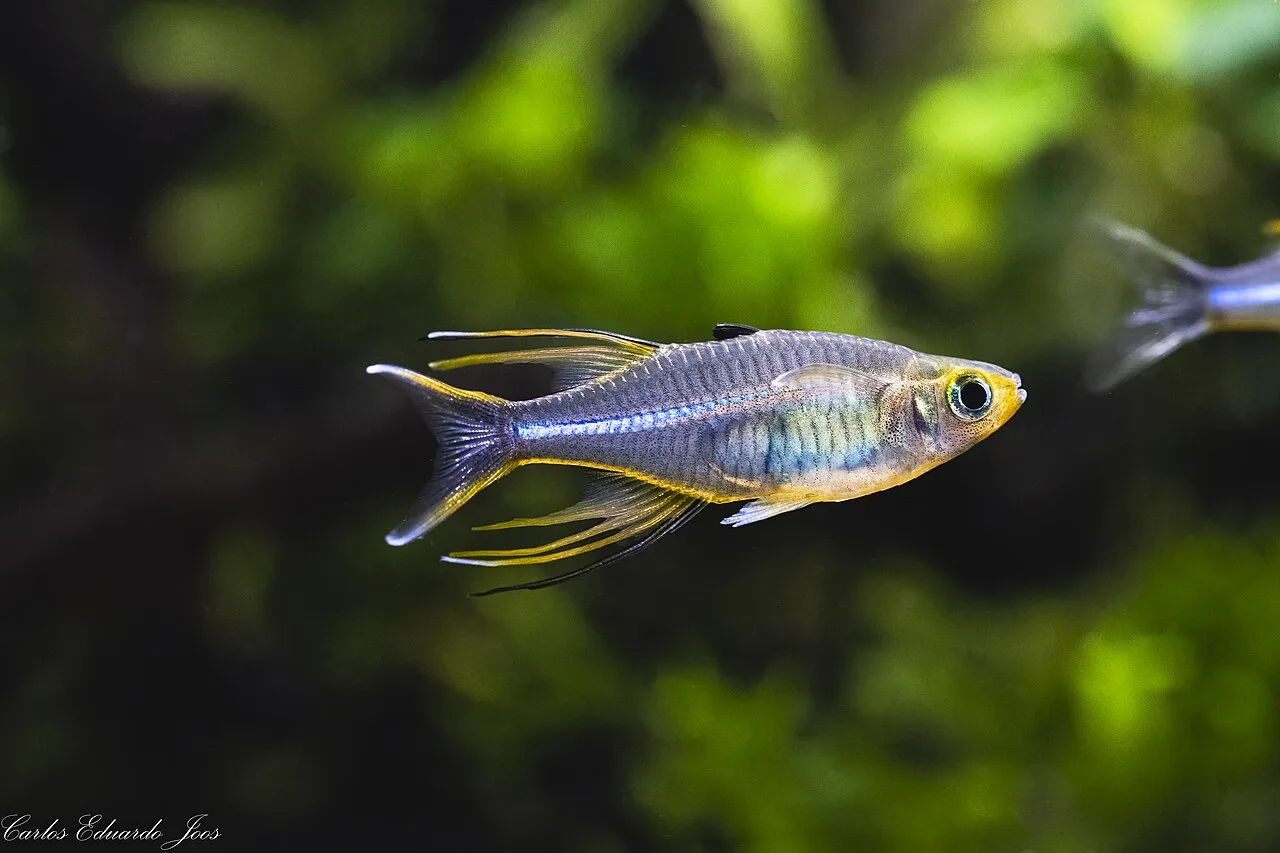
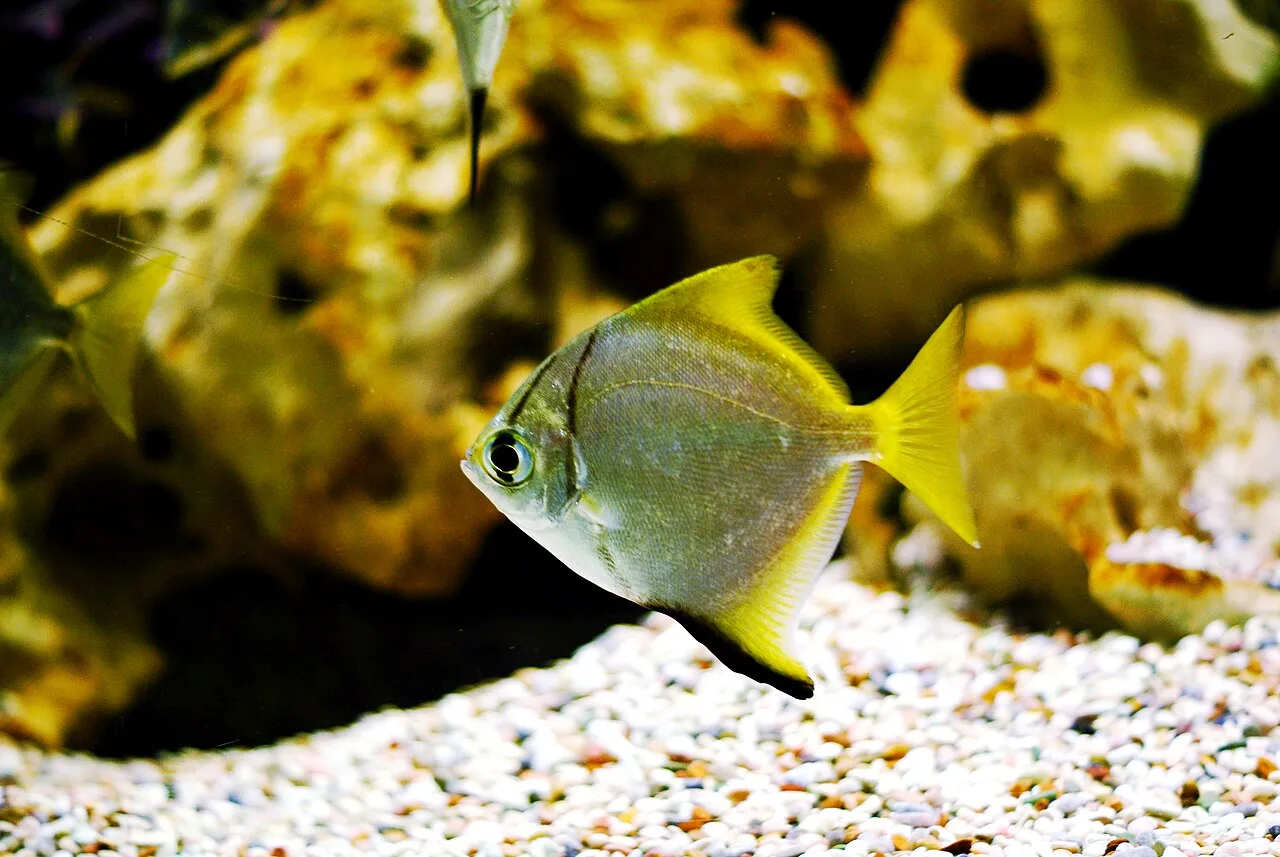
Boesemani rainbowfish
Melanotaenia boesemani
24 views
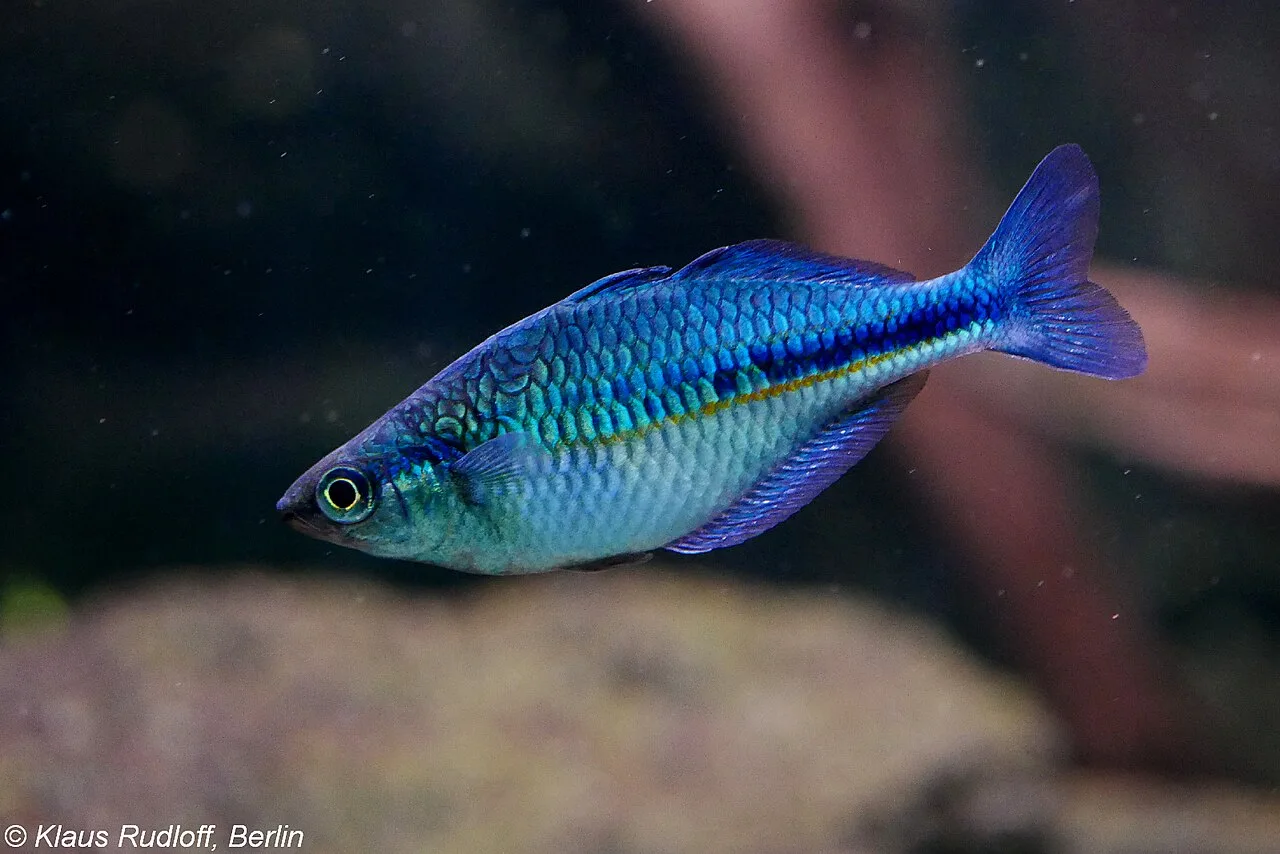
Rainbowfish whose blue and orange colour strengthens with age.
- Temperature
- 24 – 28 °C
- pH
- 7 – 8.5 pH
- General hardness
- 5 – 25 °dH
- Maximum size
- 11 cm
- Minimum group size
- 8
- Minimum tank size
- 200 L
4 min read · 581 words
Fresh water
Quick facts
Further published values
- Lifespan
- 5 – 8 a
Place in the aquarium
Highlighted are the water layer and the spots where the species usually stays in the tank.
- Upper water Usually stays in the top third of the tank.
- Middle water Usually stays in the middle of the tank, between bottom and surface.
- Open swimming space Needs an open area without plants or decor to swim at length. Tank length matters more than height.
Shrimp in the tank
Dwarf shrimp at risk
- Not shrimp safe
- Dwarf shrimp at risk
- Shrimplets at risk
- Shrimp safe
- Adult dwarf shrimp
- At risk
- Shrimplets
- Get eaten
- Safe from shrimp size
- about 4 cm
Boeseman's rainbowfish endangers small dwarf shrimp. It grows to over 10 cm and prefers meatier food when given a choice. Small Caridina and Neocaridina may be seen as prey, their young all the more. Larger shrimp such as Amano, ghost, bamboo or fan shrimp, on the other hand, usually live with it without problems.
Anyone adding larger shrimp introduces adult shrimp before young rainbowfish and offers hiding places, while the fish keep open swimming space. Dwarf shrimp are kept separately. Small dwarf shrimp then need very dense hiding places.
Home & range
The filled area shows the water body the species comes from.
- Named water body
- Water for orientation
Water bodies
- Lake Ayamaru
- The origin text names the Ajamaru lakes. The shape is the OpenStreetMap outline of the named water body Danau Ayamaru, not a species range calculated from observations.
Overview
The species needs a group and tank length. Juveniles look pale. That is normal and not a sign of the wrong food. Colour arrives with age and in the group, not on a single fish in a short tank. Several males spread the rivalry better than one pair on a short run.
Colour and sexes
The pattern of adult males differs greatly from other rainbowfish: head and front body are bluish, fins and rear body strongly orange. At the boundary light and dark vertical bars alternate. In some fish the boundary is almost sharp, and the fish can change their colour intensity, which becomes stronger at night. Females are often greenish with a broad dark midline stripe, flanked by thin orange lines between the scale rows. They resemble half-grown subordinate males but are slimmer with rounded fin tips. Males reach about 12 cm and become deeper-bodied. Growth is very slow, and fish are often fully grown only at about one and a half years.
Name and history
Gerald R. Allen and Norbert J. Cross described the species in 1980 from fish of a Dutch expedition in 1954 and 1955. The name honours the ichthyologist Marinus Boeseman, who collected the type specimens. In 1982 Allen and Heiko Bleher collected the first live fish, which Bleher brought to Europe.
Origin & habitat
This describes the origin, not how to furnish the aquarium.
Ajamaru lakes and nearby waters in western New Guinea. The wild range is small. That is an origin, not an expectation of wild fish from this small area. No reviewed coordinate map is published.
The species lives only in the centre of the Bird's Head Peninsula in West Papua, in the Ayamaru Lakes with their tributaries and in Lake Aytinjo, which drains to the Kais. The three shallow Ayamaru Lakes have muddy shores and are linked by many natural channels. Depth and size vary greatly with the seasons, and in places dense underwater vegetation grows. Lake Aytinjo, about 20 km to the south-east, is more like a broad river with rocky shores and a partly rocky, partly sandy bottom. The IUCN rates the species as endangered.
Care
About 24–28 °C. Hard, alkaline water is well tolerated. Tanks from about 200 litres, at least eight fish. Length matters more than height: the fish swim along the tank. A tall, short tank stays too tight even when the litres look sufficient.
Keeping
The species is kept at 5 to 25 dGH, pH 6.5 to 8.1 and 24 to 26 °C. On average five to eight years are reached, with good care more than eight, and with some hobbyists 13 to 15 years. The fish are kept in groups with at least as many females as males. Suitable tankmates are other rainbowfish, barbs, tetras, corydoras, gouramis, danios and loaches. Small dwarf shrimp may be seen as prey. The species is prone to columnaris infections.
Diet
Omnivore, food with a plant component. Frozen mosquito larvae alone do not cover that. The food has to reach the school, not only the leading males.
Boeseman's rainbowfish is an omnivore but prefers meatier food when given a choice. Because the mouth is relatively small, food should be suitably small, such as krill flakes, pellets, bloodworms, daphnia or brine shrimp.
Behavior
Peaceful, active school. The fish are on the move all day. Quiet bottom fish bother them little. Hectic or aggressive tankmates do.
Reproduction
Continuous spawner in plants. Fry need fine food. In a community tank the young survive only if fine plants give cover and nobody treats the larvae as food.
Breeding is regarded as fairly simple. Spawning takes place in a tuft of Java moss.
Gallery
More species in this group
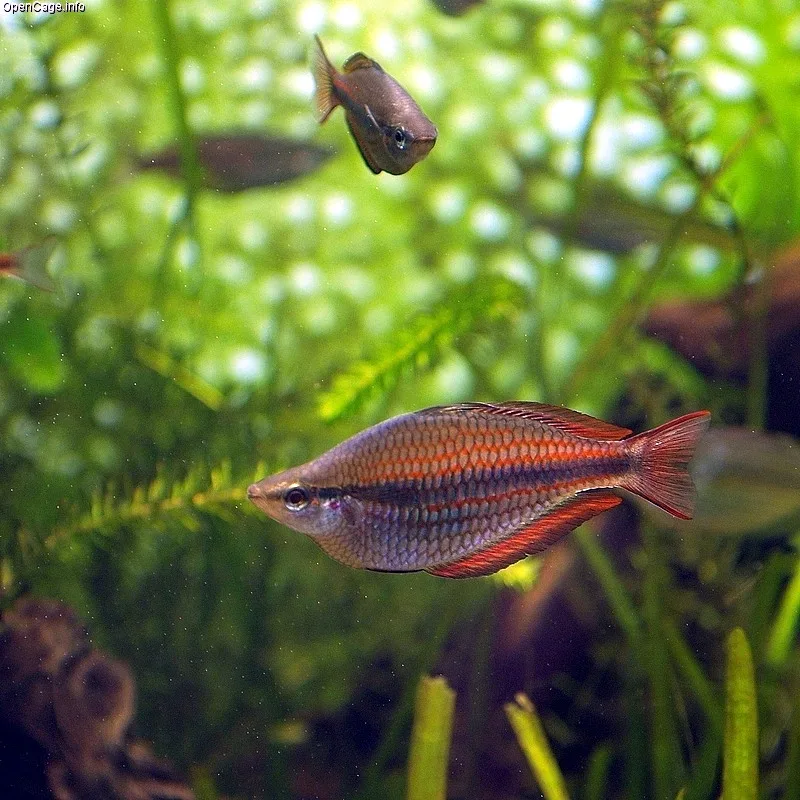
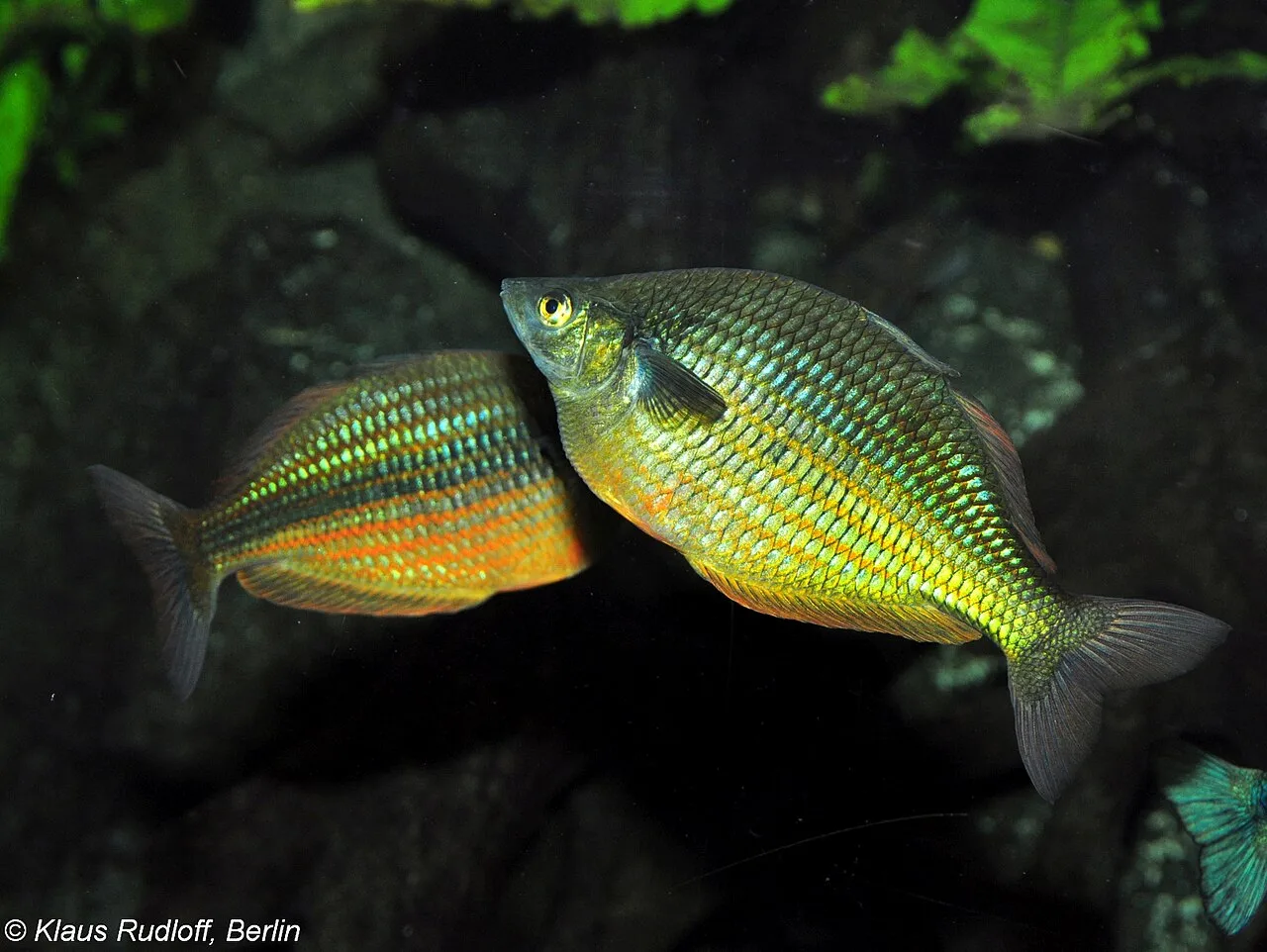
Similar water needs
Species with a similar temperature, a similar pH and a comparable adult size. Whether their behaviour fits as well is what the compatibility check is for.