Barred rainbowfish
Chilatherina fasciata
22 views
A rainbowfish from New Guinea with dark bars. Colour and bars come with age, a group and tank length.
- Temperature
- 24 – 28 °C
- pH
- 7 – 8 pH
- General hardness
- 8 – 20 °dH
- Maximum size
- 12 cm
- Minimum group size
- 6
- Minimum tank size
- 200 L
3 min read · 395 words
Fresh water
Quick facts
Place in the aquarium
Highlighted are the water layer and the spots where the species usually stays in the tank.
- Upper water Usually stays in the top third of the tank.
- Middle water Usually stays in the middle of the tank, between bottom and surface.
- Open swimming space Needs an open area without plants or decor to swim at length. Tank length matters more than height.
Shrimp in the tank
Dwarf shrimp at risk
- Not shrimp safe
- Dwarf shrimp at risk
- Shrimplets at risk
- Shrimp safe
- Adult dwarf shrimp
- At risk
- Shrimplets
- Get eaten
- Safe from shrimp size
- about 4 cm
The banded rainbowfish Chilatherina fasciata endangers dwarf shrimp. It grows to 12 cm, has a fairly pointed head and is an active swimmer that takes small animals as food. Young shrimp and Neocaridina or Caridina of 2 to 3 cm are eaten. Larger shrimp such as Amano shrimp from about 4 cm are usually safe.
Dwarf shrimp are kept separately. Larger shrimp find enough hiding places in a long tank with plants and wood along the edges. Calm bottom fish do not get in the way.
Home & range
Overview
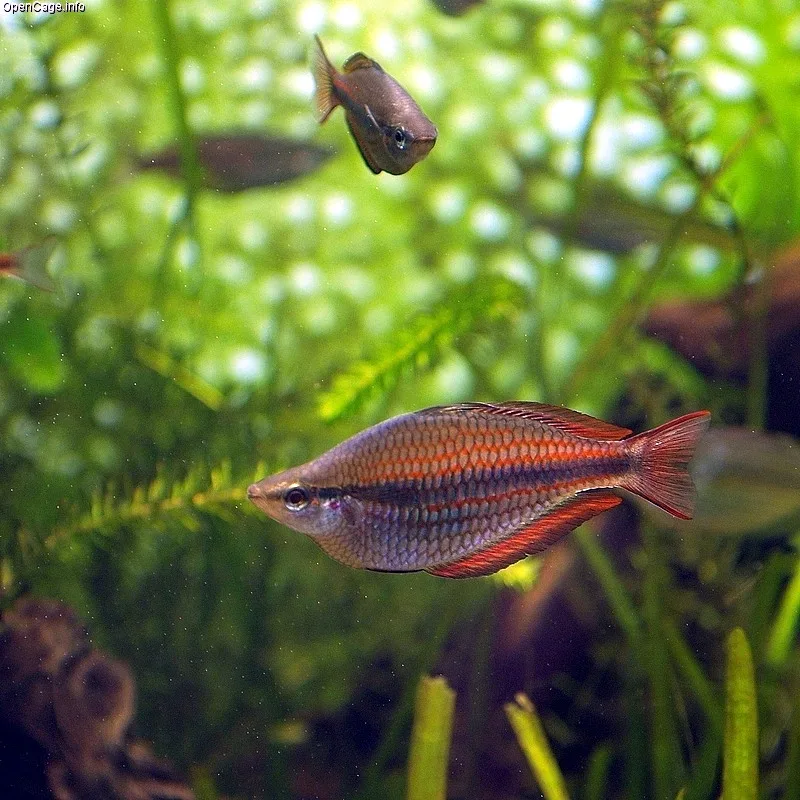
Chilatherina fasciata reaches about 10 to 12 cm. The body is silvery to gold-pink, with dark bars over it. The fins of the males can carry red and yellow. Females are plainer. Juveniles hardly show the bars.
The species is not a Melanotaenia, but it shares the keeping: a school, length, movement. A short tank leaves the males pale and quarrelsome.
Features
The banded rainbowfish has a relatively deep, strongly compressed body and grows to 12 cm. The head is fairly pointed and the eyes are strikingly large. With age the fish, especially males, become deeper-bodied. Back and flanks are brownish to blue-green, and the scales have a pale yellowish edge. Both dorsal fins and the tail fin are dark, often edged black. Males have yellowish bases on the pelvic and anal fins with a black margin, females transparent fin bases and sooty grey margins.
The name fasciata means striped. The vertical striping on the front of the body is mainly visible in preserved specimens, however, and only faintly and temporarily in live fish, as in other Chilatherina species.
Taxonomy
Max Weber described the species in 1913 as Rhombatractus fasciatus. It is the type species of the genus Chilatherina.
Origin & habitat
This describes the origin, not how to furnish the aquarium.
Rivers and streams in northern New Guinea. Clear, with current. The island stays the coarse origin. The individual rivers are not a line here.
The species lives in northern New Guinea between the Merkaham and Mamberamo rivers. It inhabits lowland waters and streams and rivers in hilly country up to 400 to 500 m altitude. There it occurs together with Chilatherina crassispinosa and Melanotaenia affinis, and in Lake Wanam with the Wanam rainbowfish.
Care
Size
24 to 28 °C, pH 7 to 8. A group from six, with several males, tanks from about 200 litres and 120 cm. An open middle, plants at the edge, some current, a cover.
Company
Other calm fish that are not tiny. Very small shrimp can be eaten. Aggressive barbs put the colour out.
Diet
A prepared food with a plant share. Flakes, granules, frozen food. Two feeding places. Colour comes from age and courtship, not from a colour food alone.
Behavior
An active school. The males show the bars and circle each other, as long as the run is long. In a short tank that becomes stress.
Reproduction
Continuous spawner on fine plants. The parents eat the eggs. A spawning mop that is moved is the breeding path. The young need fine food.
Gallery
More species in this group

Similar water needs
Species with a similar temperature, a similar pH and a comparable adult size. Whether their behaviour fits as well is what the compatibility check is for.