
McCulloch’s rainbowfish
Melanotaenia maccullochi
25 views
A small rainbowfish from northern Australia. It stays shorter than the large Melanotaenia and still needs a group and a swimming run.
- Temperature
- 22 – 26 °C
- pH
- 6.5 – 7.5 pH
- General hardness
- 5 – 15 °dH
- Maximum size
- 7 cm
- Minimum group size
- 6
- Minimum tank size
- 100 L
3 min read · 465 words
Fresh water
Quick facts
Place in the aquarium
Highlighted are the water layer and the spots where the species usually stays in the tank.
- Upper water Usually stays in the top third of the tank.
- Middle water Usually stays in the middle of the tank, between bottom and surface.
- Open swimming space Needs an open area without plants or decor to swim at length. Tank length matters more than height.
Shrimp in the tank
Shrimplets at risk
- Not shrimp safe
- Dwarf shrimp at risk
- Shrimplets at risk
- Shrimp safe
- Adult dwarf shrimp
- Safe
- Shrimplets
- Get eaten
- Safe from shrimp size
- about 2 cm
Adult dwarf shrimp are usually safe with the dwarf rainbowfish. It grows up to 7 cm, is a lively group fish and eats omnivorous food with a plant share. Shrimp from about 2 cm are rarely chased, but very small ones are harassed. Juvenile shrimp are eaten.
The species swims mainly in the upper and middle water. Many hiding places, moss and dense plants on the bottom leave the shrimp in peace. For productive breeding a separate tank is the better choice.
Home & range
Hatched countries are where the species occurs. It lives in particular waters there, not across the whole country. The points name known waters for orientation, not collection sites.
- Country of origin
- Water for orientation
Native
Overview
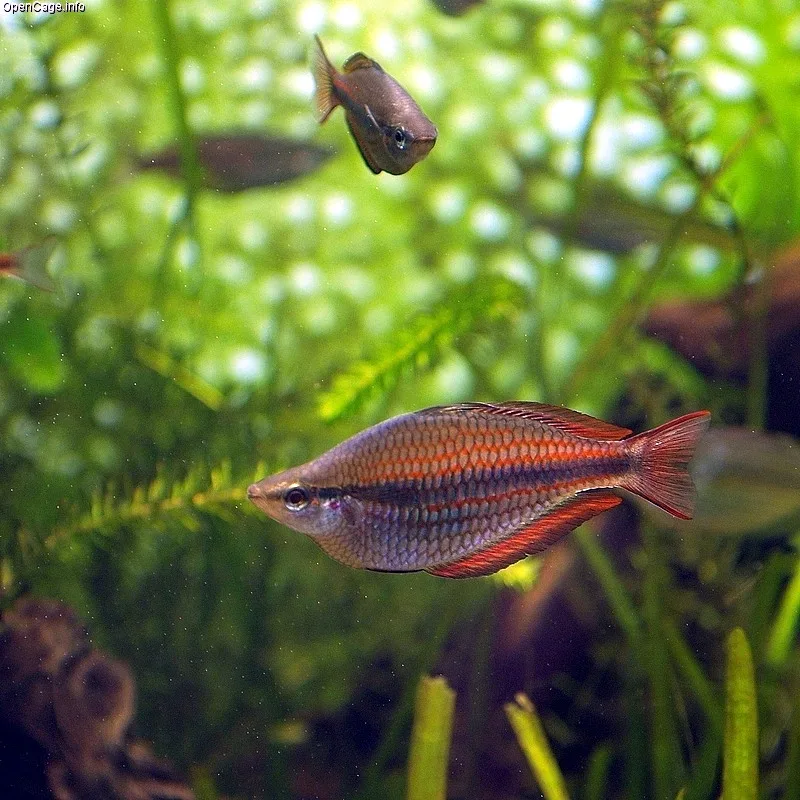
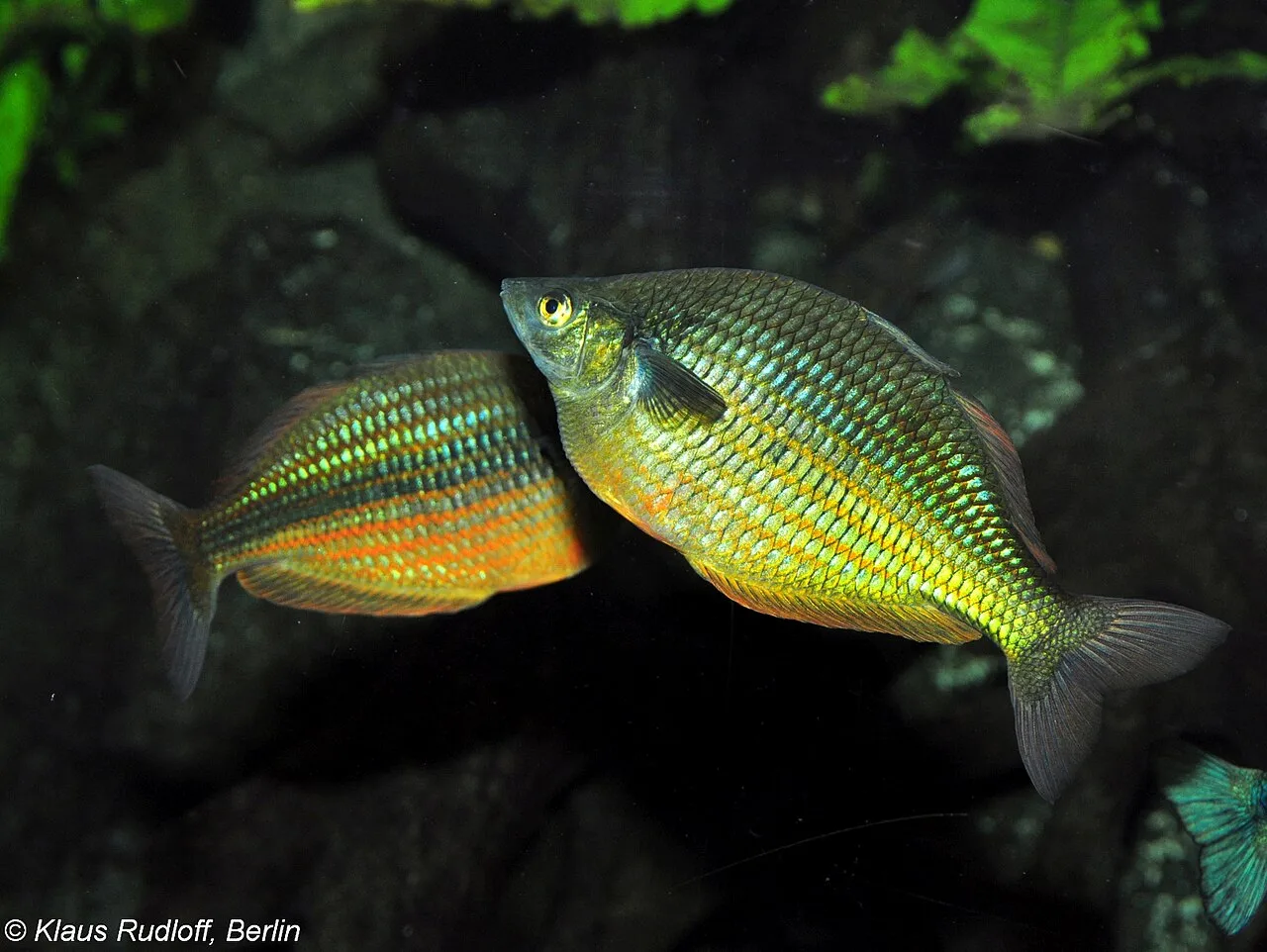
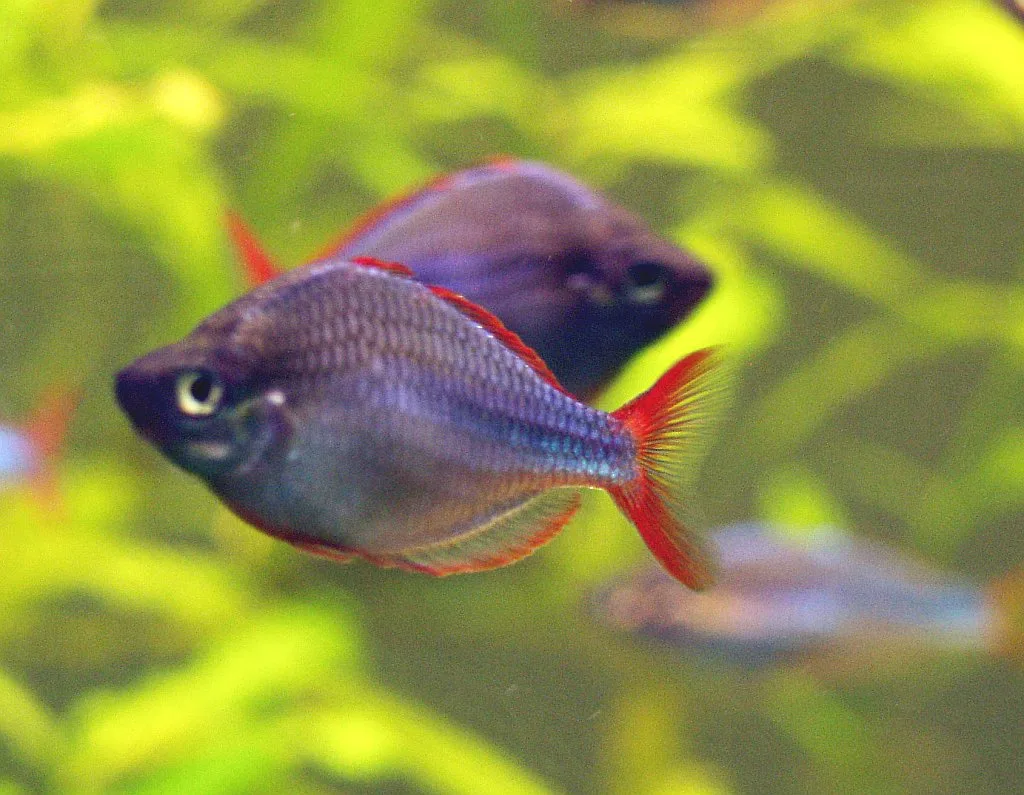
Melanotaenia maccullochi reaches about 6 to 7 cm. The body is silvery to greenish with dark longitudinal stripes and red in the fins, which become stronger with age and in the group. Males are deeper and more colourful, females plainer. Juveniles are pale. That is normal.
The species is lively, but smaller and fit for shorter tanks than Boesemani or the banded rainbowfish. A nano cube is still too short.
Name and relatives
James Douglas Ogilby described the species in 1915. The species name honours the Australian ichthyologist Allan Riverstone McCulloch. The flanks are silvery to bronze with reddish and brownish longitudinal stripes, and the unpaired fins are orange to red. Females are paler and have less pointed dorsal and anal fins.
Close relatives are Melanotaenia sahulensis from southern New Guinea between the Bensbach and Fly rivers and from the Cape York Peninsula, and Melanotaenia wilsoni from small waters in Litchfield National Park in the Northern Territory. Both were regarded as local variants of M. maccullochi until they were described. A form of Melanotaenia australis is often sold in the trade under this name by mistake.
Origin & habitat
This describes the origin, not how to furnish the aquarium.
Streams and swamps in northern Australia and southern New Guinea. Clear to lightly stained water, plants, swimming room. The origin stays coarse.
The species lives in Queensland in north-eastern Australia, from the Starcke River north of Cape Flattery to slightly south of Cardwell. The populations are not connected and differ in colour intensity. It inhabits mostly small, shaded waters, sometimes also swampy areas. There it lives together with Cairnsichthys rhombosomoides, Melanotaenia trifasciata, M. nigrans, M. splendida and several blue-eyes of the family Pseudomugilidae.
Care
Size
22 to 26 °C, pH 6.5 to 7.5. A group from six, with several males, tanks from about 100 litres and 80 cm. An open middle, plants at the edge, some current, a cover. A permanent stay above 28 °C is unnecessary and unfavourable in the long run.
Company
Other calm fish that are not tiny. Very small shrimp can be harassed. Aggressive barbs put the colour out. The fish are on the move all day.
Diet
A prepared food with a plant share. Flakes, granules, frozen food. Two feeding places, so the females do not receive only leftovers. Colour comes from age, light and courtship, not from a single colour food.
Behavior
An active school. The males spread the fins and circle each other, as long as the length is right. In a short tank that becomes stress. The species stands in the upper and middle water.
Reproduction
Continuous spawner on fine plants. The parents eat the eggs. A spawning mop that is moved is the breeding path. The young need fine food. In a community tank young are the exception.
The first fish reached Germany in the 1930s and have been bred in aquaria ever since. Today the species is rare in the trade.
Gallery
More species in this group

Similar water needs
Species with a similar temperature, a similar pH and a comparable adult size. Whether their behaviour fits as well is what the compatibility check is for.


