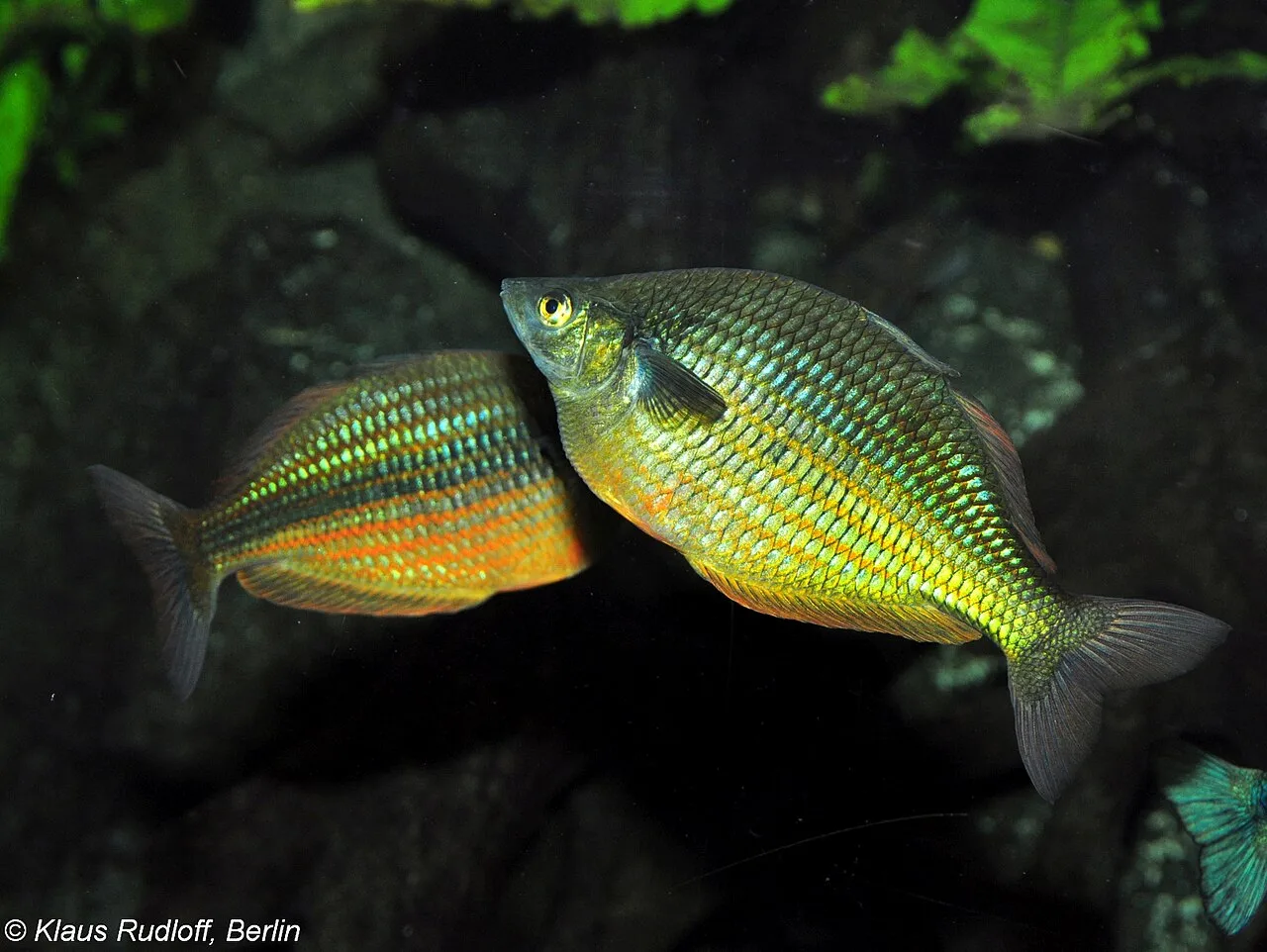
Banded rainbowfish
Melanotaenia trifasciata
20 views
A sturdy rainbowfish from northern Australia. The colour and the bands come with age, a group and tank length.
- Temperature
- 24 – 28 °C
- pH
- 7 – 8 pH
- General hardness
- 8 – 20 °dH
- Maximum size
- 12 cm
- Minimum group size
- 6
- Minimum tank size
- 250 L
4 min read · 672 words
Fresh water
Quick facts
Place in the aquarium
Highlighted are the water layer and the spots where the species usually stays in the tank.
- Upper water Usually stays in the top third of the tank.
- Middle water Usually stays in the middle of the tank, between bottom and surface.
- Open swimming space Needs an open area without plants or decor to swim at length. Tank length matters more than height.
Shrimp in the tank
Dwarf shrimp at risk
- Not shrimp safe
- Dwarf shrimp at risk
- Shrimplets at risk
- Shrimp safe
- Adult dwarf shrimp
- At risk
- Shrimplets
- Get eaten
- Safe from shrimp size
- about 4 cm
The banded rainbowfish endangers even adult dwarf shrimp. It grows to 12 to 15 cm and, as an opportunistic omnivore, mainly eats arthropods, including aquatic insects and crustaceans. Young shrimp and Neocaridina or Caridina of 2 to 3 cm are eaten. Larger shrimp such as Amano shrimp from about 4 cm are usually safe.
Dwarf shrimp are kept separately. For larger shrimp a long tank with plants and wood along the edges offers enough hiding places while the active shoal uses the open lane.
Home & range
Hatched countries are where the species occurs. It lives in particular waters there, not across the whole country. The points name known waters for orientation, not collection sites.
- Country of origin
- Water for orientation
Native
- Australia
- Range: Arnhem Land in the Northern Territory and Cape York Peninsula in Queensland.
Overview
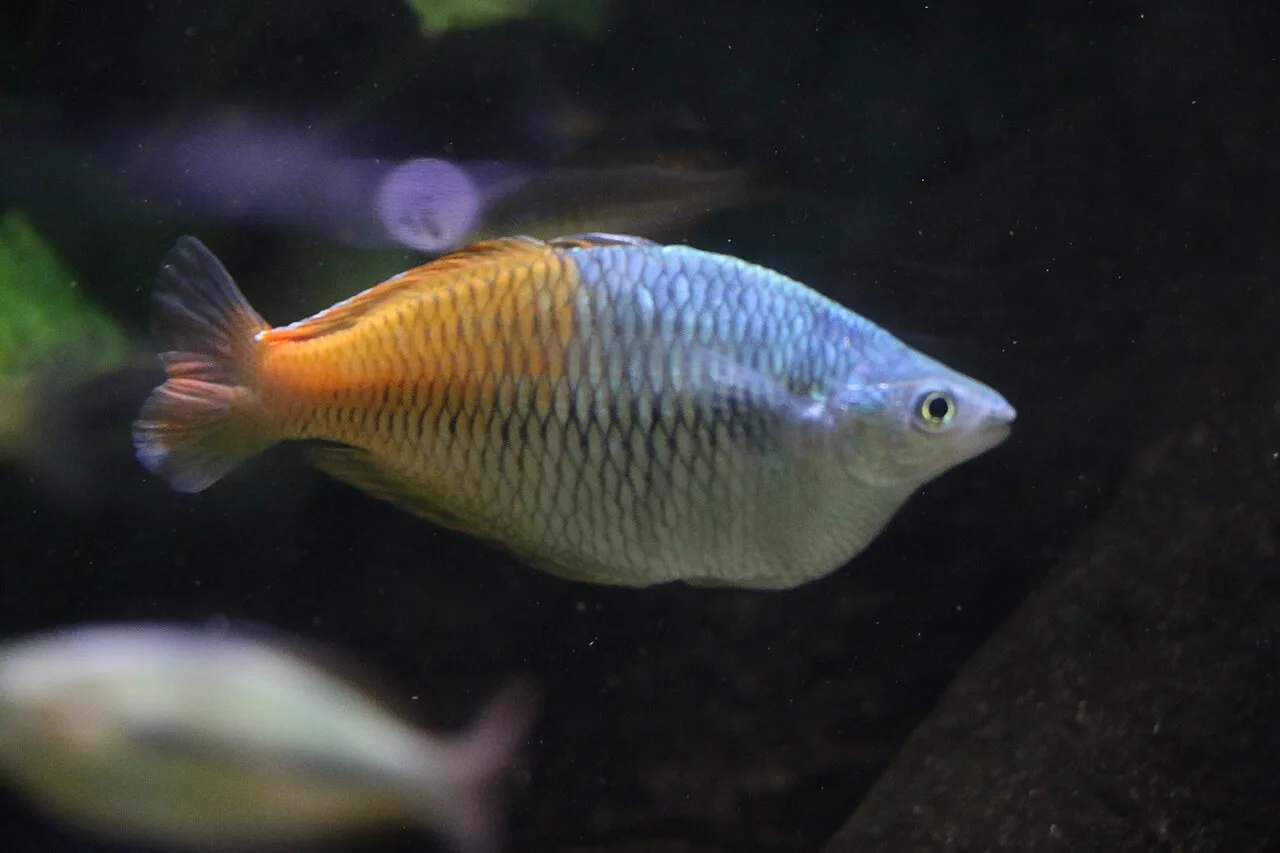
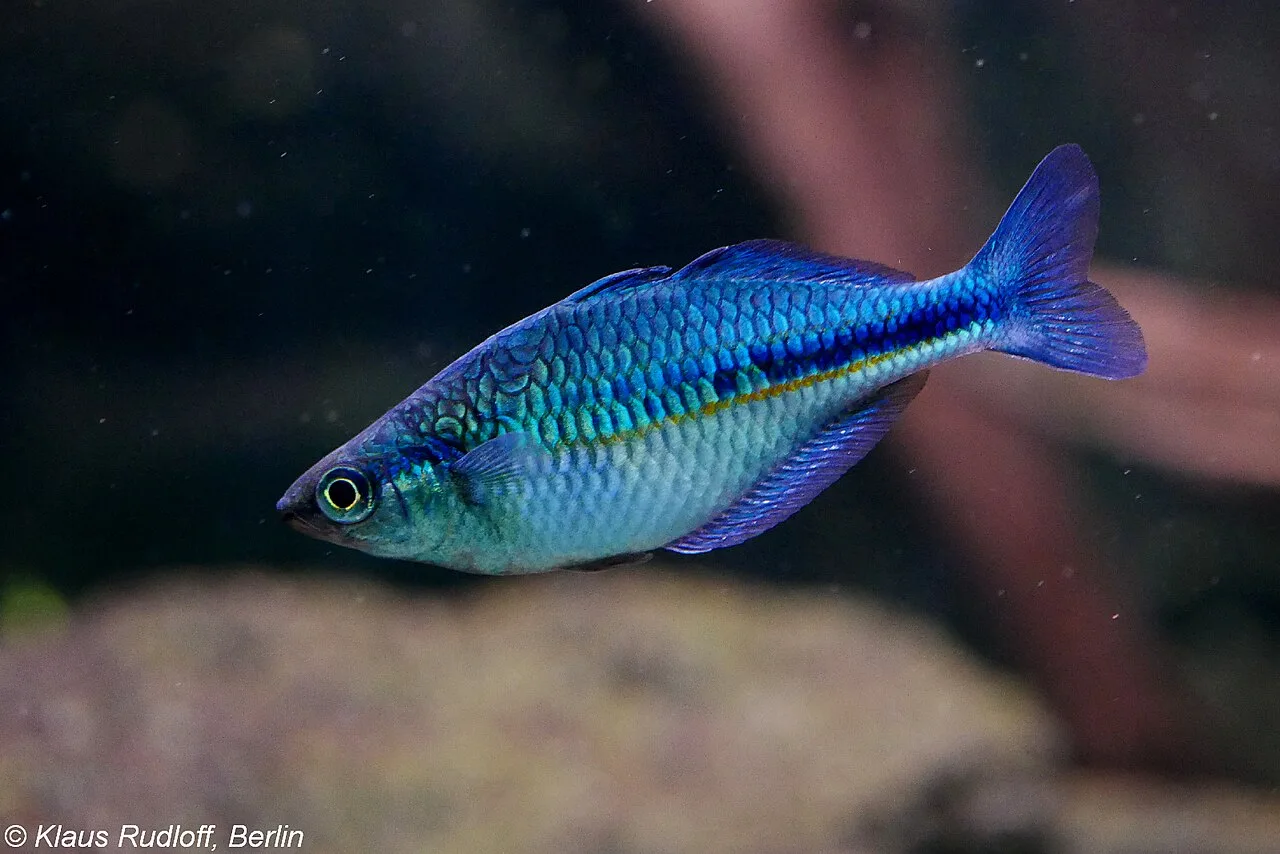
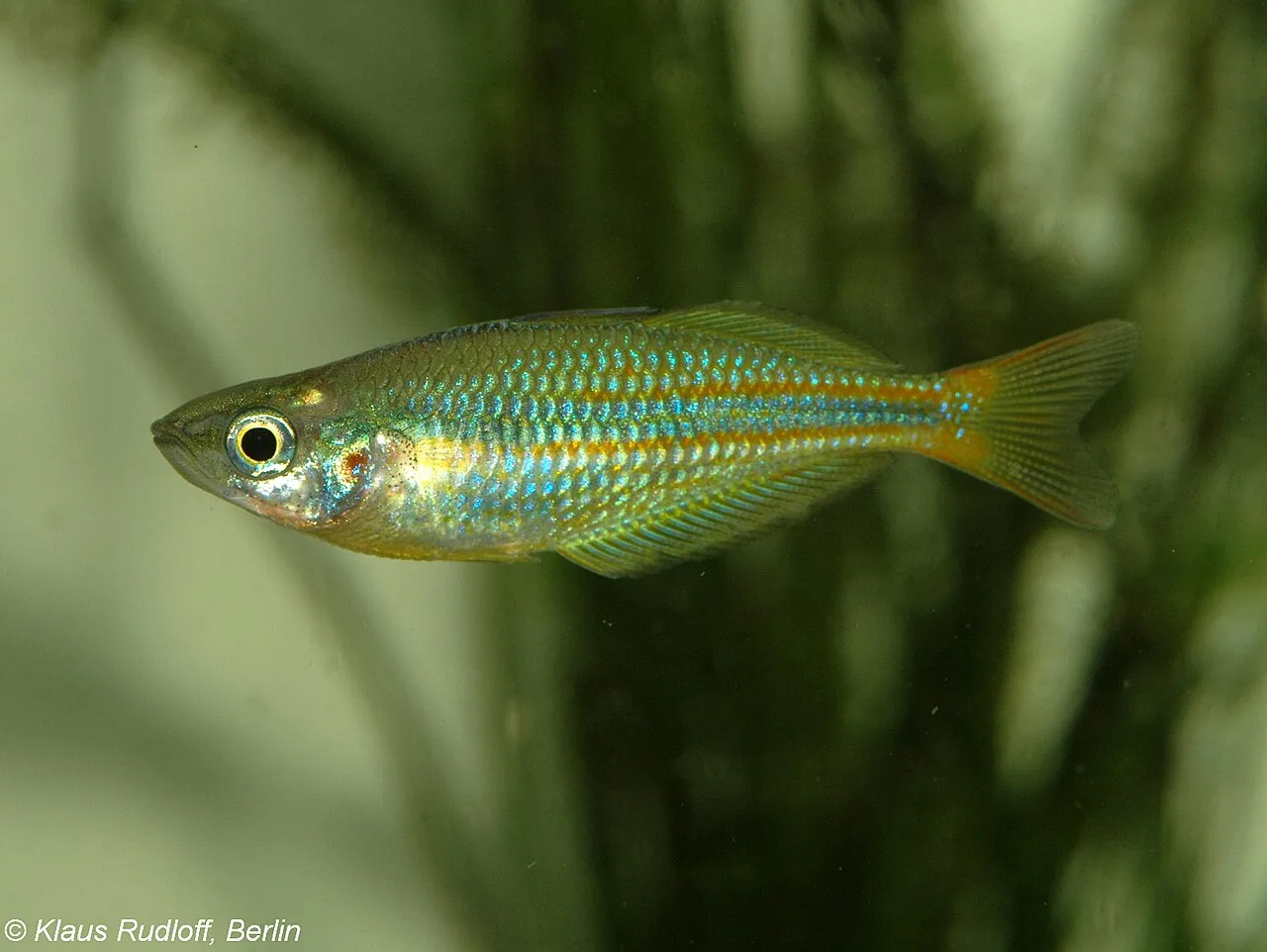
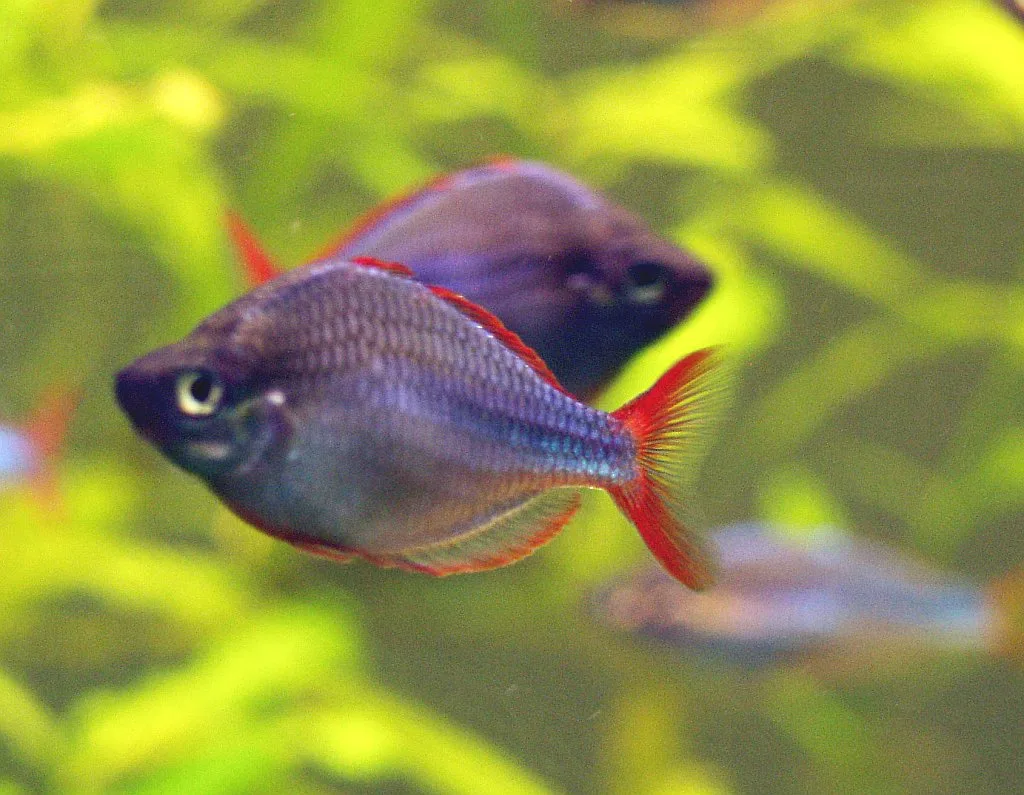
Melanotaenia trifasciata reaches about 12 cm. Depending on the locality form the body is gold, red or blue-green, with dark longitudinal bands. Males become deeper and more colourful, females plainer. Juveniles are silvery and disappoint anyone who expects the catalogue colour on the day of purchase.
The forms should not be mixed if a line is to be kept. For keeping the needs are the same: length, a group, hard to medium-hard water, a lot of movement.
Features
The body is relatively deep and strongly compressed, usually 12 to 13 cm long. The back is steel-blue or dark blue, the sides yellowish, yellow-green, bluish, green-brown or olive-brown, and the fins deep red, reddish or brownish. The second dorsal and anal fins are edged black, and the first dorsal and pelvic fins have a black leading edge. A dark mid-lateral band, bordered lighter above and below, runs from the eye to the base of the tail. Females are less colourful, and males show a glowing forehead stripe during courtship. Other reports give 12 to 15 cm standard length.
Name
Hialmar Rendahl described the species in 1922. Trifasciata means three-banded, but live fish usually show only one band. The pattern of the museum specimen had been altered by preservation. English names include banded, jewel and Goyder River rainbowfish.
Origin & habitat
This describes the origin, not how to furnish the aquarium.
Streams and rivers in northern Australia, often clear, with current and sunlight. Australia stays the coarse origin. Individual rivers are not a reviewed line here.
The habitat is not a short living-room tank. The fish swim the run all day.
The species lives in streams and rivers in Arnhem Land in the north of the Northern Territory and on Cape York Peninsula in Queensland. Clear, often fast-flowing waters are named, but also muddy waterholes, with 22 to 30 °C and pH 5.2 to 7.0. Typical features are strong flow, sandy substrate, dense submerged plants and sunken wood. The IUCN lists the species as least concern.
Care
Size
24 to 28 °C, pH 7 to 8. A group from six, with several males, tanks from about 250 litres and 120 cm. An open middle, plants at the edges, some current, a cover. A tall, short tank stays too tight even when the litres look sufficient.
Company
Other calm fish that are not tiny. Very small shrimp and Boraras are harassed or eaten. Aggressive barbs put the colour out, because the courtship no longer happens. The species is active by day and loud in its movement.
Diet
Omnivore with an appetite. Flakes, granules, frozen food and a plant share. Two feeding places, so the females do not receive only the leftovers of the leading males. Colour comes from age, light and the chance to court, not from a single colour food.
Behavior
An active school with a constant small rivalry among the males. That is spreading fins and circling, as long as the length is right. In an 80 cm tank it becomes stress, and one male stands pale in an upper corner.
The fish use the upper and middle water. Bottom fish bother them little.
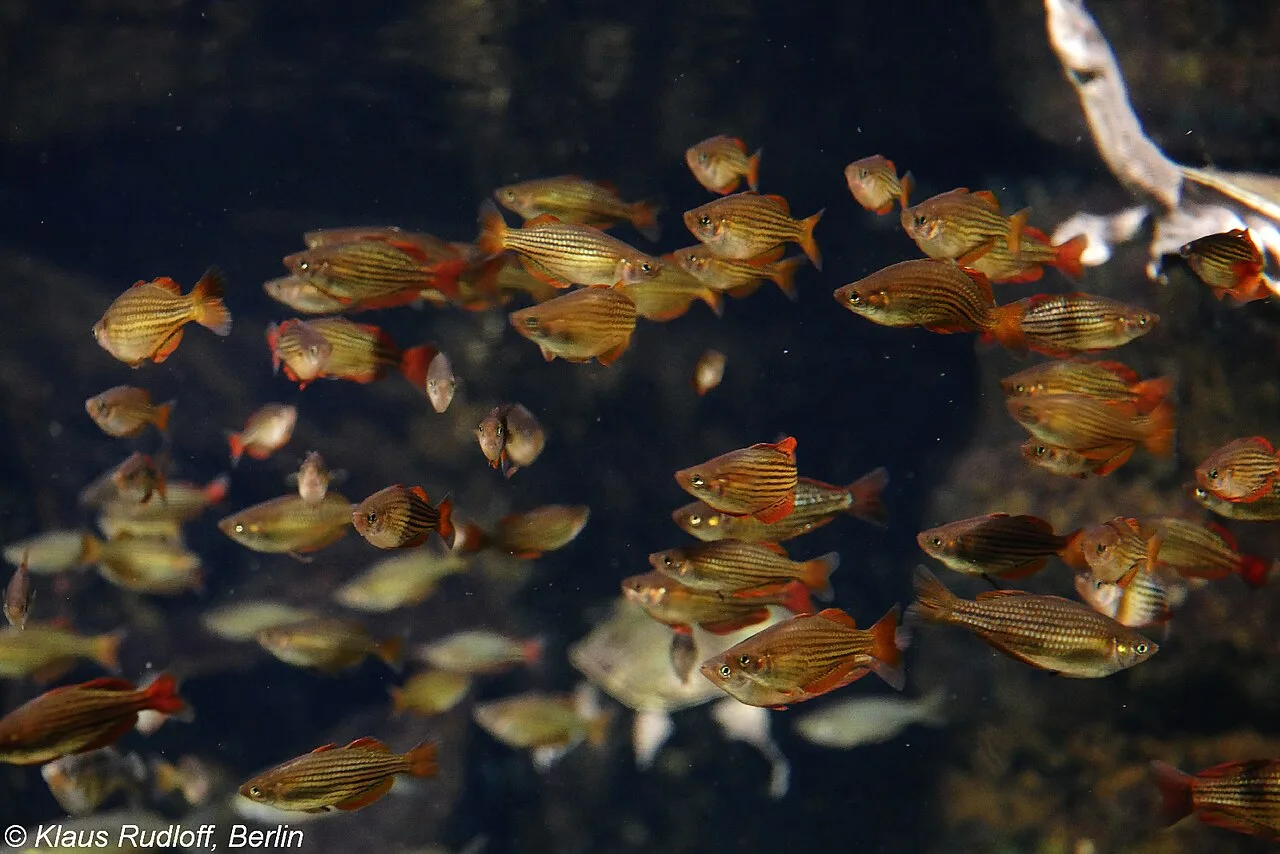
The banded rainbowfish is an active shoaling fish at the surface and in midwater. Males compete for territory and females by swimming side by side with spread fins, comparing colour and size. The species is regarded as hardy, peaceful and tolerant of many water values and suits most peaceful community tanks. Because it jumps, the tank needs a lid. In the wild it is an opportunistic omnivore eating mainly arthropods such as aquatic insects, arachnids and crustaceans, plus algae and insects that fall into the water such as weaver ants.
Reproduction
Continuous spawner. The eggs hang on fine plants or a spawning mop and are given over several days. The parents eat them. Anyone who wants to breed moves the mop. The young need fine food and clean water. In a community tank young are the exception.
The species spawns intermittently throughout the year. A female lays 200 to 500 eggs and attaches them to plants with adhesive threads. Then the male guards the territory and the eggs until the young hatch after 6 to 7 days.
Gallery
More species in this group
Similar water needs
Species with a similar temperature, a similar pH and a comparable adult size. Whether their behaviour fits as well is what the compatibility check is for.