Lake Kutubu rainbowfish
Melanotaenia lacustris
19 views
A deep-bodied rainbowfish from a small lake in New Guinea. The turquoise colour arrives with age, a group and tank length, not on a single juvenile.
- Temperature
- 22 – 26 °C
- pH
- 7.5 – 8.5 pH
- General hardness
- 10 – 20 °dH
- Maximum size
- 12 cm
- Minimum group size
- 6
- Minimum tank size
- 200 L
4 min read · 520 words
Fresh water
Quick facts
Place in the aquarium
Highlighted are the water layer and the spots where the species usually stays in the tank.
- Upper water Usually stays in the top third of the tank.
- Middle water Usually stays in the middle of the tank, between bottom and surface.
- Open swimming space Needs an open area without plants or decor to swim at length. Tank length matters more than height.
Shrimp in the tank
Dwarf shrimp at risk
- Not shrimp safe
- Dwarf shrimp at risk
- Shrimplets at risk
- Shrimp safe
- Adult dwarf shrimp
- At risk
- Shrimplets
- Get eaten
- Safe from shrimp size
- about 3 cm
The Lake Kutubu rainbowfish is only partly suitable for dwarf shrimp. It grows to about 10, rarely 12 cm and is an omnivore that takes live, frozen, flake and green food. Juvenile shrimp are eaten, and very small adult dwarf shrimp are harassed. Larger shrimp from about 3 cm such as Amano shrimp are usually safe.
The species needs hard, alkaline water, which Neocaridina tolerate. Many hiding places on the bottom and dense plants protect the shrimp. A separate tank is safer for breeding.
Home & range
Hatched countries are where the species occurs. It lives in particular waters there, not across the whole country. The points name known waters for orientation, not collection sites.
- Country of origin
- Water for orientation
Native
Overview
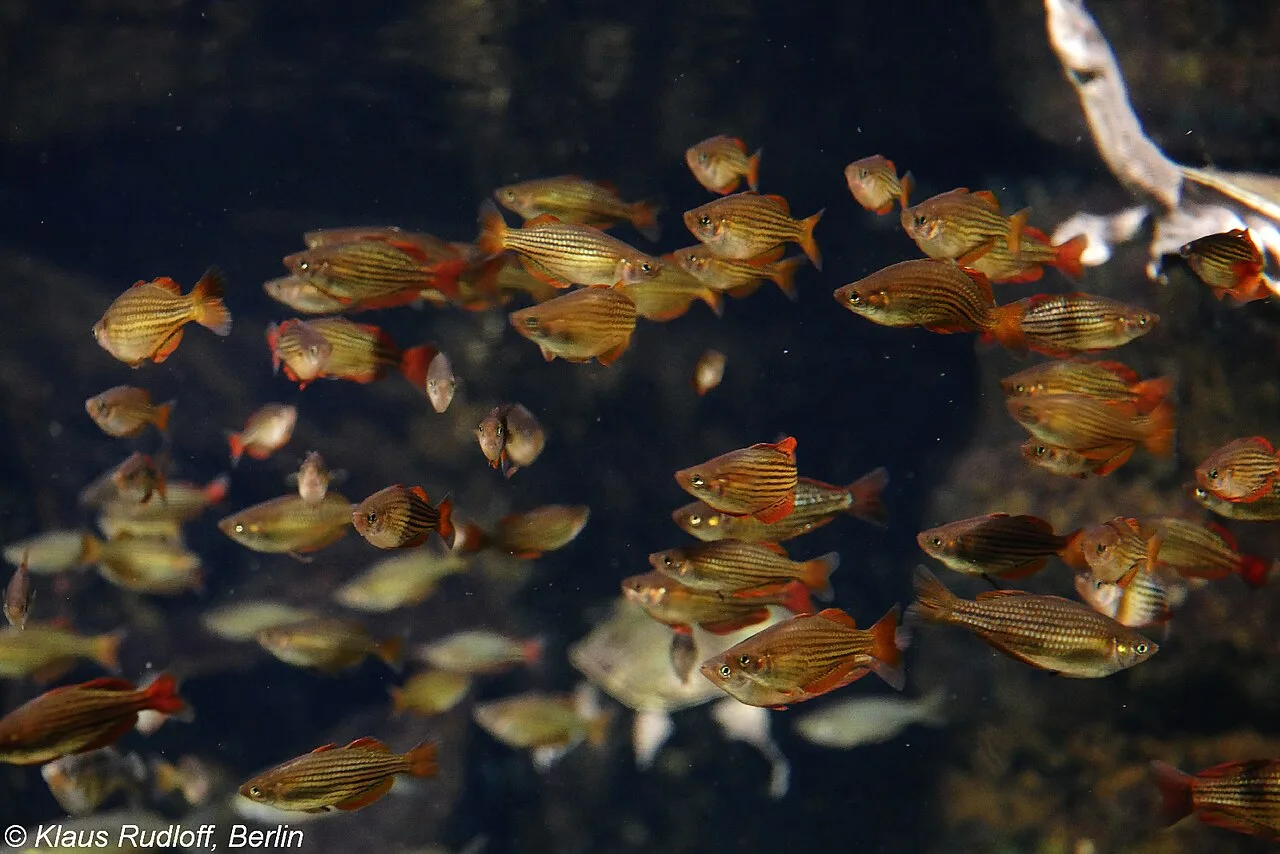
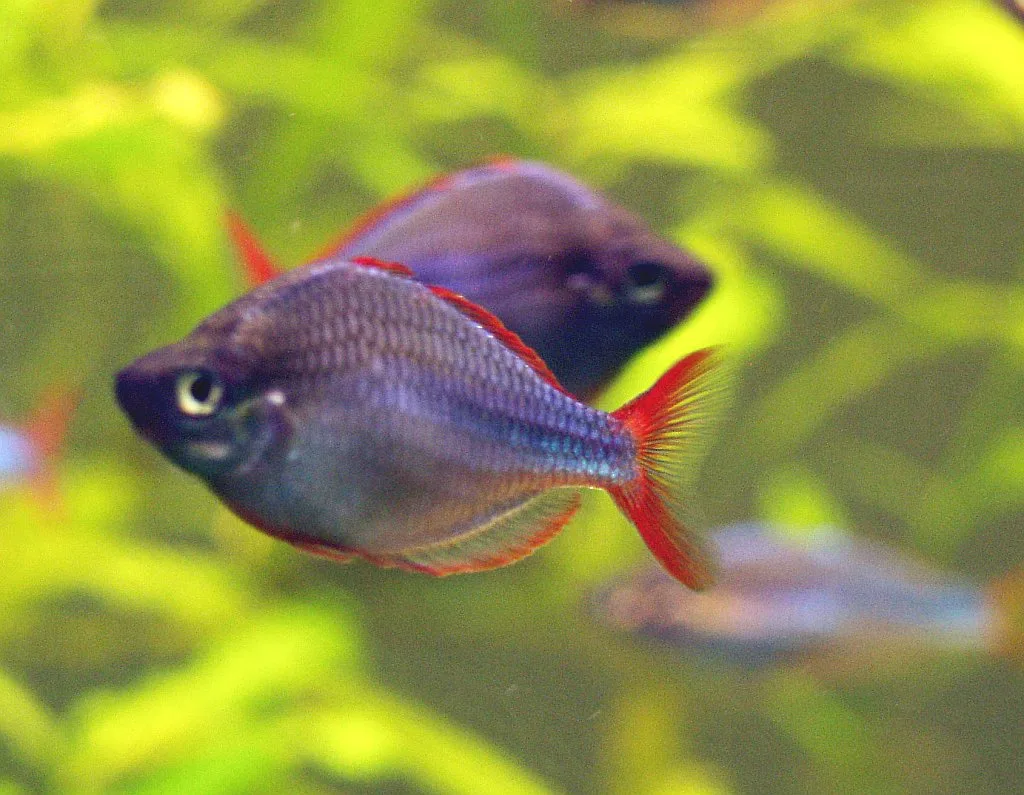
Melanotaenia lacustris reaches about 10 to 12 cm and is clearly deeper-bodied than many slender rainbowfish. Adult males are turquoise to blue-green with a warm yellow zone that shifts with mood. Females stay paler and less deep. Juveniles are silvery and disappoint anyone who expects the catalogue colour on the day of purchase.
The colour is a group effect. A male without rivals and without a run stays pale, even on good food. Several males in a long tank display to each other.
The species is also called aquamarine or Kutubu rainbowfish. It was first collected in 1955 and described by Ian Munro in 1964. Depending on water, surroundings and food the colour ranges from cobalt blue through steel blue and aquamarine to turquoise. During courtship the males' forehead turns bright yellow.
Origin & habitat
This describes the origin, not how to furnish the aquarium.
The species is native to Lake Kutubu and the waters immediately connected with it in Papua New Guinea. The natural range is small. The lake water is clear, hard and alkaline, not acidic blackwater. A coarse origin is New Guinea. The lake is not an invitation to expect wild fish from a narrow endemic area. Aquarium fish should be captive-bred.
The small range is a reason not to wear the species out as a mass fish in unstable tanks.
Besides Lake Kutubu the species inhabits the Soro, the lake's only outflow, which drains into the Kikori system. The lake water has 21 to 25 °C and pH 8.5 to 9.0.
Care
Size
22 to 26 °C, pH 7.5 to 8.5, rather hard. Tanks from about 200 litres and 120 cm long. Height is secondary. The swimming run is not. A group from six, mixed sexes, with several males. An open middle, planting at the edges, a quiet surface. They do not jump as extremely as some rasboras. A cover is still sensible.
Company
Other calm fish that are not tiny. Very small shrimp and tiny rasboras are harassed or eaten. Aggressive barbs destroy the calm from which the colour comes. Rainbowfish are on the move all day. Anyone who wants a still tank of dusk fish is in the wrong place.
Diet
Omnivore with a strong appetite. Flakes, granules, frozen food and a plant share. The portions must not be taken only by the leading males. A second feeding spot further back brings the females in.
Colour does not come from colour food alone. It comes from age, light, water and the chance to court without being driven off.
Behavior
An active school with a constant small rivalry among the males. That is spreading fins and circling, not biting to a wound, as long as the length is right. In an 80 cm tank the same rivalry becomes stress.
The fish stand in the upper and middle water. Bottom fish bother them little if those fish do not themselves claim the whole column.
Reproduction
A continuous spawner. The eggs hang on fine plants or a spawning mop and are given over several days. The parents eat them. Anyone who wants to breed moves the mop and rears the eggs apart. The young are small and need fine food and very clean water.
In a community tank young are the exception, not a plan.
Gallery
More species in this group

Similar water needs
Species with a similar temperature, a similar pH and a comparable adult size. Whether their behaviour fits as well is what the compatibility check is for.