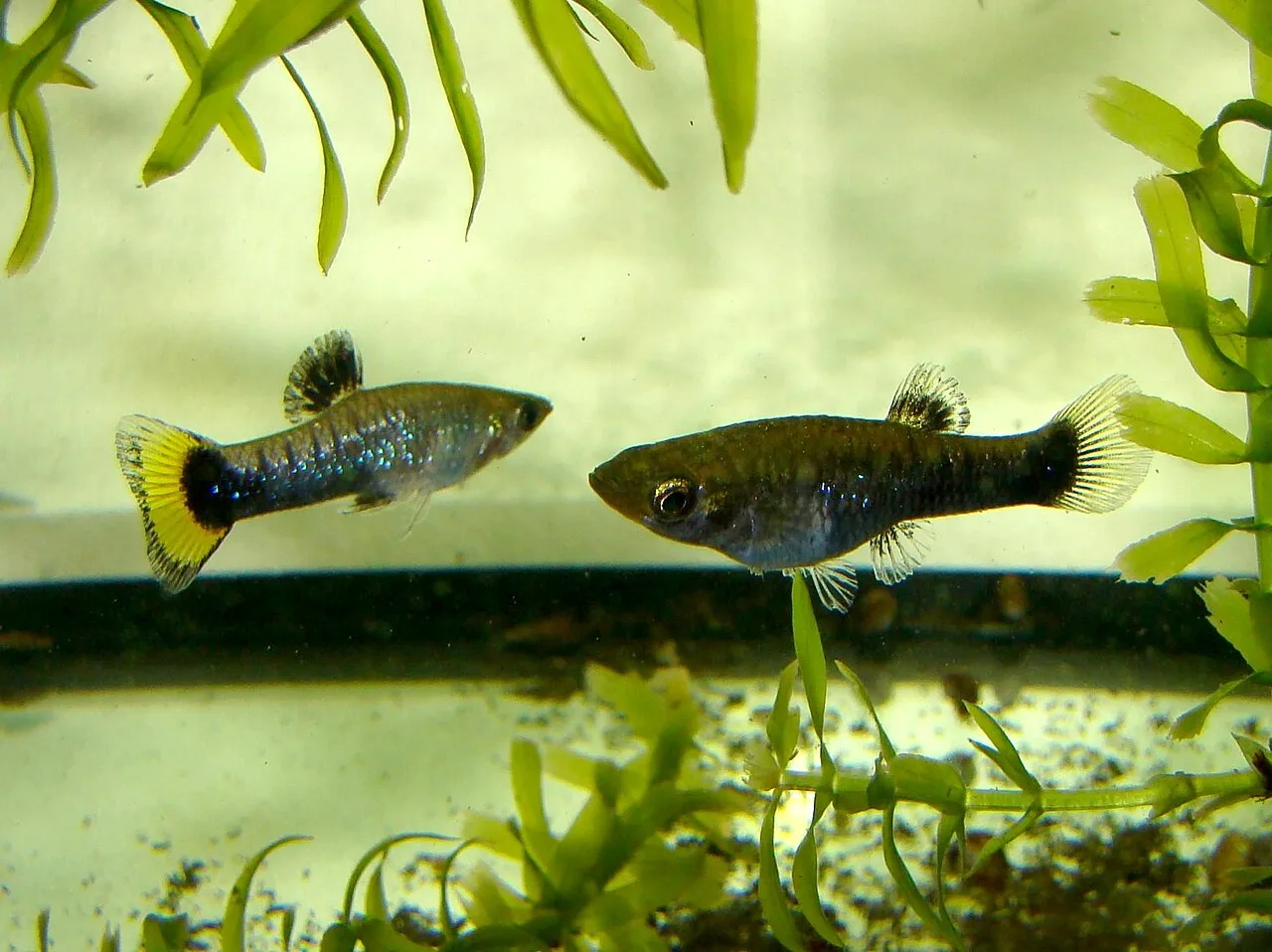
Lyretail cichlid
Neolamprologus pulcher
16 views
A cichlid of the rocky shore of Lake Tanganyika, maximum 8 cm. This profile covers Neolamprologus pulcher, also sold as princess of Burundi. Lamprologus brichardi is a similar form described later and is not a second published species.
- Temperature
- 22 – 26 °C
- pH
- 7.3 – 8.5 pH
- General hardness
- 10 – 20 °dH
- Maximum size
- 8 cm
- Minimum tank size
- 100 L
4 min read · 568 words
Fresh water
Quick facts
Place in the aquarium
Highlighted are the water layer and the spots where the species usually stays in the tank.
- Near the bottom Mostly stays just above the bottom. Food has to reach the substrate.
- Rocks and caves Needs caves, crevices or rockwork as hiding place, territory or spawning site.
Shrimp in the tank
Dwarf shrimp at risk
- Not shrimp safe
- Dwarf shrimp at risk
- Shrimplets at risk
- Shrimp safe
- Adult dwarf shrimp
- At risk
- Shrimplets
- Get eaten
- Safe from shrimp size
- about 4 cm
Neolamprologus pulcher is dangerous for dwarf shrimp. It grows to 8 to 10 cm and eats small invertebrates, fish fry, plankton and small crustaceans. The groups are strongly territorial and drive any intruder out of their rocky territory. Young shrimp and adult dwarf shrimp are eaten in the process. Larger shrimp from about 4 cm are usually no longer overpowered, but the hard, alkaline Tanganyika water suits only a few shrimp species. Dwarf shrimp therefore belong in a separate tank with soft water.
Home & range
Hatched countries are where the species occurs. It lives in particular waters there, not across the whole country. The points name known waters for orientation, not collection sites.
- Country of origin
- Water for orientation
Native
Overview
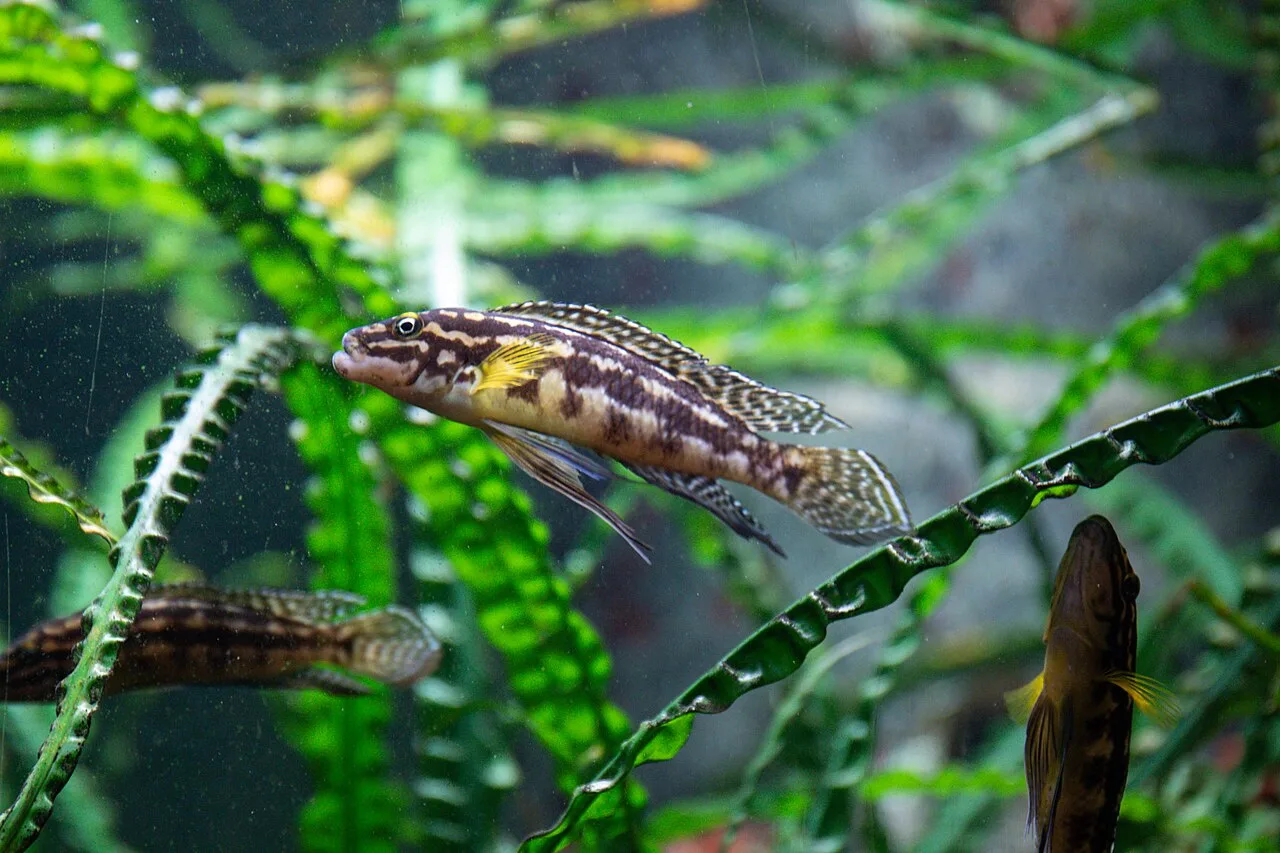
Maximum 8 cm, females a little smaller. Beige, some populations with orange scale margins, white fin edges, two long white tail filaments, pale blue lines on the cheeks.
Features
Body depth is 26 to 33 percent of standard length, and the underside is somewhat lighter than the beige body. In some populations the orange scale edges become more distinct towards the tail stalk. The unpaired fins are drawn out, and the tail fin is lyre-shaped. Two dark spots sit on the gill cover and preopercle. The fin formula is dorsal XVIII–XIX/8–9 and anal V–VIII/5–7. Size figures range from 8 to 10 cm, occasionally up to 15 cm in the aquarium. With good care the fish live eight to ten years. It describes tan fish with yellow tones especially on the upper body, blue-violet spots, icy blue fin tips and brilliant blue eyes.
Pulcher and brichardi
Trewavas and Poll described the form in 1952 as the subspecies Lamprologus savoryi pulcher. Twenty-two years later Poll described a very similar form as Lamprologus brichardi, named after the Belgian Pierre Brichard. The two differ only in the spots on the preopercle: a lying T in brichardi, two vertical curved bars in pulcher. Brichardi lives in the northern half of the lake and at places on the southern coast, pulcher only in the south. According to DNA analyses they are a single species, and the brichardi type arose several times from pulcher fish. Because pulcher is the older name, it takes priority. With N. crassus, N. falcicula, N. helianthus, N. marunguensis, N. olivaceous and N. savoryi the species forms a natural group within the Lamprologini.
In the trade it is mostly still sold as Neolamprologus brichardi, princess of Burundi or lyretail cichlid, and in English also as daffodil cichlid or fairy cichlid.
Origin & habitat
This describes the origin, not how to furnish the aquarium.
Endemic to the rocky shores of Lake Tanganyika. No riparian state is named.
The species is widespread in the south of the lake, along the rocky shores of Burundi, the Democratic Republic of the Congo, Tanzania and Zambia. The popular daffodil variety comes from the steep rocky slopes near Kantalamba and Kambwimba. The fish live at depths of ten metres or more and often swim in large schools of hundreds of fish.
Diet
In the wild the species eats small invertebrates and fish fry. It also eats drifting plankton swarms and small crustaceans.
Behavior
Breeding with helpers
The species lives in permanent groups of one breeding pair and helpers of both sexes, usually older juveniles. One to fourteen helpers are usual, and larger groups hold larger territories. Breeding pairs with helpers are more successful. With more helpers females lay smaller eggs, because the helpers protect the young. Juveniles prefer to stay with relatives, even ones they do not know. In genetic studies 80 percent of groups had mixed parentage. Rank is usually set by size. Helpers can become breeders by moving to other groups or by moving up.
The fish are strongly territorial and drive out intruders of any kind. Males react more aggressively to unfamiliar neighbours than to familiar ones. The fish quickly recognise the faces of other fish by their colour pattern.
Reproduction
Described in 1952 as a subspecies of Lamprologus savoryi. Brichardi was described 22 years later and stays outside this profile.
For breeding, pairs form and lay 20 to 60 eggs in caves or rock crevices. Female and male care for the brood together as a parental family and jointly defend the territory, supported by the helpers.
Gallery
More species in this group

Similar water needs
Species with a similar temperature, a similar pH and a comparable adult size. Whether their behaviour fits as well is what the compatibility check is for.