
Celebes rainbowfish
Marosatherina ladigesi
20 views
Endemic to southwest Sulawesi. Telmatherina ladigesi is the synonym. Not the whole island.
- Temperature
- 20 – 28 °C
- pH
- 7 – 7.5 pH
- General hardness
- 8 – 20 °dH
- Maximum size
- 8 cm
- Minimum group size
- 6
- Minimum tank size
- 100 L
3 min read · 382 words
Fresh water
Quick facts
Place in the aquarium
Highlighted are the water layer and the spots where the species usually stays in the tank.
- Upper water Usually stays in the top third of the tank.
- Open swimming space Needs an open area without plants or decor to swim at length. Tank length matters more than height.
Shrimp in the tank
Shrimplets at risk
- Not shrimp safe
- Dwarf shrimp at risk
- Shrimplets at risk
- Shrimp safe
- Adult dwarf shrimp
- Safe
- Shrimplets
- Get eaten
- Safe from shrimp size
- about 2 cm
Adult dwarf shrimp are usually safe from the Celebes rainbowfish. It grows to about 7 to 8 cm but is slender and peaceful and eats small worms, insects and plant debris. Shrimp from about 2 cm are usually too large for it. Freshly hatched young, however, are eaten.
Plenty of plants and moss give the young cover. Because the species likes hard, alkaline water, Neocaridina suit better than softwater Caridina. For strong breeding a separate tank is safer.
Home & range
Hatched countries are where the species occurs. It lives in particular waters there, not across the whole country. The points name known waters for orientation, not collection sites.
- Country of origin
- Water for orientation
Native
- Southwest Sulawesi
- Only the hinterland of Makassar.
Overview
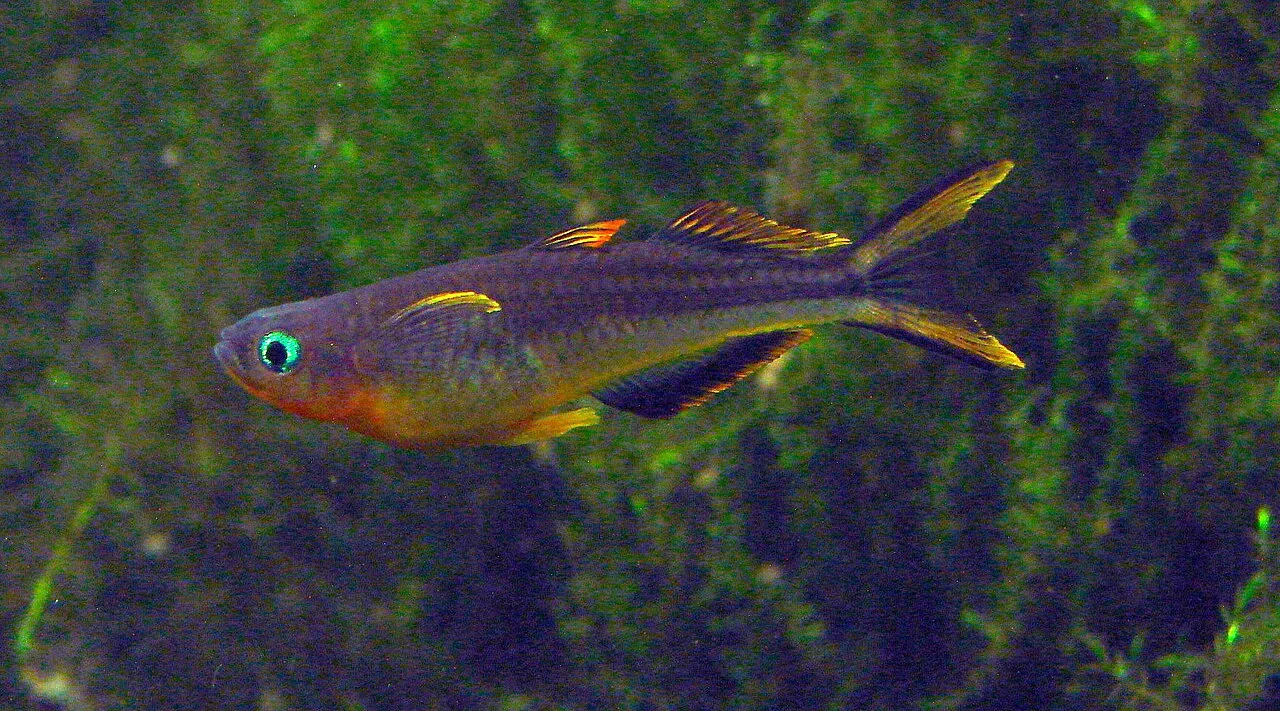
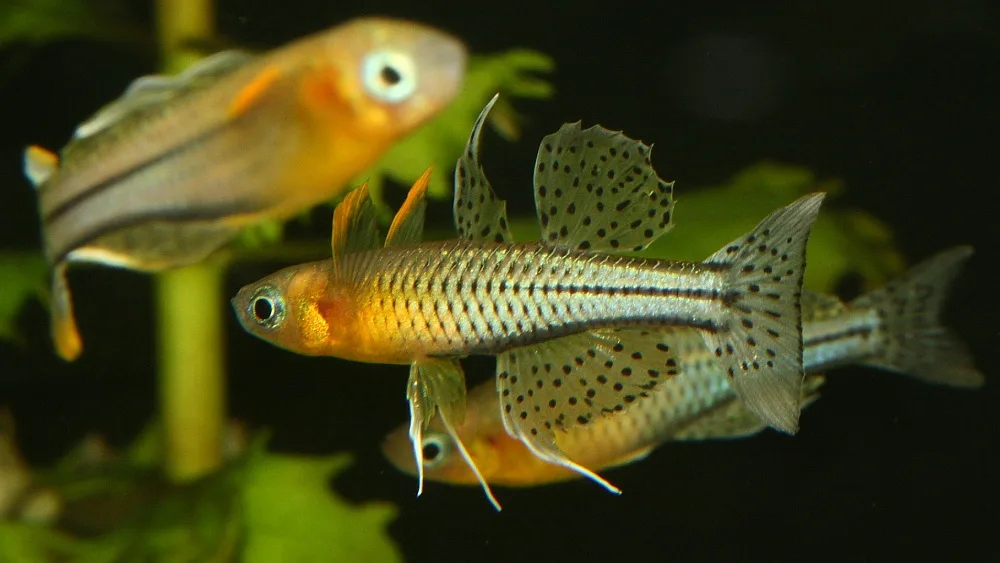
7 to 8 cm. Yellowish iridescent, a turquoise band to the caudal base, blue-green iris.
Features and sexes
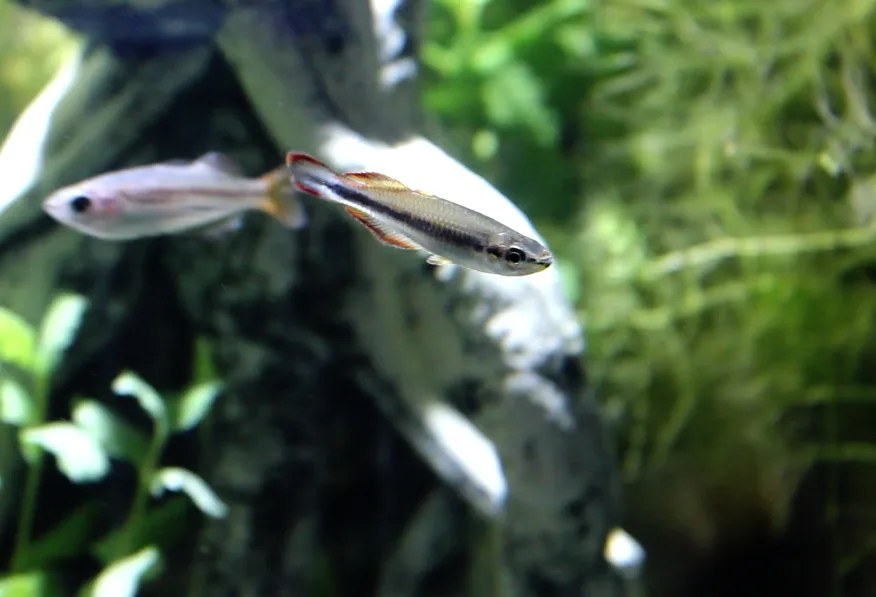
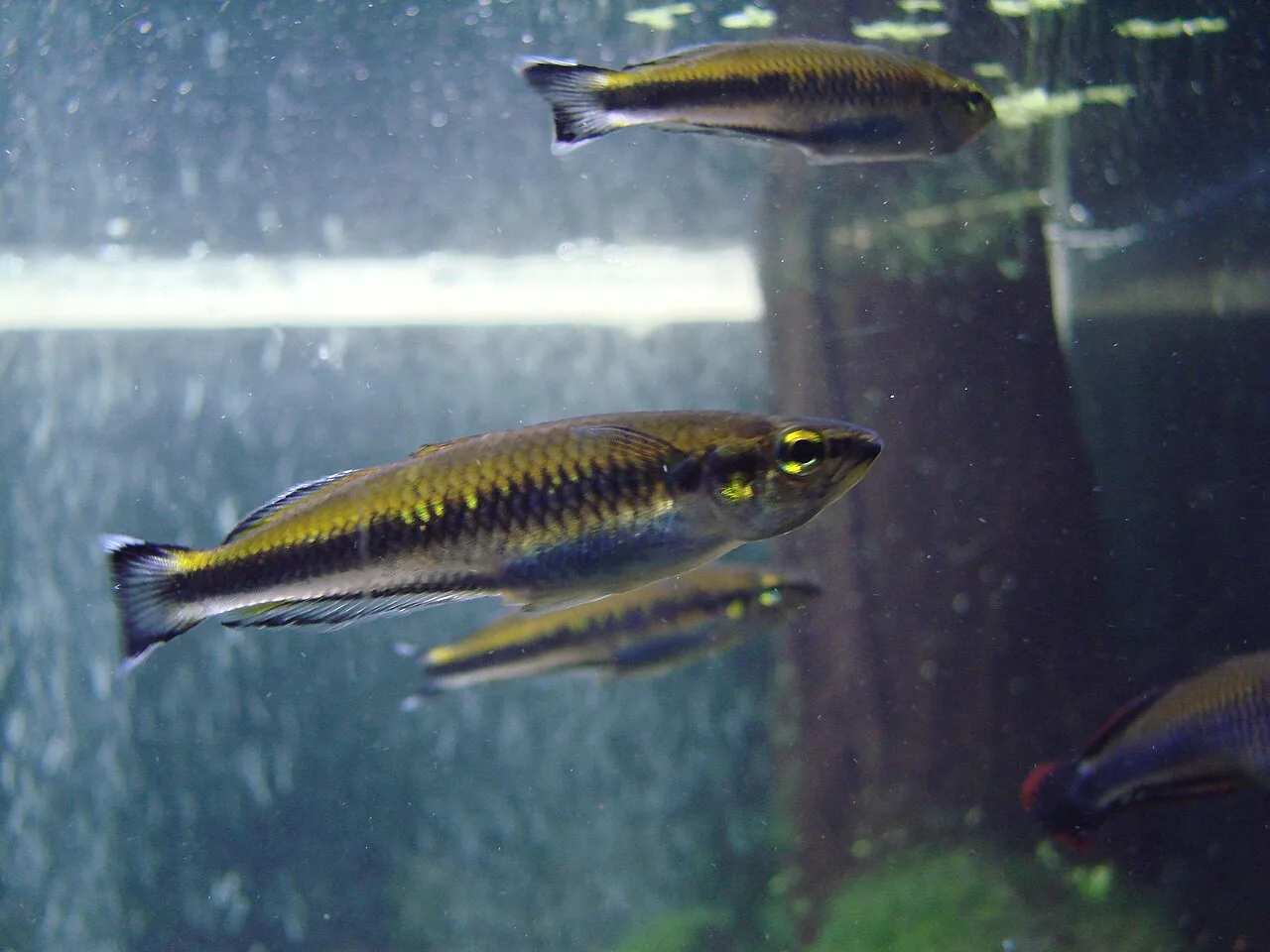
The Celebes rainbowfish has an elongated, laterally compressed body. The dorsal fin is split, and the second part is clearly larger than the first. The body looks almost transparent, with a blue stripe along the lateral line. Adult males carry elongated rays in the dorsal and anal fins, these fins are black in males, and males are usually a little darker than females. The sexes are therefore easy to tell apart. Sizes range from 6 to 8 cm for males and 5 to 7 cm for females.
Name and taxonomy
Ernst Ahl described the species in 1936 as Telmatherina ladigesi. The specific name honours the ichthyologist Werner Ladiges, who collected the type specimens. Aarn, Ivantsoff and Kottelat erected the genus Marosatherina in 1998. The name combines the town of Maros in the range with the silverside genus Atherina. The species is the only known member of its genus and belongs to the Sulawesi rainbowfishes (Telmatherinidae).
Origin & habitat
This describes the origin, not how to furnish the aquarium.
The hinterland of Makassar. The genus name points to Maros. Indonesia stays coarse and is not filled as a country shape.
The species occurs only around Maros. It lives in streams and estuaries, from fresh to mildly brackish water, usually where dissolved oxygen is high. It spends most of the day hidden among plant leaves. Numbers have dropped sharply because of the ornamental fish trade and pollution. The IUCN rates the species as vulnerable.
Care
Keeping
The Celebes rainbowfish is peaceful and sensitive to poor water quality. It is kept at 20 to 28 °C, pH 7.0 to 7.5 and a hardness of 150 to 200 mg/L. It is a well-known and popular aquarium fish.
Diet
In the wild the species eats small worms, insects and plant debris. In the aquarium it takes prepared foods and small live food.
Reproduction
A well-known aquarium fish.
Spawning for months
The Celebes rainbowfish is an egg scatterer. After lively courtship the females place the eggs on fine-leaved aquatic plants and on the fine roots of floating plants. Spawning takes place daily over several months, mostly in the morning, with a total of 30 to 50 yellowish eggs per spawning period. The number declines during the season. The young hatch after 8 to 11 days at about 7 mm and mature after around seven months. Adults often eat their eggs.
Gallery
More species in this group
Similar water needs
Species with a similar temperature, a similar pH and a comparable adult size. Whether their behaviour fits as well is what the compatibility check is for.





