Spotted blue-eye
Pseudomugil gertrudae
17 views
A blue-eye of about 3 cm. 12 to 34 °C and pH 3.7 to 9.4 are the span of the sites, not a care optimum.
- Temperature
- 24 – 30 °C
- pH
- 6 – 7.5 pH
- General hardness
- 2 – 12 °dH
- Maximum size
- 3 cm
- Minimum group size
- 8
- Minimum tank size
- 40 L
3 min read · 388 words
Fresh water
Quick facts
Place in the aquarium
Highlighted are the water layer and the spots where the species usually stays in the tank.
- Upper water Usually stays in the top third of the tank.
- Dense plants Looks for dense planting as cover, retreat or grazing ground.
Shrimp in the tank
Shrimplets at risk
- Not shrimp safe
- Dwarf shrimp at risk
- Shrimplets at risk
- Shrimp safe
- Adult dwarf shrimp
- Safe
- Shrimplets
- Get eaten
- Safe from shrimp size
- about 1 cm
The spotted blue-eye is a good partner for dwarf shrimp. It mostly stays at 2.5 cm, rarely 3 cm, and eats mainly algae and small invertebrates. Adult shrimp from about 1 cm are safe. Freshly hatched young may be caught, though.
In a small, densely planted tank with moss and floating plants many young grow up. Because the blue-eye adapts readily to captivity, it suits a calm shrimp tank well.
Home & range
Hatched countries are where the species occurs. It lives in particular waters there, not across the whole country. The points name known waters for orientation, not collection sites.
- Country of origin
- Water for orientation
Native
Overview
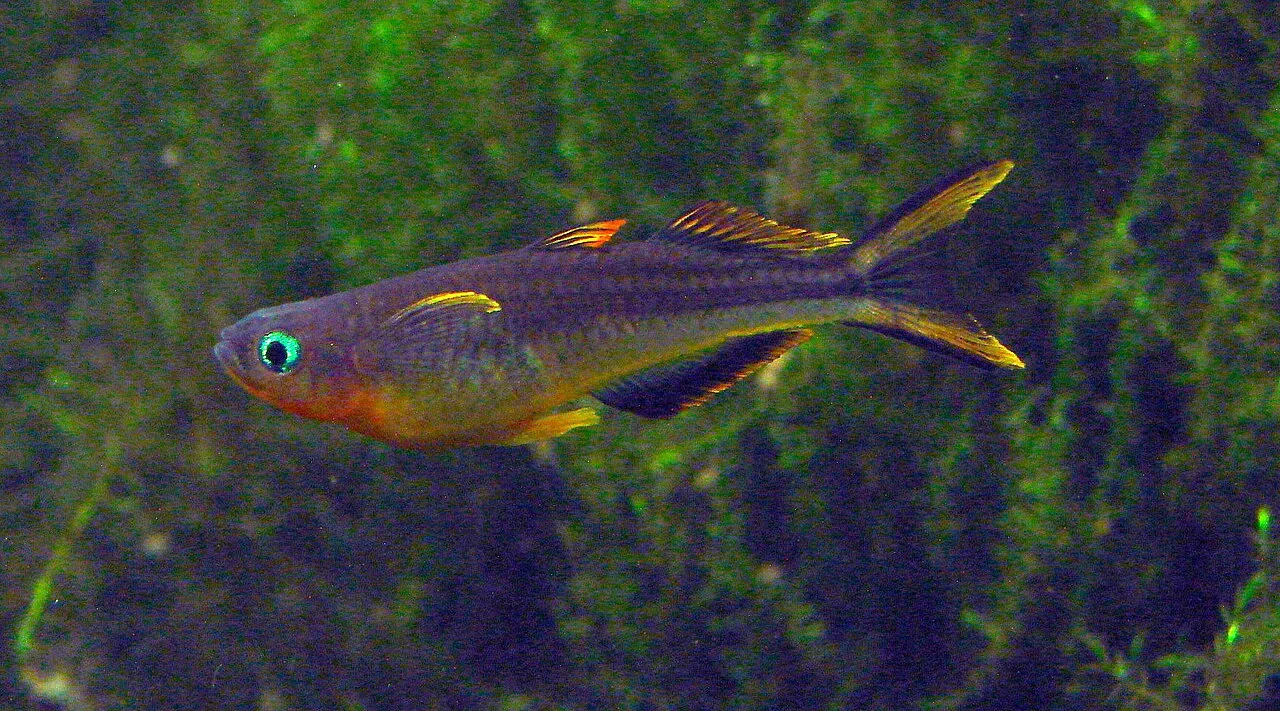
About 30 mm. Silvery blue or golden yellow depending on the site. Males with extended fins and many dark spots. Australian and New Guinean populations differ strongly in genetics. They are still treated as one species. Pseudomugil paskai and P. luminatus are other species.
Features
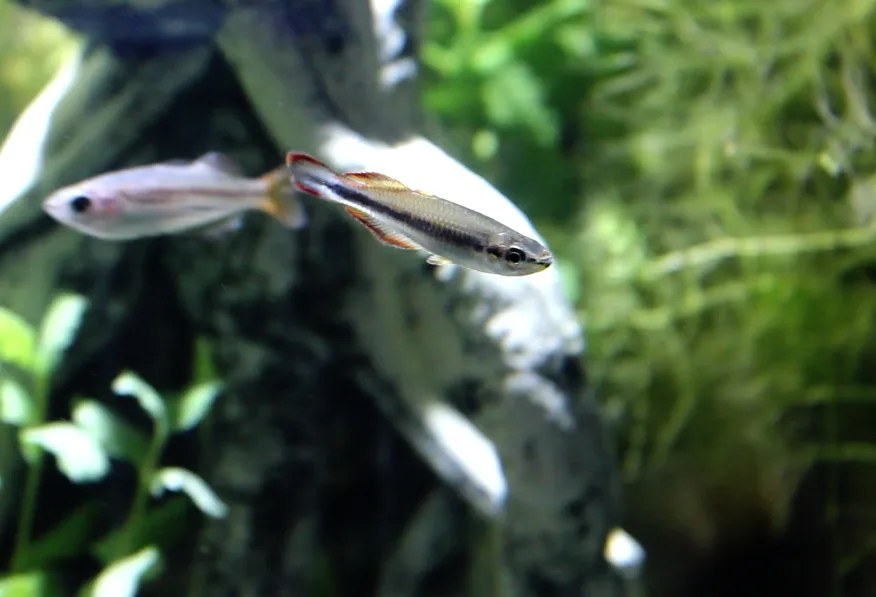
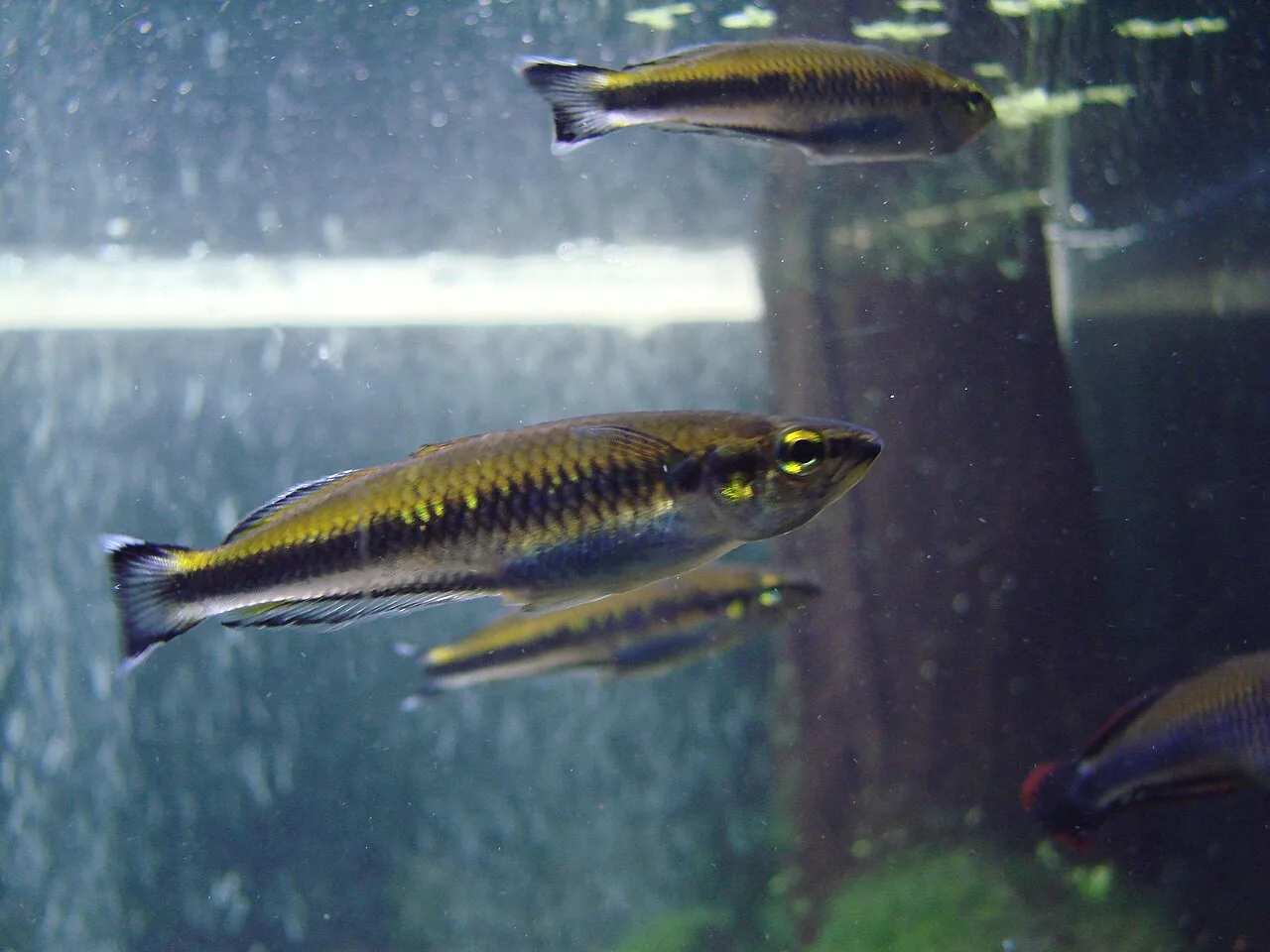
Some scale rows are edged black, which gives a grid-like pattern. The eyes are blue. The two dorsal fins sit close together, and the first is smaller. The tips of the pectoral fins are yellow, orange or orange-red depending on locality, the other fins transparent, whitish, silver-grey or yellow. Most fish stay at 2.5 cm, rarely reaching 3 cm. The rear half of the body carries three black lines that break into spots towards the front, and the fins are yellow with black markings. Fish from the Aru Islands are larger, fish from the Darwin area have orange pectoral fins, and at Goanna Lagoon in Arnhem Land there are fish with an orange body.
Name
Max Weber described the species in 1911 from fish taken on Trangan in the Aru Islands. The name honours Gertrude Merton, wife of the zoologist Hugo Merton, who visited the islands with him in 1907 and 1908. The species is related to the New Guinea endemics Pseudomugil paskai and P. luminatus.
Origin & habitat
This describes the origin, not how to furnish the aquarium.
Around the Arafura Sea: Australia on the Gulf of Carpentaria, Cape York, Bathurst, Melville, Groote Eylandt and Torres Strait, plus the Aru Islands and the Pahoturi, Fly and Bensbach rivers. Australia, Indonesia and Papua New Guinea stay coarse.
It lives in small rainforest streams, oxbows of larger rivers, swamps and billabongs. There is often dense underwater vegetation and a muddy bottom with branches and leaves, with floating plants or leaves at the surface. It also lives in small, slow streams, often less than 60 cm deep, pools and Melaleuca and Pandanus swamps. The populations differ clearly in colour, size and fin shape.
Care
The wide span of the sites is not a keeping recommendation.
Keeping
The spotted blue-eye adapts readily to captivity and can be kept in a small freshwater aquarium. It breeds readily there.
Diet
The diet is little studied. Algae and small invertebrates are believed to make up much of it.
Reproduction
Quiet, weedy places, often acidic tea-coloured water, but also quite different values.
Little is known about breeding behaviour in the wild. A complex courtship is believed to occur.
Gallery
More species in this group
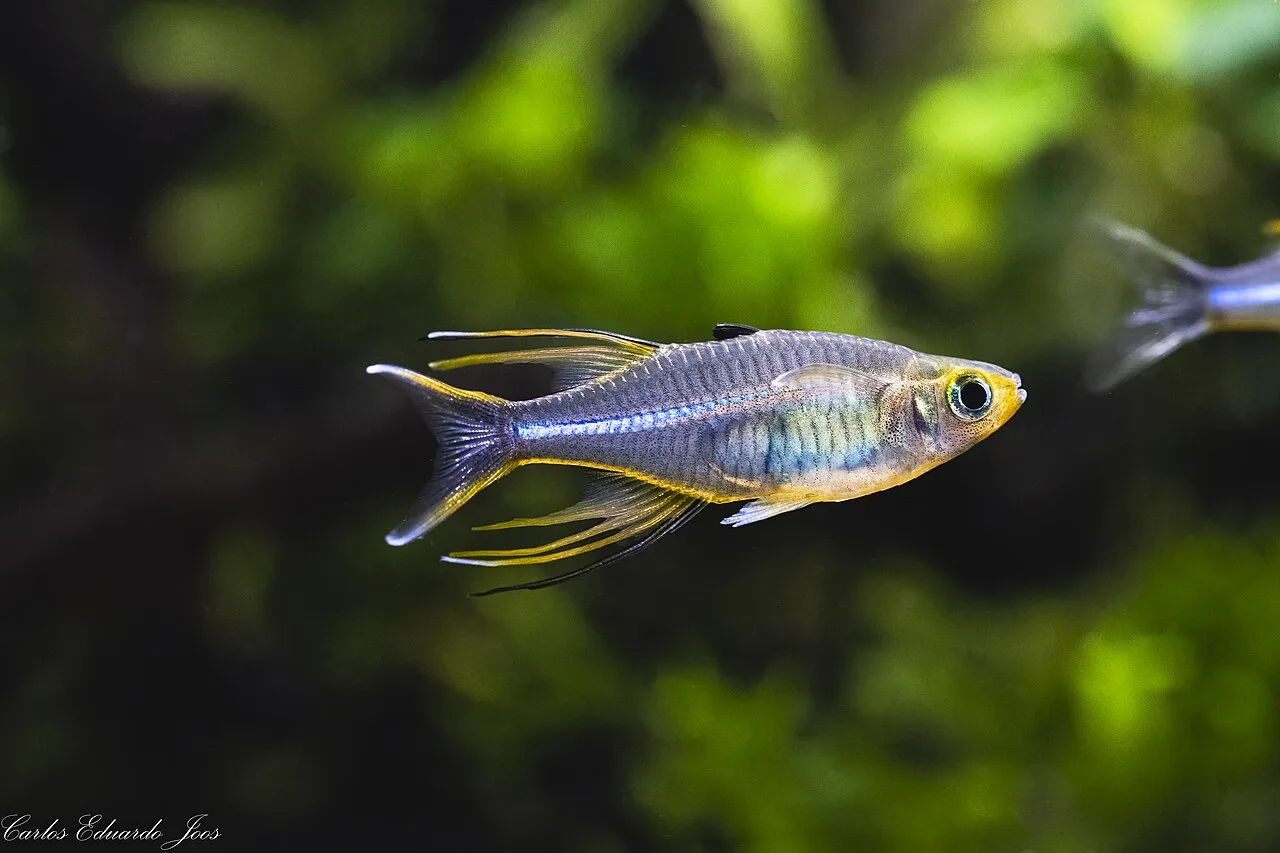
Similar water needs
Species with a similar temperature, a similar pH and a comparable adult size. Whether their behaviour fits as well is what the compatibility check is for.