Madagascar rainbowfish
Bedotia madagascariensis
18 views
The type species of the genus, not Bedotia geayi. The trade names Madagascar rainbowfish and red-tailed silverside have been used for both.
- Temperature
- 21 – 25 °C
- pH
- 6.5 – 8 pH
- General hardness
- 8 – 15 °dH
- Maximum size
- 10 cm
- Minimum group size
- 6
- Minimum tank size
- 150 L
4 min read · 526 words
Fresh water
Quick facts
Further published values
- Lifespan
- 10 a
Place in the aquarium
Highlighted are the water layer and the spots where the species usually stays in the tank.
- Upper water Usually stays in the top third of the tank.
- Middle water Usually stays in the middle of the tank, between bottom and surface.
- Open swimming space Needs an open area without plants or decor to swim at length. Tank length matters more than height.
Shrimp in the tank
Dwarf shrimp at risk
- Not shrimp safe
- Dwarf shrimp at risk
- Shrimplets at risk
- Shrimp safe
- Adult dwarf shrimp
- At risk
- Shrimplets
- Get eaten
- Safe from shrimp size
- about 4 cm
The Madagascar rainbowfish is a risk for dwarf shrimp. In captivity it reaches up to 10 cm standard length, and at this size young shrimp and smaller adult dwarf shrimp fit its mouth. Larger shrimp from about 4 cm, such as Amano shrimp, are usually safe. The fish live in loose schools and use all water layers, adults also deeper areas. When in doubt, dwarf shrimp are kept separately, and the rainbowfish are combined with larger shrimp species in a densely planted tank.
Home & range
Hatched countries are where the species occurs. It lives in particular waters there, not across the whole country. The points name known waters for orientation, not collection sites.
- Country of origin
- Water for orientation
Native
- Eastern Madagascar
- From the Ivoloina to the Manambolo, plus the introduction in the Betsiboka.
Overview
In captivity to 10 cm standard length, wild fish probably usually smaller. Two dorsal fins. Loose schools of several dozen, graded by size. An age of ten years is reachable in captivity.
Description and name
The English ichthyologist Charles Tate Regan described the species in 1903 and created a new genus for it. It is named after Maurice Bedot, director of the Natural History Museum of Geneva, where the type specimen is kept. Locally the fish is called zona. It first reached Europe for the aquarium hobby in 1953.
Body and fins
The body is covered with large cycloid scales, relatively elongated and somewhat sturdier at the front, and the belly and back lines are slightly curved. The jaws carry four to six rows of small, strongly curved teeth, and the lower jaw projects slightly. The first dorsal fin has four to five weak spines, the second ten to twelve soft rays. The anal fin has 14 to 17 soft rays, and the short, high-set pectoral fins twelve.
Sexes
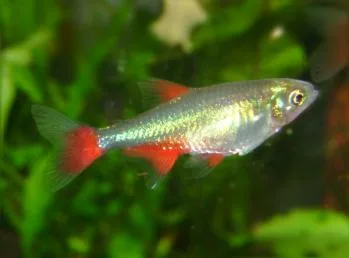
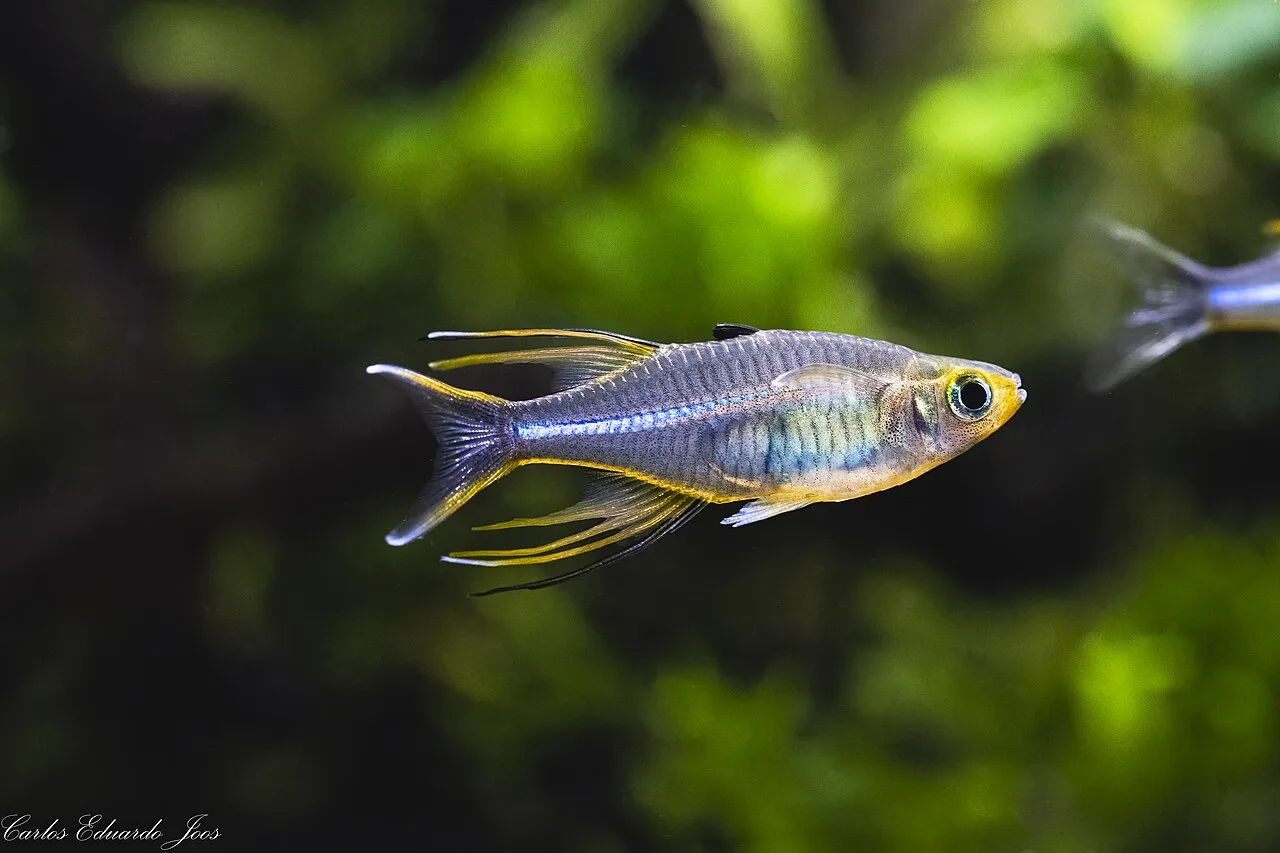
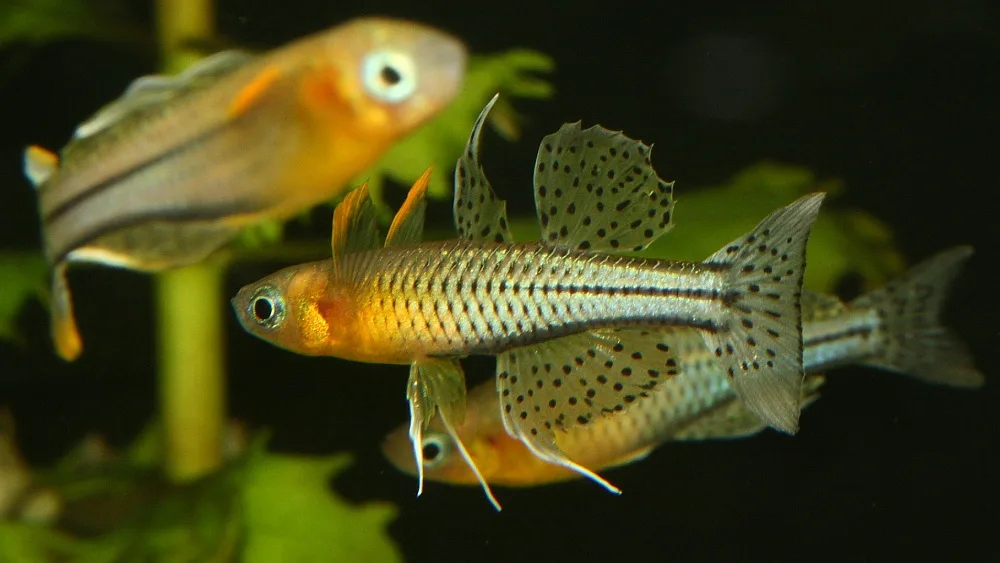
The sexes differ clearly in the unpaired fins. In males the first dorsal and pelvic fins are dark-edged and transparent to metallic golden yellow at the base. The second dorsal and the anal fin are golden yellow at the base and edged with black and, further out, dark red. A dark lateral band extends into the tail fin, where it is surrounded by a silvery white to golden yellow sheen. The corners of the slightly notched tail fin are dark red or iridescent white, and the pectoral fins have a dark dot at the tip. Some males have uniformly red or black fins. Females are more plainly marked.
Origin & habitat
This describes the origin, not how to furnish the aquarium.
Eastern Madagascar from the lower Ivoloina north of Toamasina south at least to the Manambolo near Vatomandry. An introduction on the upper Betsiboka. Clear shaded streams, very soft under 17.1 ppm, in swamps down to pH 4.8. Those are habitat figures, not care optima. Brackish water is avoided. Madagascar stays coarse and is not filled as an island.
The habitat consists of clear, at least partly shaded streams, preferably slow-flowing stretches. The type of bank vegetation matters less than the shade. In captivity the fish show some salt tolerance. After the introductions of the 1950s the species is now probably native throughout the Betsiboka basin.
Behavior
Younger fish in the shallows, adults also deeper.
Predators and threats
Predators include fish-eating wading birds, the Madagascar malachite kingfisher, cichlids of the genus Paratilapia, flagtails of the genus Kuhlia, the tigerfish Mesopristes elongatus and the goby Glossogobius giuris. Since 1978 the introduced snakehead Channa maculata has been added. Despite its small size the species is caught by local fisheries in much of its range. Because of high predation, wild fish probably do not reach the age of ten years that is possible in captivity.
Thanks to commercial breeding as an aquarium fish, the species is not in danger of disappearing. Habitat destruction and introduced species, especially the snakehead, are serious problems, however. The IUCN lists it as Near Threatened. In the trade it is often confused with Bedotia geayi.
Reproduction
Little is known about reproduction in the wild. A long breeding season is inferred from the size classes.
More species in this group
Similar water needs
Species with a similar temperature, a similar pH and a comparable adult size. Whether their behaviour fits as well is what the compatibility check is for.