Simulans tetra
Paracheirodon simulans
20 views
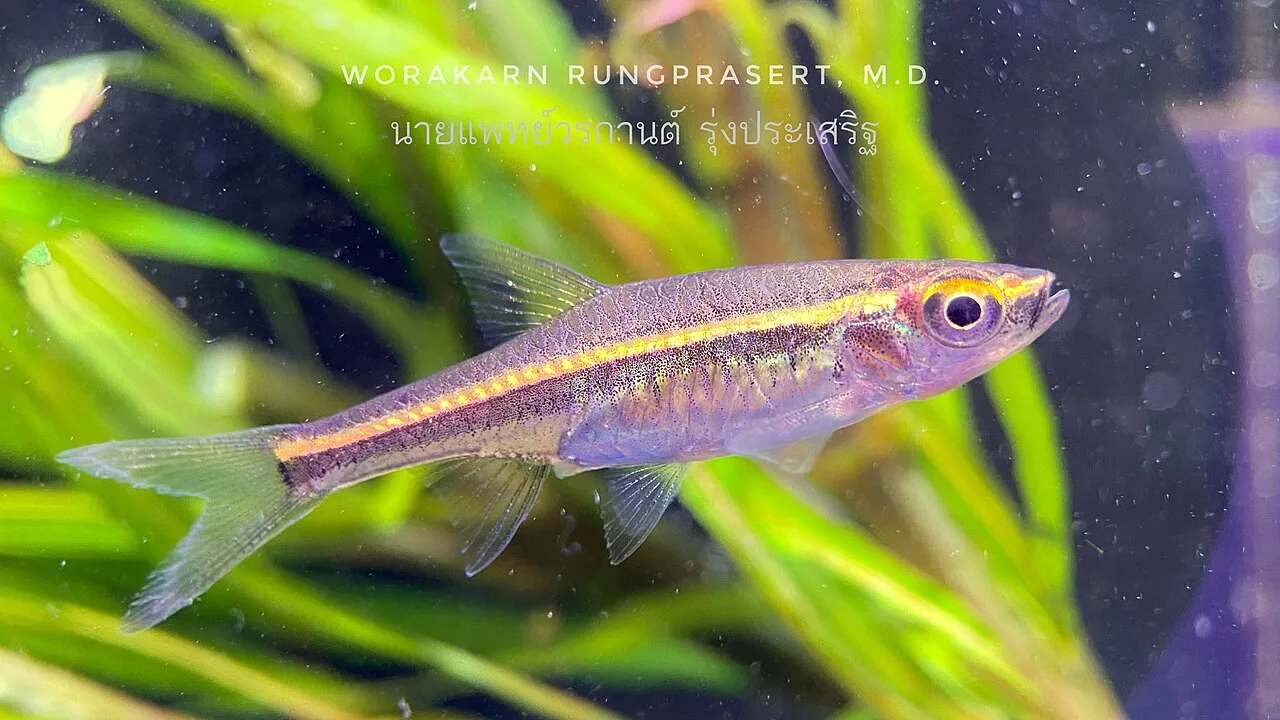
A small tetra with a blue-green stripe along the whole body. Shops often call it the green neon. In this catalogue that is a different fish.
- Temperature
- 23 – 28 °C
- pH
- 5 – 6.5 pH
- General hardness
- 5 – 30 °dH
- Maximum size
- 3 cm
- Minimum group size
- 10
- Minimum tank size
- 60 L
4 min read · 582 words
Fresh water
Quick facts
Further published values
- Lifespan
- 5 a
Place in the aquarium
Highlighted are the water layer and the spots where the species usually stays in the tank.
- Middle water Usually stays in the middle of the tank, between bottom and surface.
- Dense plants Looks for dense planting as cover, retreat or grazing ground.
Shrimp in the tank
Shrimplets at risk
- Not shrimp safe
- Dwarf shrimp at risk
- Shrimplets at risk
- Shrimp safe
- Adult dwarf shrimp
- Safe
- Shrimplets
- Get eaten
- Safe from shrimp size
- about 1 cm
The green neon goes well with dwarf shrimp but eats their young. At 3 to 3.5 cm it is the smallest of its genus. Amano shrimp, Neocaridina and Caridina are named as suitable tankmates, and adults from about 1 cm are safe. Juvenile shrimp are often eaten, however.
In the recommended blackwater tank with leaves, roots and dense plants, young shrimp find many hiding places. Soft, acidic water suits Caridina better than Neocaridina. For targeted breeding, put the shrimp in a tank of their own.
Home & range
Hatched countries are where the species occurs. It lives in particular waters there, not across the whole country. The points name known waters for orientation, not collection sites.
- Country of origin
- Water for orientation
Native
Overview
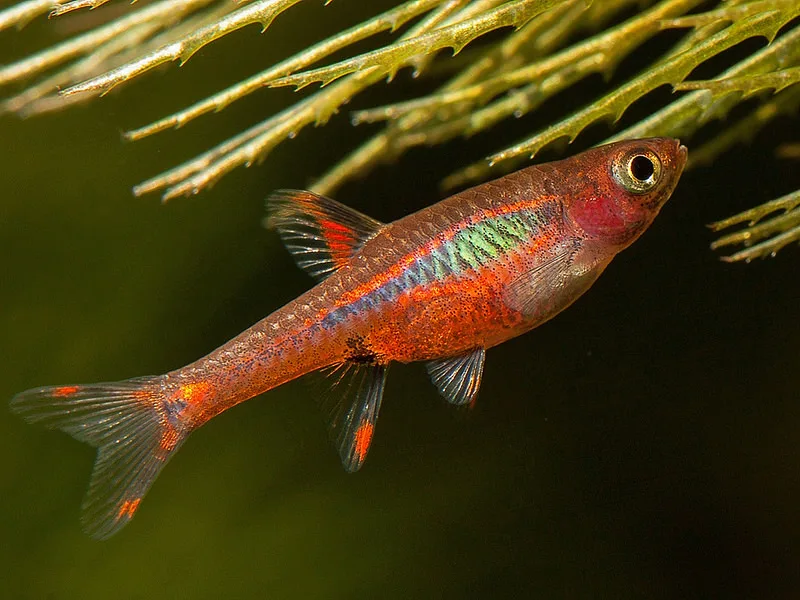
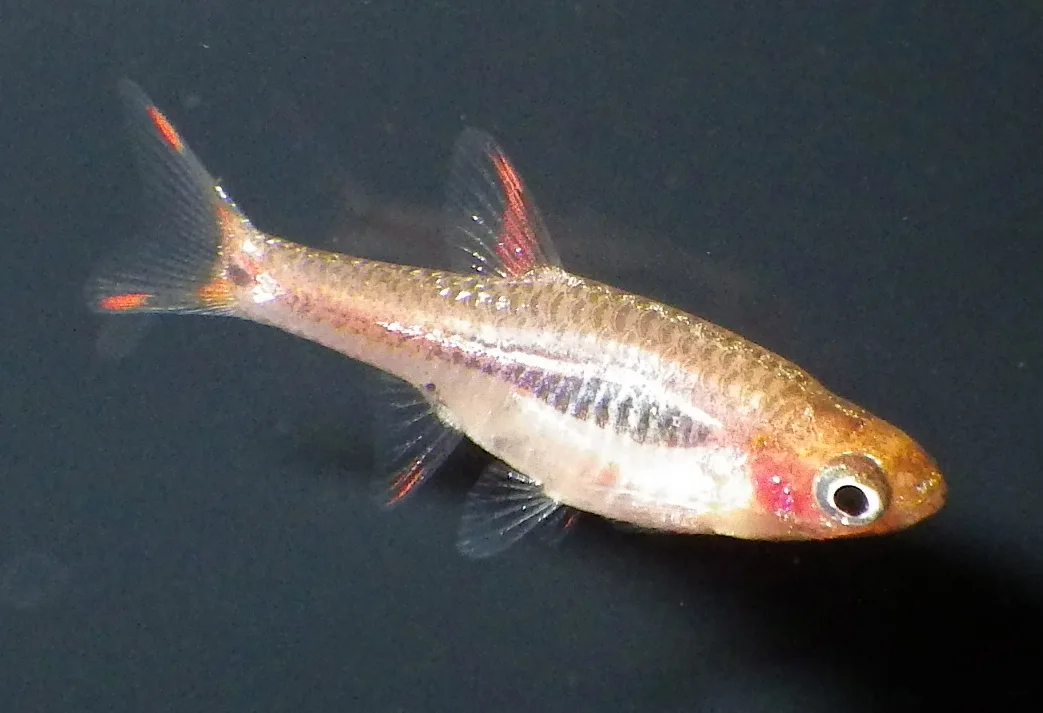
Paracheirodon simulans stays at about 3 cm. The luminous stripe runs from the snout into the tail fin. Red is almost absent or remains a thin hint. That places it between the neon tetra, whose red begins at mid-body, and the cardinal tetra, which is red along the whole length.
The green neon of this catalogue is Hemigrammus hyanuary. That fish has no continuous luminous stripe. Anyone who buys a simulans as a green neon receives a more demanding blackwater fish.
Name and systematics
Jacques Géry described the species in 1963; a synonym is Hyphessobrycon simulans. After the strong blue stripe along the middle of the body it is also called blue neon. At 3 to 3.5 cm it is the smallest species of the genus Paracheirodon. The ground colour is silvery. A short red stripe runs parallel to the blue one on the rear body. Females are larger and fuller than males, but the sexes are hard to tell apart with the naked eye.
Origin & habitat
This describes the origin, not how to furnish the aquarium.
Blackwater and clear, acidic streams of the upper Rio Negro. The origin stays coarse. Soft, acidic water and dim light match that better than hard tap water.
Range and waters
The main range lies on the upper Rio Negro in Brazil up to the Rio Branco. A second area lies in the Orinoco system on the border of Venezuela and Colombia, between San Fernando de Atabapo and the mouth of the Río Meta. The type locality was first given as the Rio Purus near Manaus and later corrected to the Rio Jufaris, a tributary of the Rio Negro.
The species lives only in blackwater areas, mainly in the upper reaches of tributaries on dry land. Current is slow to moderate, and the banks are densely overhung. The bottom is sand with branches, roots and leaves. The water is acidic, low in carbonate hardness, low in conductivity and tea-brown from humic substances. In palm swamps of the middle Rio Negro, 24.6 to 35.2 °C were measured in its habitats.
Care
Water
23 to 28 °C, pH 5 to 6.5, soft. A school from ten, tanks from about 60 litres, a dark bottom, plants, little current, a cover.
Company
Other small, quiet blackwater fish and corydoras. Hard-water barbs, lively platies and large cichlids, no. In hard water it often survives for a while and loses colour and the school.
Keeping
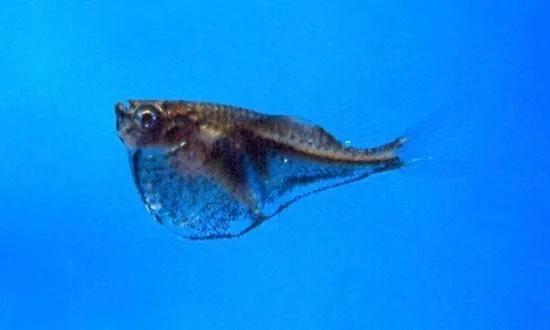
The trade mostly offers wild-caught fish from Amazonia. Ten fish need 54 litres or more, true schooling 100 litres or more. A darkened blackwater tank with peat-filtered water and dried leaves of beech, oak, walnut or alder cones suits it best. The species is kept at 22 to 30 °C, 25 °C on average, 5 to 30 °dGH and pH 5 to 7. Suitable tankmates are small cichlids, corydoras and suckermouth catfishes, labyrinth fishes, bristlenose catfishes, barbs and hatchetfishes. Dwarf shrimps are possible, but their young are often eaten. Because of its small size the species is prey for predatory fish. It lives at most five years.
Diet
Fine prepared food. Flakes, cyclops, brine-shrimp nauplii. Several small feeds. Coarse granules are left behind.
Behavior
A tight school in midwater. Too few fish stand pale and shy. The colour comes on a dark ground. Occasional jumping makes the cover necessary.
Reproduction
Egg scatterer without brood care. In a community tank the eggs are eaten. A breeding setup needs very soft, acidic water and fine plants.
The partners circle each other and lay sticky eggs on plants, where they develop. Targeted breeding is considered a task for advanced aquarists. The species was first exported from Manaus to Zurich in 1962.
Gallery
More species in this group






Similar water needs
Species with a similar temperature, a similar pH and a comparable adult size. Whether their behaviour fits as well is what the compatibility check is for.