Kuhli loach
Pangio kuhlii
18 views
A kuhli loach, to 8 cm. The named subspecies stay one species. A population in Vietnam is only mentioned as supposed and is not mapped.
- Temperature
- 24 – 30 °C
- pH
- 5.5 – 6.5 pH
- General hardness
- 5 °dH
- Maximum size
- 8 cm
- Minimum group size
- 5
- Minimum tank size
- 76 L
4 min read · 521 words
Fresh water
Quick facts
Further published values
- Lifespan
- 10 – 14 a
Place in the aquarium
Highlighted are the water layer and the spots where the species usually stays in the tank.
- Near the bottom Mostly stays just above the bottom. Food has to reach the substrate.
- Substrate Sifts through the substrate or burrows into it. Fine, rounded sand without sharp edges suits it.
Shrimp in the tank
Shrimplets at risk
- Not shrimp safe
- Dwarf shrimp at risk
- Shrimplets at risk
- Shrimp safe
- Adult dwarf shrimp
- Safe
- Shrimplets
- Get eaten
- Safe from shrimp size
- about 1.5 cm
The kuhli loach gets along with shrimp and is often kept with them. It is slender, has a small mouth and, as a scavenger, collects whatever sinks to the bottom at night. It does not attack tankmates. Adult dwarf shrimp from about 1.5 cm are safe. Freshly hatched young on the bottom may be eaten during its nightly search, though.
Moss and plants where the young stay reduce losses. Fine sand and hiding places benefit both.
Home & range
Hatched countries are where the species occurs. It lives in particular waters there, not across the whole country. The points name known waters for orientation, not collection sites.
- Country of origin
- Water for orientation
Native
Overview
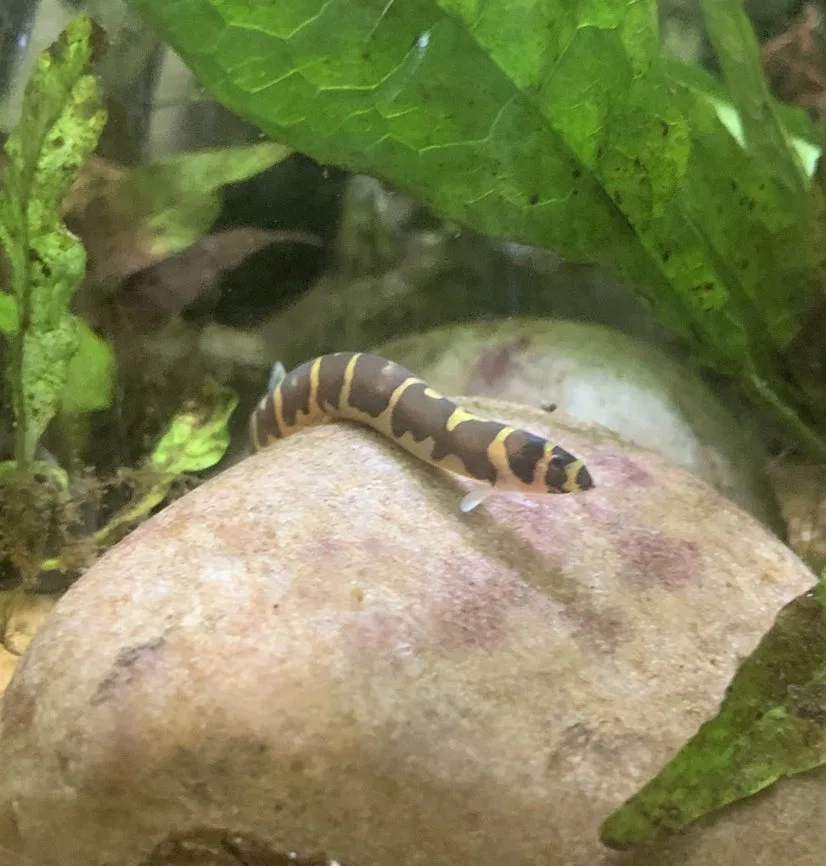
Scaleless, yellowish to salmon, 15 to 20 dark brown to black bars, the first three on the head. The bars can be split by a pale line. Three pairs of barbels. Females a little rounder, males more intense, the difference is rarely certain.
Features
The body is eel-like and slightly compressed, the fins are very small. The dorsal fin starts behind the middle of the body, the anal fin even further back. The eyes lie under transparent skin, and below each eye sits an erectile spine for defence. This gave the old genus name Acanthophthalmus, meaning thorn-eye, now a synonym of Pangio. Counts of dark bars range from 10 to 20. Maximum length is 8 to 10 cm, and the fish mature at about 7 cm.
Outside breeding the sexes are hard to tell apart. Males have larger, paddle-shaped and often pigmented pectoral fins with a hard ray, females no hard ray. Females ready to spawn are often larger, and the greenish ovaries show through the skin.
Confusion and name
Pangio semicincta is almost impossible to distinguish and is often sold under the same name. P. oblonga and the larger P. myersi are similar as well. Whether true P. kuhlii from Java reaches the trade at all is doubtful. The species is named after the zoologist Heinrich Kuhl.
Origin & habitat
This describes the origin, not how to furnish the aquarium.
South of the Malay Peninsula, Sumatra, Kalimantan and Java. Malaysia and Indonesia stay coarse.
The range includes Java, Malaysia, Sumatra, the Sunda shelf except Sarawak, and Thailand. Reports from China are thought to be misidentifications. The fish live on sandy beds of slow rivers and clear mountain streams in shallow water, also at dams, reservoirs and in swamps. They gather in shallow, muddy pools out of the sun, hide in leaf litter and plants and burrow into soft ground. In turbid water they also breathe air.
The IUCN lists the species as least concern. Named threats are agriculture, oil palm plantations causing siltation, dams, pollution and overcollection for the ornamental trade.
Care
Nocturnal.
Keeping
The kuhli loach prefers pH 5.5 to 6.5, tolerating pH 7.0, a hardness around 5 dGH and 24 to 30 °C. The fish need sand to burrow in, dense planting and hiding places with small gaps. Sharp decor and other substrates are not recommended. A group of five or more fits a tank of about 75 litres (20 gallons). The fish readily slip into unguarded filter intakes and escape from open tanks. They avoid bright light and become more active before storms.
Diet
The species collects at night whatever sinks to the bottom: sinking pellets, flakes, shrimp and bloodworms.
Behavior
A popular aquarium fish. The subspecies kuhlii, myersi and sumatranus are not further profiles.
The kuhli loach is social but does not school; it lives in small groups. It is shy, nocturnal, swims near the bottom and leaves tankmates alone. Suitable companions are tetras, rasboras, shrimp and corydoras. In captivity nearly 10, sometimes up to 14 years are reached.
Reproduction
Blue-green eggs into open water. They stick to the substrate.
In the wild the fish spawn simultaneously in very shallow water. A few hundred greenish eggs are laid among the roots of floating plants. Breeding in the aquarium is difficult, and most successes involved hormone treatment.
Gallery
More species in this group
Similar water needs
Species with a similar temperature, a similar pH and a comparable adult size. Whether their behaviour fits as well is what the compatibility check is for.