Cardinal tetra
Paracheirodon axelrodi
18 views
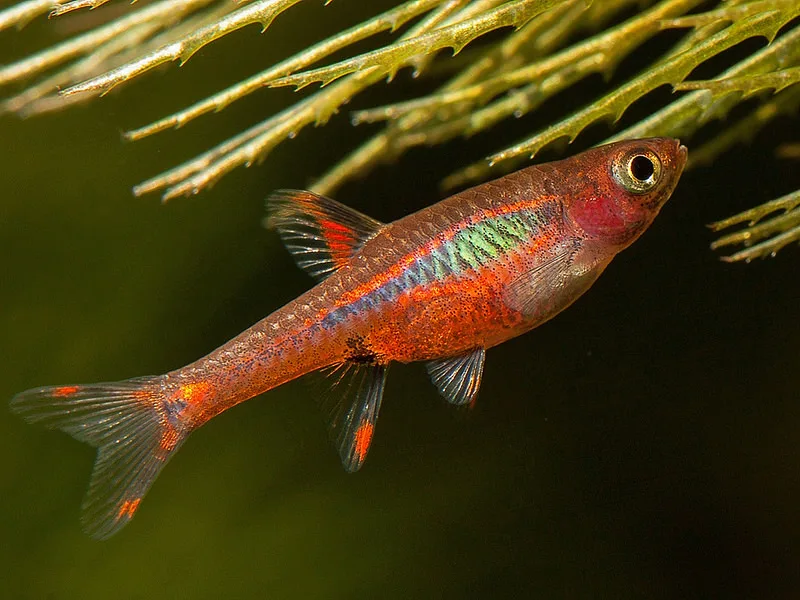
Tetra with a red body and a blue-green stripe, from side streams of the Rio Negro and the upper Orinoco.
- Temperature
- 25 – 30 °C
- pH
- 4.5 – 6.5 pH
- General hardness
- 1 – 8 °dH
- Maximum size
- 5 cm
- Minimum group size
- 10
- Minimum tank size
- 80 L
4 min read · 571 words
Fresh water
Quick facts
Further published values
- Lifespan
- 6 – 8 a
Place in the aquarium
Highlighted are the water layer and the spots where the species usually stays in the tank.
- Middle water Usually stays in the middle of the tank, between bottom and surface.
- Dense plants Looks for dense planting as cover, retreat or grazing ground.
Shrimp in the tank
Shrimplets at risk
- Not shrimp safe
- Dwarf shrimp at risk
- Shrimplets at risk
- Shrimp safe
- Adult dwarf shrimp
- Safe
- Shrimplets
- Get eaten
- Safe from shrimp size
- about 1.5 cm
Adult dwarf shrimp are safe from the cardinal tetra. It grows to only about 3 cm and has a small mouth. Shrimp from about 1.5 cm are too big for it.
In nature, however, it eats mainly microcrustaceans and chironomid larvae among roots and plants. Newly hatched baby shrimp fit that prey pattern exactly, so only a few survive in a community tank. Dense moss, leaf litter and fine-leaved plants give enough cover for a shrimp colony to persist.
Home & range
Hatched countries are where the species occurs. It lives in particular waters there, not across the whole country. The points name known waters for orientation, not collection sites.
- Country of origin
- Introduced
- Water for orientation
Native
Introduced
- Suriname
- Named in the origin text as an introduced population, not as the native range.
Overview
The red runs the length of the body, unlike the neon tetra. The species reaches 2.5 to 5.1 cm standard length. Captive fish tend to grow larger. Czech captive-bred fish tolerate different water better than wild fish from Amazonia. Most fish in the trade are wild-caught from those side streams.
Telling it apart
In the cardinal tetra the red underside reaches almost to the head, in the neon tetra only to mid-body. The blue-green band is stronger. In the Rio Negro it was formerly confused with Paracheirodon simulans, which usually lives further upstream. In the Rio Negro there are golden and silver-blonde forms with a weaker band, and in the Orinoco form the band ends before the adipose fin. Schultz described the species in 1956 as Cheirodon axelrodi, and the name honours the publisher Herbert R. Axelrod.
Origin & habitat
This describes the origin, not how to furnish the aquarium.
The range is the middle and upper Rio Negro basin in Brazil and the upper Orinoco in southeastern Colombia and southwestern Venezuela. The Rio Branco is the eastern limit. The species is absent from the main blackwater channel of the Rio Negro. It lives in small, nutrient-poor streams that are often brown but clear, at pH 4 to 5, conductivity often around 20 µS/cm, on shaded banks 40 to 70 cm deep. Manaus and Suriname are named as introductions. Suriname is not drawn as a native country.
The cardinal tetra lives not in the main river but in small black-water streams and clear forest streams, in shaded shore zones 40 to 70 cm deep with almost still water, roots and leaf litter. pH 4 to 5 and usually about 20 µS/cm were measured. In the dry season the fish retreat to the main channels, and in the rainy season they spread over flooded vegetation.
Care
In the aquarium at least 25 °C and at most 30 °C, averaging about 27 °C. That floor is also the lower limit of the habitat. pH 4.5–6.5 and GH under 4. Groups from ten, tanks from about 80 litres and at least 60 cm long, dense plants, floating plants and open water in the middle. In harder water the fish often survive but breed less.
For keeping 25 to 30 °C are given, with 25 °C as the natural lower limit. Soft water below 4 °GH and pH below 6.5 are preferred, and hard water can cause hardened eggs and organ damage in females. Groups of no fewer than ten, tanks from 60 cm. Wild-caught fish are more sensitive than Czech captive-bred ones. In captivity the fish live more than five years.
Diet
Fine food that sinks slowly and is taken in midwater.
In the wild they eat mainly microcrustaceans and chironomid larvae, plus worms, mites, insect eggs, rotifers and algae.
Behavior
Peaceful and social. Too few fish and bright light do not suit it. Wild fish are more sensitive to water chemistry than captive-bred ones.
Reproduction
Egg scatterer. Breeding is described only in a separate tank at GH/KH under 4, conductivity under 100 µS/cm, dim light and very clean water. Larvae hatch in about 36 hours at 29 °C. The parents are removed because they eat the spawn. A community tank should not be expected to produce young. In the wild the species lives little more than a year. In captivity it can pass five.
Spawning takes place in the early morning over fine-leaved plants, and the eggs must be kept dark. At 29 °C the larvae hatch after about 36 hours and swim free after three to four days. The parents eat their eggs and are removed.
Gallery
More species in this group






Similar water needs
Species with a similar temperature, a similar pH and a comparable adult size. Whether their behaviour fits as well is what the compatibility check is for.