Ram cichlid
Mikrogeophagus ramirezi
20 views
Small cichlid from the Orinoco and the Llanos. Warm, soft, and kept as a pair.
- Temperature
- 27 – 30 °C
- pH
- 5.5 – 7 pH
- General hardness
- 8 – 10 °dH
- Maximum size
- 5 cm
- Minimum tank size
- 80 L
4 min read · 515 words
Fresh water
Quick facts
Further published values
- Lifespan
- 2 – 3 a
Place in the aquarium
Highlighted are the water layer and the spots where the species usually stays in the tank.
- Near the bottom Mostly stays just above the bottom. Food has to reach the substrate.
- Dense plants Looks for dense planting as cover, retreat or grazing ground.
- Substrate Sifts through the substrate or burrows into it. Fine, rounded sand without sharp edges suits it.
Shrimp in the tank
Shrimplets at risk
- Not shrimp safe
- Dwarf shrimp at risk
- Shrimplets at risk
- Shrimp safe
- Adult dwarf shrimp
- Safe
- Shrimplets
- Get eaten
- Safe from shrimp size
- about 2 cm
Adult dwarf shrimp are usually safe with the ram cichlid, but their young are not. It grows to only about 4 to 5 cm but readily eats live food such as bloodworms, daphnia and brine shrimp and searches the bottom for small animals.
Shrimp from about 2 cm are usually too large for it, while baby shrimp are eaten. During brood care the pair defends its territory and also chases shrimp away. Dense moss and plants give the young cover, and a species tank is better for deliberate breeding.
Home & range
Hatched countries are where the species occurs. It lives in particular waters there, not across the whole country. The points name known waters for orientation, not collection sites.
- Country of origin
- Water for orientation
Native
Overview
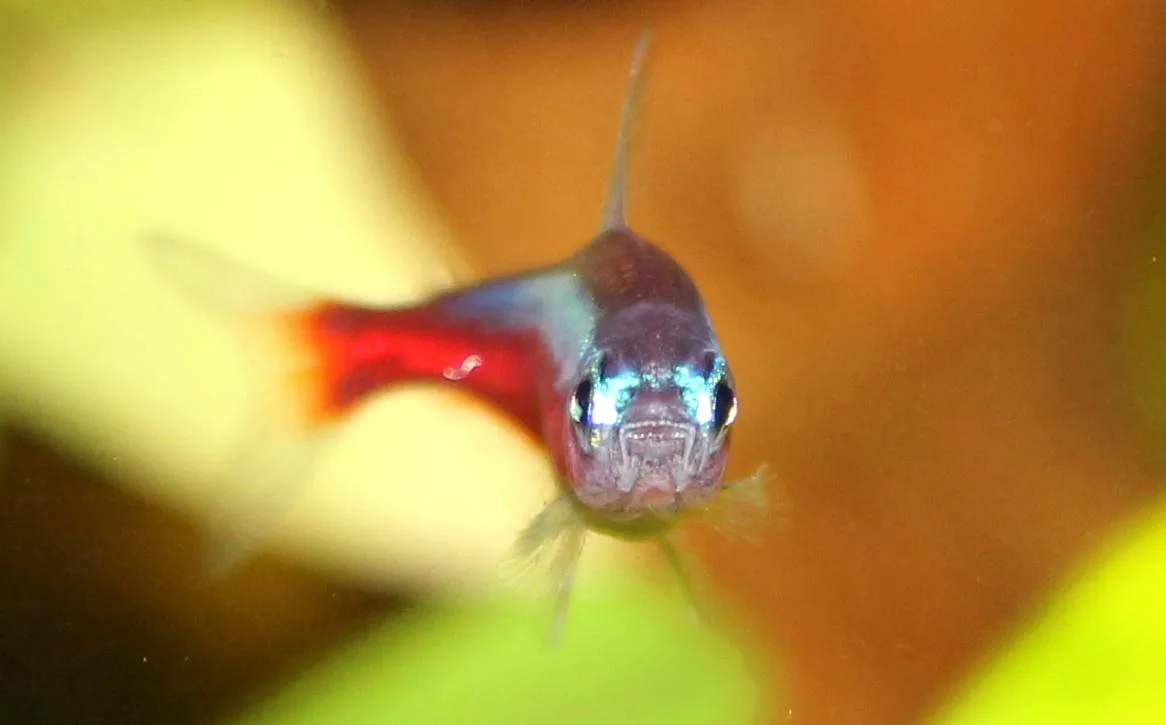
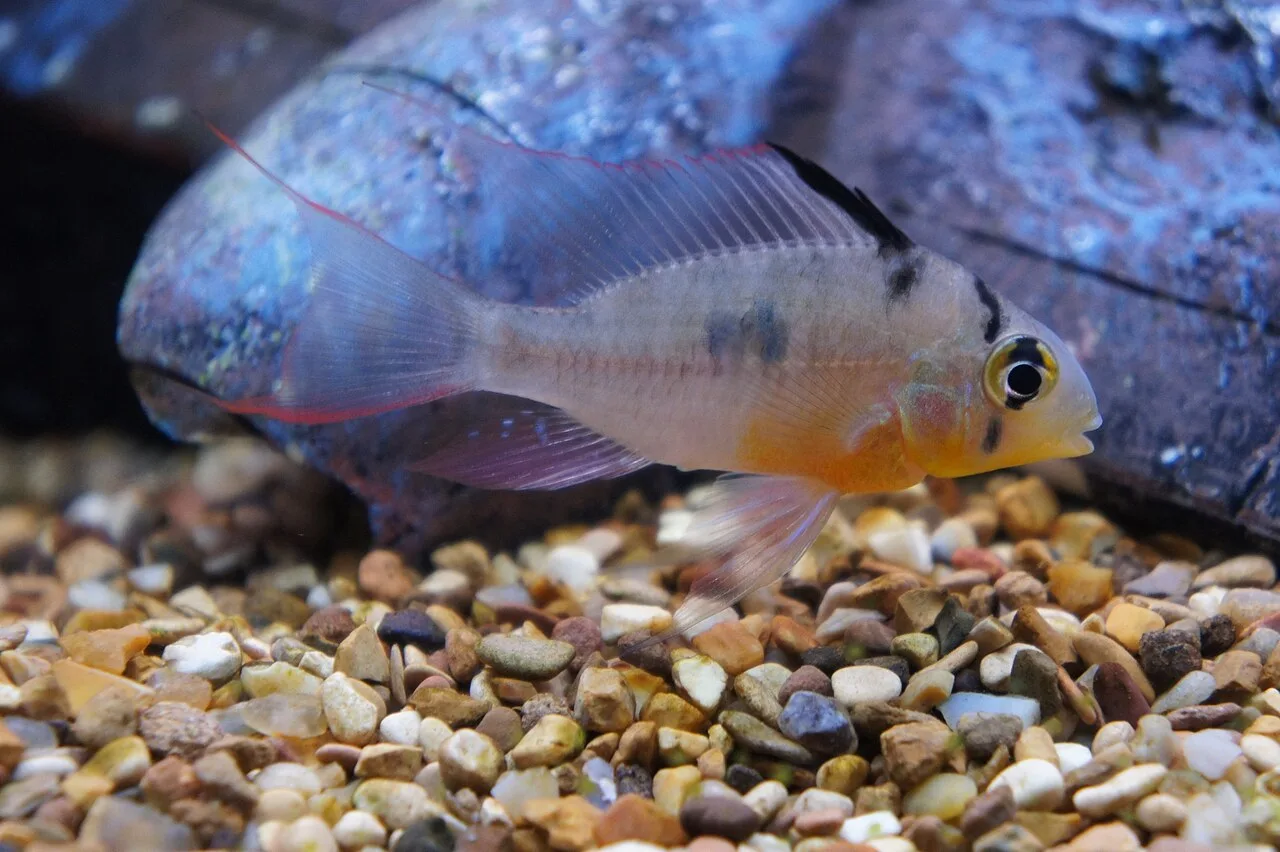
Rarely to 5 cm. Males have a longer second dorsal ray. Females are smaller and have a reddish to violet belly. A short ovipositor shows just before spawning. Fish from large Southeast Asian farms, and so-called jumbo rams, have lost parts of their breeding behaviour. The African butterfly cichlid is a different species.
Confusion and cultivated forms
The Bolivian ram, Mikrogeophagus altispinosus, was long confused with this species. The African Anomalochromis thomasi is also sometimes called a butterfly cichlid in German. Females shortly before spawning show a pink to red belly and a short ovipositor, and in them a blue sheen lies over the dark spot below the dorsal fin. In Asia gold, electric blue, balloon and long-finned forms were developed, many with lower fertility, health problems or weaker brood care. So-called jumbo rams can no longer breed.
Myers and Harry described the species in 1948 as Apistogramma ramirezi, named after Manuel Ramirez, an early collector and importer.
Origin & habitat
This describes the origin, not how to furnish the aquarium.
Lower and middle Orinoco and the other waters of the Llanos in Venezuela and Colombia. Both countries stay a coarse origin and are not filled. Earlier records from the Bolivian Mamoré belong to the sister species Mikrogeophagus altispinosus and are not added here. The habitat is clear, slow, densely planted streams with a mud bottom, and vegetated shores of warm turbid lakes.
The species is endemic to the Orinoco basin, in the lower and middle Orinoco and other waters of the Llanos in Venezuela and Colombia. It lives in clear, slow streams with dense vegetation and muddy bottoms and on vegetated shores of warm, turbid lakes. 25.5 to 31 °C, pH 4.6 to 7.3 and below 10 to 40 µS/cm were measured.
Care
Measured habitats: one reading of pH 5.1, 3 µS/cm and 28.5 °C, and a span of pH 4.6 to 7.3, under 10 to 40 µS/cm and 27.5 to 31 °C. Keeping stays at 27–30 °C and pH 5.5–7, inside those readings, without turning one sample into the new span. Tanks from about 80 litres are an editorial figure. Fine substrate and cover follow from mud and plants.
Diet
Frozen brine shrimp and mosquito larvae, and live daphnia, cyclops and brine shrimp. Varied food is a condition for growth and breeding. Granules alone are not what it states.
Behavior
Always a pair, not a loose group. Territorial when spawning, otherwise reserved. A pair that does not tolerate each other is not a pair that can be kept.
Reproduction
Open spawner on stones or in pits, 150 to 200 eggs. Both parents guarding the brood is the older wording. It says breeding is difficult and depends on food and on soft, slightly acidic water. A community tank should not be expected to produce young.
Before spawning monogamous pairs form, and males do not tolerate other males. The eggs are small, sticky and 0.9 to 1.5 mm across and are laid on flat stones or in pits in the gravel, usually 150 to 300, rarely up to 500. At 29 °C the larvae hatch after about 40 hours, swim free after five days and are led in a dense school. Both parents care for the brood. Varied frozen and live food and soft, slightly acidic water are regarded as important for keeping and breeding.
Gallery
More species in this group
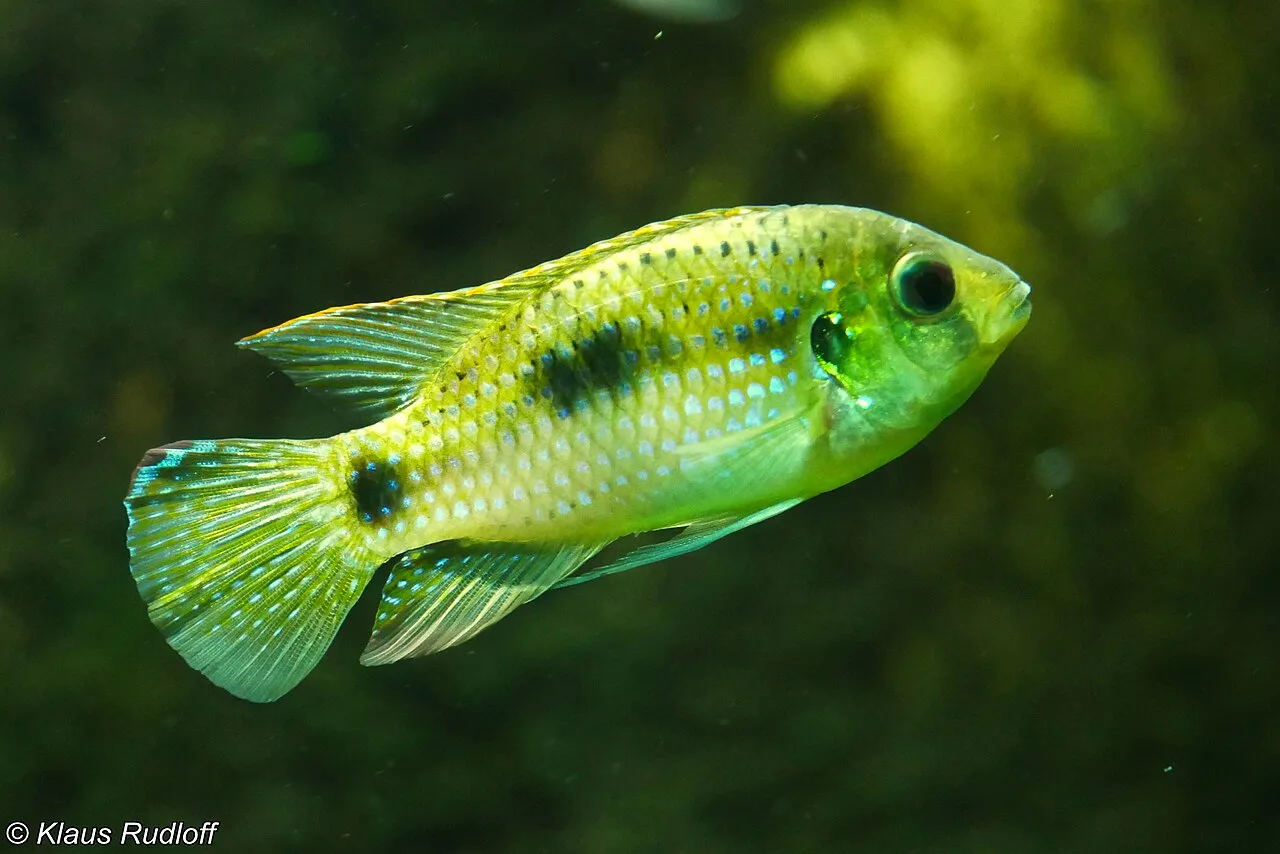
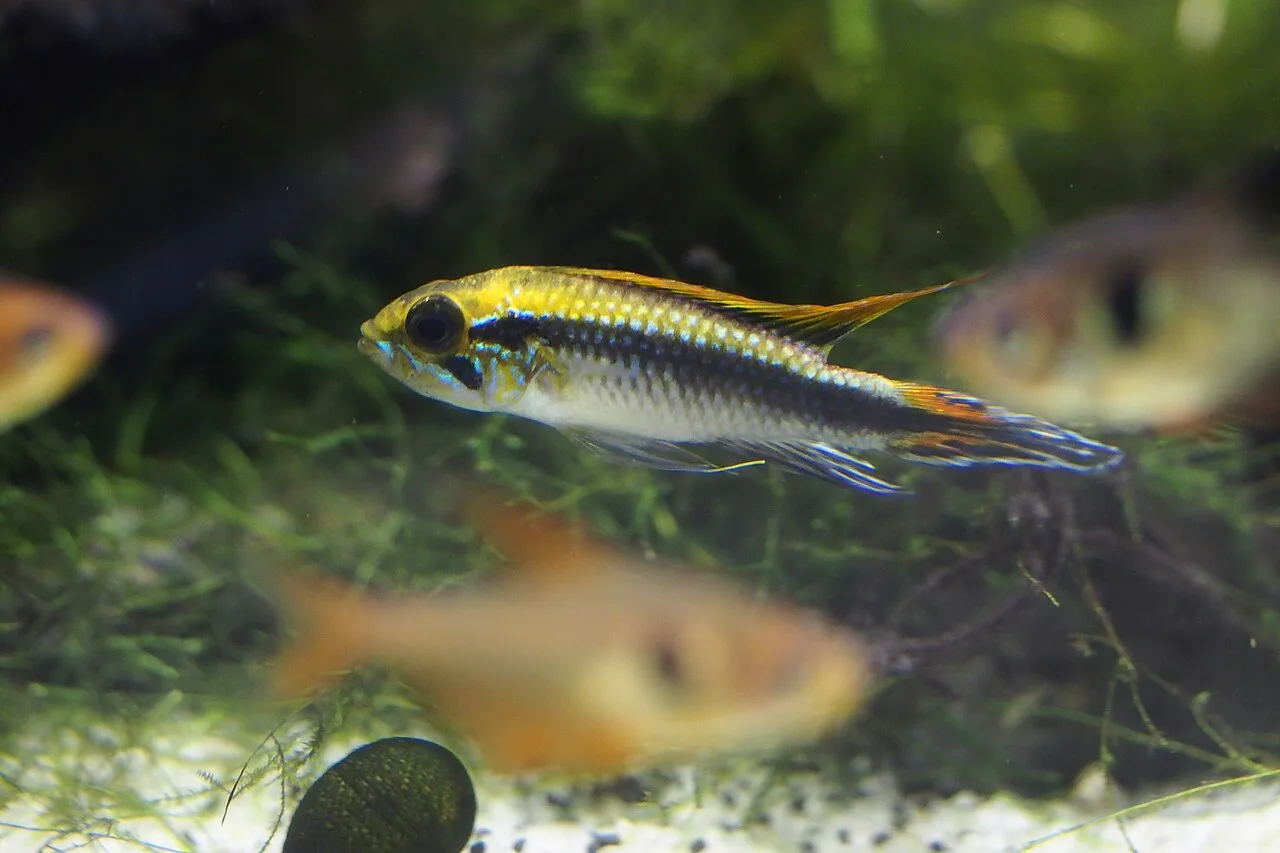

Similar water needs
Species with a similar temperature, a similar pH and a comparable adult size. Whether their behaviour fits as well is what the compatibility check is for.