Rummy-nose tetra
Petitella rhodostomus
30 views
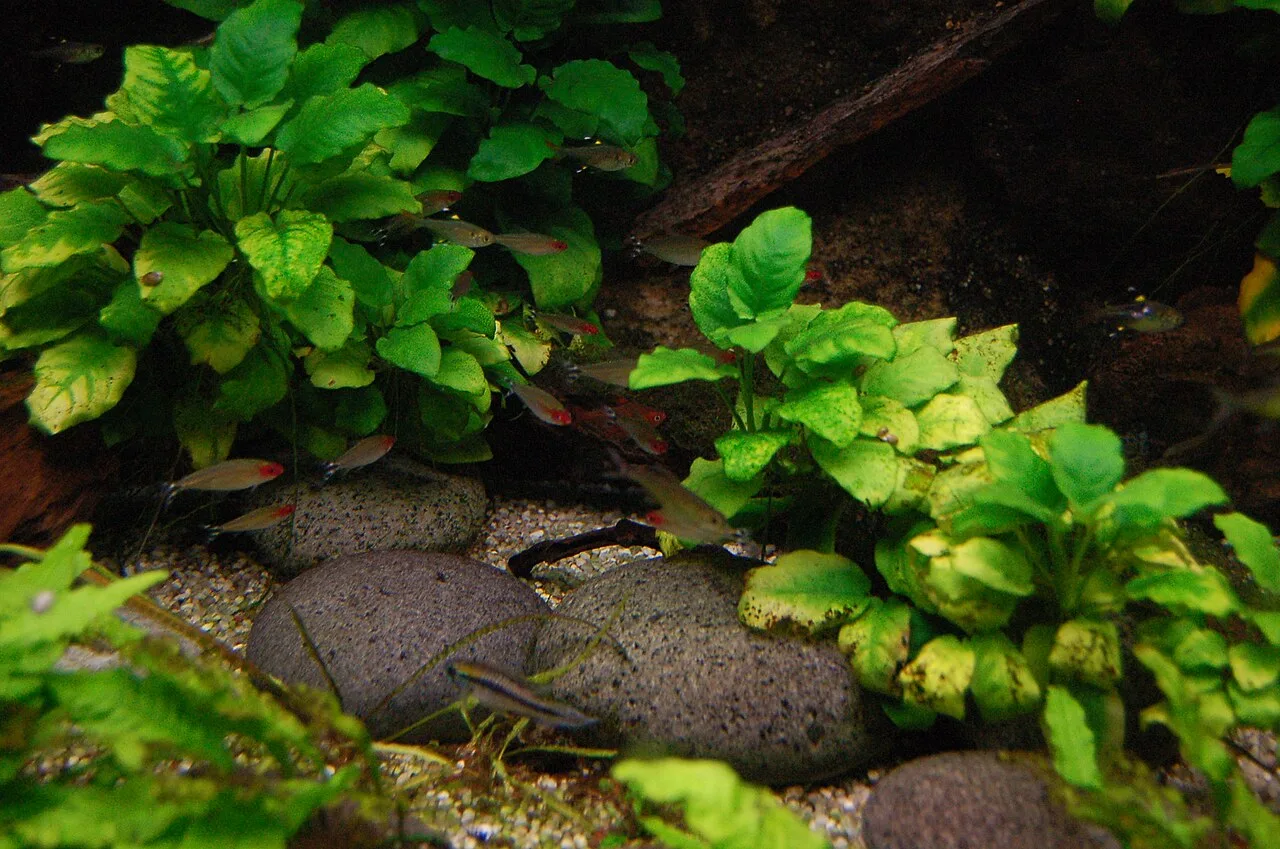
A rummy-nose tetra, 4 to 5 cm. Hemigrammus rhodostomus is the synonym. Not Petitella bleheri, which is already published as the other rummy-nose.
- Temperature
- 24 – 31 °C
- pH
- 6.4 – 7 pH
- General hardness
- 2 – 10 °dH
- Maximum size
- 5 cm
- Minimum group size
- 5
- Minimum tank size
- 80 L
3 min read · 398 words
Fresh water
Quick facts
Further published values
- Lifespan
- 5 – 6 a
Place in the aquarium
Highlighted are the water layer and the spots where the species usually stays in the tank.
- Middle water Usually stays in the middle of the tank, between bottom and surface.
- Open swimming space Needs an open area without plants or decor to swim at length. Tank length matters more than height.
Shrimp in the tank
Shrimplets at risk
- Not shrimp safe
- Dwarf shrimp at risk
- Shrimplets at risk
- Shrimp safe
- Adult dwarf shrimp
- Safe
- Shrimplets
- Get eaten
- Safe from shrimp size
- about 1.5 cm
Adult dwarf shrimp are safe from the rummy-nose tetra. At 4 to 5 cm and with a small mouth, it cannot handle shrimp from about 1.5 cm. Freshly hatched young, however, fit its prey range, and a school finds many of them. In a community tank the number of young therefore stays low.
Dense moss, fine-leaved plants and leaf litter give the young cover. Anyone who wants to raise many shrimp moves a few into a tank of their own. Calm tankmates such as corydoras hardly disturb the shrimp.
Home & range
Hatched countries are where the species occurs. It lives in particular waters there, not across the whole country. The points name known waters for orientation, not collection sites.
- Country of origin
- Water for orientation
Native
Overview
Elongated, back brownish to olive, sides greenish white to silver. The front of the head is blood red when the fish is well.
Identification
The body is elongated and strongly compressed. Belly and flanks shine greenish white to silvery, the iris is silver. A dark band starts behind the dorsal fin and widens towards the rear. The tail fin is banded black and yellowish white, the other fins are colourless with white tips or have a faint green sheen. Females look stockier and sturdier than males.
Confusion with related species
The rummy-nose tetra described by Ahl looks very much like Bleher's rummy-nose (Petitella bleheri). The latter, however, lacks a narrow dark band that runs from the base of the tail fin along the middle of the caudal peduncle and fades towards the centre of the body. In Ahl's species the red is usually stronger and stays on the head, while in Bleher's rummy-nose it extends beyond the gill cover. In Petitella georgiae the red also stops before the gills. Its central stripe on the caudal peduncle is clearly wider, though, and there is a striking black line at the base of the anal fin. All three species live in a very similar area of the Amazon basin.
Origin & habitat
This describes the origin, not how to furnish the aquarium.
Lower Amazon in Pará and the Río Caura in Venezuela. Brazil and Venezuela stay coarse.
The species occurs in the lower Amazon in the Brazilian state of Pará and in the Río Caura, a tributary of the Orinoco in Venezuela. The type locality lies near Santarém, where the Rio Tapajós flows into the Amazon.
Care
A peaceful schooling fish for community tanks. Possible tankmates are discus, neon tetras, corys and dwarf cichlids.
Tankmates
As a peaceful schooling fish the rummy-nose tetra suits community tanks. Suitable tankmates are discus, neon tetras, corydoras and dwarf cichlids. The strong red on the head shows when the fish are doing well. In Austria the animal keeping regulation requires at least five fish of this species.
Reproduction
A school.
Name and taxonomy
Ernst Ahl described the species in 1924 in the Wochenschrift für Aquarien- und Terrarienkunde and placed it in the genus Hemigrammus. A study published in 2020 on the relationships of the neon tetras (Paracheirodon) showed the close link to the rummy-nose tetras. Bleher's rummy-nose and Ahl's species were then moved into the genus Petitella alongside Petitella georgiae.
Gallery
More species in this group






Similar water needs
Species with a similar temperature, a similar pH and a comparable adult size. Whether their behaviour fits as well is what the compatibility check is for.