Half-banded kuhli loach
Pangio semicincta
20 views
A slender loach with half-dark bands. It lives on the bottom in a group and is often sold as a kuhli loach.
- Temperature
- 24 – 28 °C
- pH
- 6 – 7 pH
- General hardness
- 2 – 10 °dH
- Maximum size
- 10 cm
- Minimum group size
- 6
- Minimum tank size
- 60 L
4 min read · 596 words
Fresh water
Quick facts
Place in the aquarium
Highlighted are the water layer and the spots where the species usually stays in the tank.
- Near the bottom Mostly stays just above the bottom. Food has to reach the substrate.
- Substrate Sifts through the substrate or burrows into it. Fine, rounded sand without sharp edges suits it.
Shrimp in the tank
Shrimplets at risk
- Not shrimp safe
- Dwarf shrimp at risk
- Shrimplets at risk
- Shrimp safe
- Adult dwarf shrimp
- Safe
- Shrimplets
- Get eaten
- Safe from shrimp size
- about 1.5 cm
Adult dwarf shrimp are largely safe from the half-banded kuhli loach. The slender loach grows to about 10 cm but has a very small mouth. It sifts sand through its gills and eats insect larvae, small crustaceans and other small animals in the process. Young shrimp on the bottom easily fall into its food range, while animals from about 1.5 cm hardly do. The peaceful loaches are active at night and search the bottom then. Dense moss cushions and plants away from the sandy area offer the young the best refuges.
Home & range
Hatched countries are where the species occurs. It lives in particular waters there, not across the whole country. The points name known waters for orientation, not collection sites.
- Country of origin
- Water for orientation
Native
- Malaysia
- Range: the Malay Peninsula and Borneo.
- Indonesia
- Range: Sumatra and Borneo.
Overview
Pangio semicincta reaches about 8 to 10 cm and stays pencil-thin. The dark bands often do not run around the whole body, which is where the name half-banded comes from. That separates it from the spotted kuhli loach Pangio kuhlii, with which it is mixed in the trade. The barbels are short. The body is built to thread through leaf litter and fine gravel.
The species is active by day only when it feels safe. Otherwise it comes out at dusk and after feeding. An empty, bright tank shows an empty bottom for weeks, although the fish are there.
Markings and sexes
There it is called the half-banded kuhli loach. The eel-like body carries nine to twelve uneven dark brown bands with yellow between them, and the underside is pale whitish. The loach usually reaches at most 10 cm. Adult females are often somewhat larger and heavier than males. In males the first pectoral fin ray is thickened.
Confusion with Pangio kuhlii
In the trade the species is very often labelled Pangio kuhlii. That slightly deeper-bodied species, however, is limited to Java, where little collecting for the aquarium trade takes place. It therefore rarely if ever appears in the trade.
Origin & habitat
This describes the origin, not how to furnish the aquarium.
Slow, plant- and leaf-rich waters of the Malay Peninsula and Sumatra. A soft bottom, hiding places, little glaring light. The origin stays coarse. A sharp gravel bottom injures the barbels and the belly.
Besides the Malay Peninsula and Sumatra the species also lives on Borneo. The species mostly lives in calm, shallow blackwater rich in tannins, such as streams, swamps and oxbow lakes. These waters are often shaded and acidic from decaying plant material. The bottom is often sand or mud.
Care
Layout
24 to 28 °C, pH 6 to 7. A group from six, tanks from about 60 litres with a lot of floor area. Fine sand, leaf litter, tight tubes, roots, dim light. The cover has to be close. The fish squeeze through small gaps at the filter and at the rim of the lid.
Company
Calm fish that do not dig the bottom over. Large cichlids and hungry barbs eat the loaches or stress them so that they never come out. Shrimp are sometimes grabbed by the legs. Adult shrimp usually stay unharmed.
Diet
Frozen food and tablets that lie on the sand. Mosquito larvae, brine shrimp, a fine granule in the evening. Food that is eaten by the tetras in the first seconds does not reach the loaches. A feed after the light goes out is often the only one that arrives.
Pangio species search for food in the substrate. They take sand into the mouth and sift it through the gills to filter out insect larvae, small crustaceans and other small animals. Fine sand is therefore important for natural foraging.
Behavior
A group. Single fish become shy to the point of invisibility. The animals often lie several together in one tube. That is normal and not a lack of space, as long as further tubes are free. A fish that lies on its side in the open sand by day and no longer reacts to disturbance is ill. A short rest in the group is not.
In the wild Pangio live in large aggregations. In the aquarium too they often stay together and squeeze into the same cave or crevice. They are regarded as peaceful and attack neither their own kind nor other fish.
Reproduction
Breeding in the aquarium is rare. The fish spawn as a group in fine plant growth, without brood care. For keeping, the visible, fed group is what counts, not a breeding setup.
Gallery
More species in this group
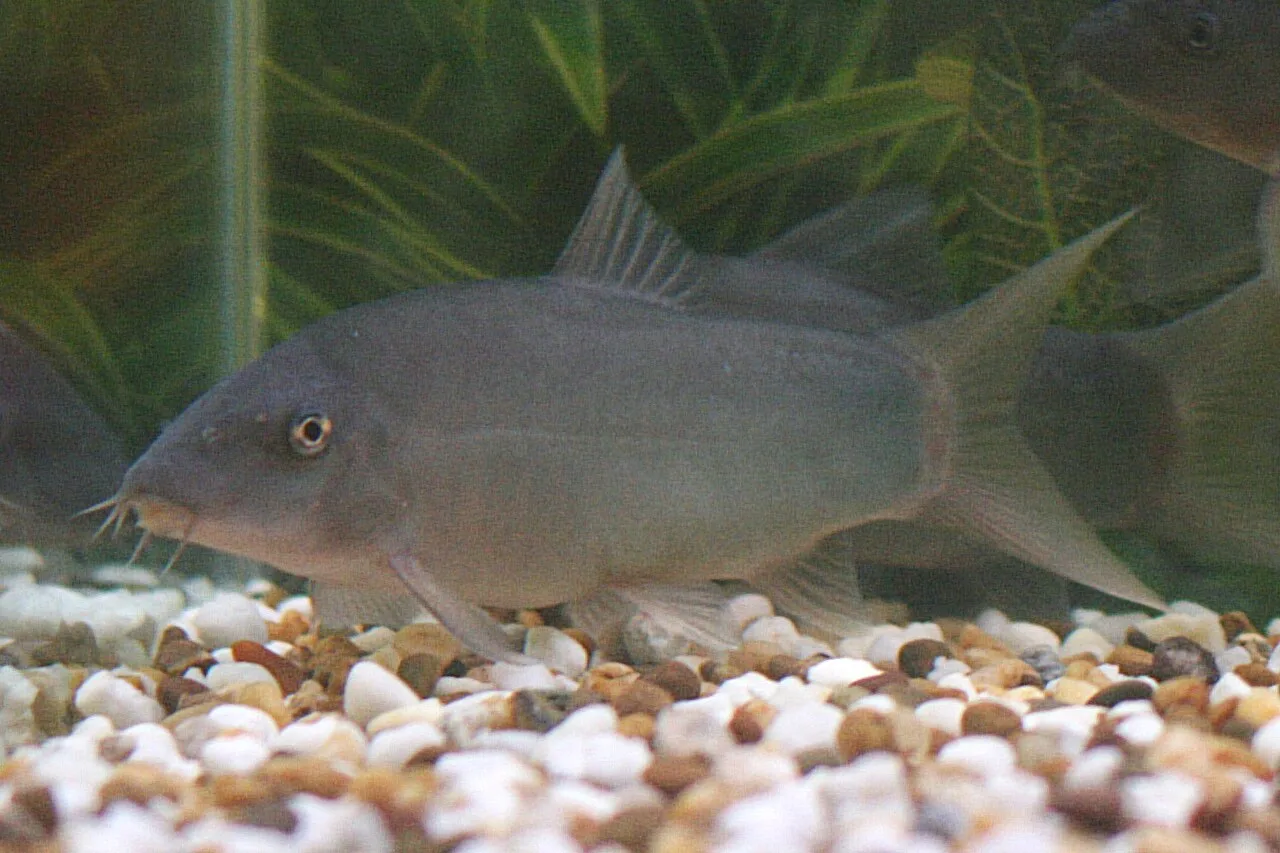
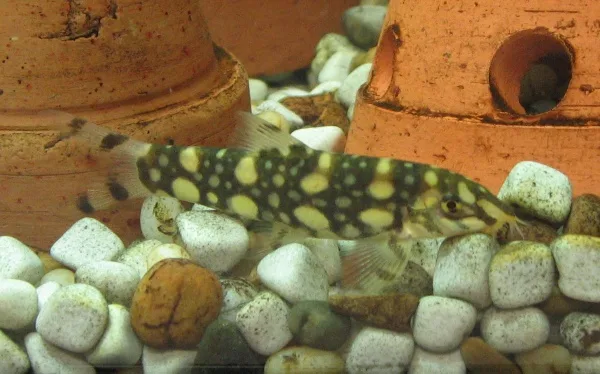
Similar water needs
Species with a similar temperature, a similar pH and a comparable adult size. Whether their behaviour fits as well is what the compatibility check is for.