
Tiger barb
Puntius tetrazona
10 views
The barred barb of the trade. The article that was read treats it as scientifically undescribed and says it does not occur on Sumatra.
3 min read · 447 words
Quick facts
The profile values are backed by one source.
Home & range
Every named country gets a frame and a circle around known waters in or near that area. Hotspots are orientation, not collection sites. A filled area is the range only when the source names a particular water body.
Coarse origin
The circle sits around the country or, a little wider, around known waters there. The points are orientation, not collection sites.
- Singapore Wikipedia deutsch
- Malaysia Wikipedia deutsch
- Singapore Coarse region of origin
- Malaysia Coarse region of origin
Overview
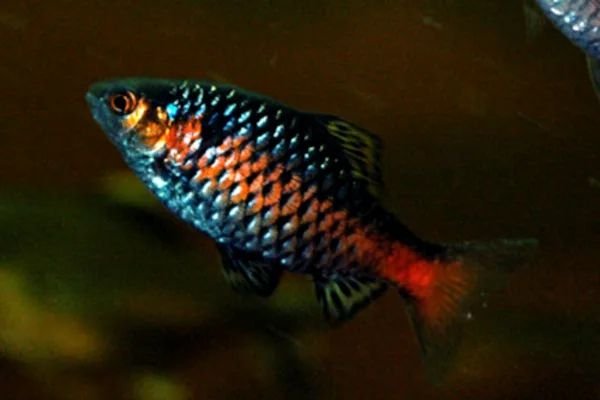
The article lists the trade fish as Puntigrus cf. tetrazona, not as the species Bleeker described in 1855 from southern Sumatra. Bleeker named barred barbs more than once and from different places, including a form from the Kahajan on Borneo that is now Desmopuntius rhomboocellatus. After a live import from Borneo in 2007, Zarske concluded that the fish long carried as Puntius tetrazona, the “Sumatra barb”, cannot be assigned to a described species. In 2013 Kottelat placed the Southeast Asian tiger barbs in the genera Desmopuntius and Puntigrus. The catalogue keeps the previously published name Puntius tetrazona without equating the trade fish with a described species. The body is deep and laterally compressed. Four broad bands encircle it: across the eyes, in front of the dorsal and pelvic fins, as a continuation of the dorsal colour into the anal fin, and around the caudal base. Pectoral and pelvic fins are often red. Males reach five centimetres, females at most seven centimetres in total length.
Origin & habitat
This describes the origin, not how to furnish the aquarium.
The only occurrences the article treats as soundly documented are Singapore and the Gunung Pulai Recreational Forest in Johor, in the south of the Malay Peninsula. According to the article the Sumatra barb does not occur on Sumatra. Other distribution records rest on confusion or on captive-bred stocks.
Care
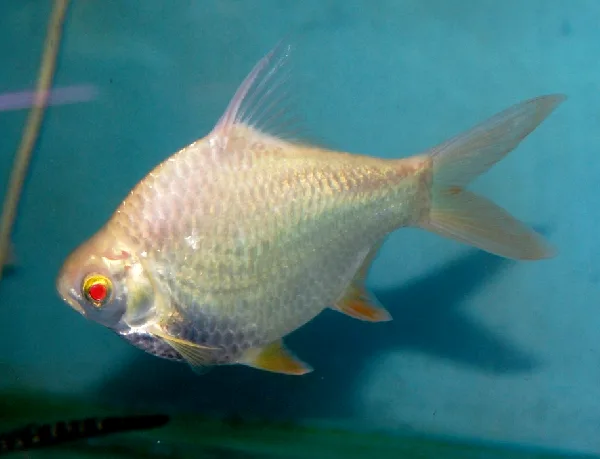
Since the probable first import in 1933 by Otto Winckelmann in Hamburg-Altona, the fish has been one of the most frequently traded aquarium species. It is bred in the millions in Thailand, Malaysia, Singapore, the United States, Canada, Israel and the Czech Republic. Colour and attainable length vary with the breeding strain. Green, leucistic, albinotic and xanthoristic forms are named, and a leucistic form without an operculum.
Only as a large school
The tiger barb nips fins when the group is small or the tankmates wear long veils. From ten fish, better more, from about 100 litres and 80 cm, 24 to 28 °C. Several males, so the rivalry stays in the school and is not taken out on an angelfish. Dense plants at the edge, an open middle.
Moss barbs and green cultivated forms are not tamer species. They are the same fish in another coat. An albino in a group of four nips just the same.
Behavior
It should not be kept with long-finned fish, for example guppies, because it eats their fins. The text does not name a minimum group size.
Lively all day. Quiet bottom animals cope with that. Bettas, gouramis and angelfish do not. The species is a schooling fish for a tank set up for it, not the gap-filler beside expensive long fins.
Reproduction
Mass breeding in Southeast Asia, North America, Israel and the Czech Republic is stated as a trade fact, not as instructions.
More species in this group

Sources & assertions 2
Wikipedia
Texte in Aquarisma sind eigenständig formuliert. Zahlen folgen dem genannten Artikel, Lizenz CC BY-SA. Deutsch und Englisch sind dieselbe Enzyklopädie, keine zweite unabhängige Quelle.
- Männchen erreichen fünf, Weibchen höchstens sieben Zentimeter Gesamtlänge.
Wikipedia (deutsch)
Texte in Aquarisma sind eigenständig formuliert. Zahlenbereiche folgen den verlinkten Wikipedia-Artikeln, Lizenz CC BY-SA.
- Haltungsbereich nach https://de.wikipedia.org/wiki/Sumatrabarbe