
Ticto barb
Pethia ticto
11 views
A small barb from South Asia with two dark spots. The males redden when courting. The group has to be large enough.
2 min read · 226 words
Quick facts
The profile values are backed by one source.
Home & range
Every named country gets a frame and a circle around known waters in or near that area. Hotspots are orientation, not collection sites. A filled area is the range only when the source names a particular water body.
Overview
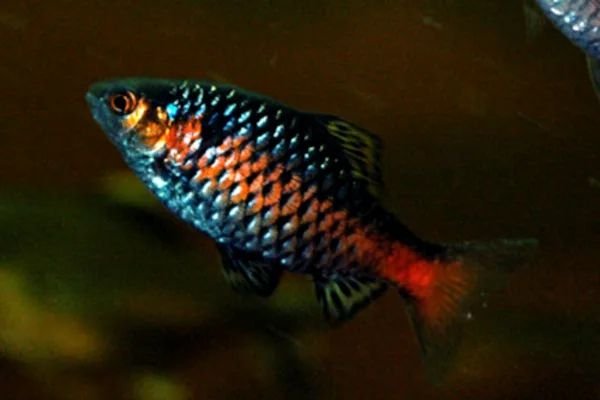
Pethia ticto reaches about 8 cm, in the aquarium often less. Two black spots, one behind the gill cover and one in front of the tail base, stay the mark. Males become reddish when courting and grow a higher dorsal. Females stay more silvery.
It is not the Odessa barb and not the rosy barb. The two spots separate it. Like the other barbs it shows the colour only in a school.
Origin & habitat
This describes the origin, not how to furnish the aquarium.
Rivers, ditches and flooded fields in India, Nepal, Bangladesh and Sri Lanka. The countries stay a coarse origin. The water is not extremely soft.
Care
School
20 to 26 °C, pH 6.5 to 7.5. A group from eight, tanks from about 100 litres and 80 cm. Plants at the edge, an open middle, some current. Permanently very warm water is unfavourable.
Company
Other peaceful barbs and medium-sized tetras. Long fins are a risk when the own group is too small. In the right number it stays tolerant.
Diet
Omnivore with a plant share. Flakes, granules, vegetables, frozen food. Several small feeds. Mosquito larvae alone make them fat.
Behavior
A lively school. The males display with the dorsal. That is courtship, not a permanent chase, as long as there is room to get away. A single fish turns pale or nips.
Reproduction
Egg scatterer without brood care. Fine plants and removing the parents are the breeding path. In a community tank the eggs are eaten.
More species in this group

Sources & assertions 1
Wikipedia (deutsch)
Texte in Aquarisma sind eigenständig formuliert. Zahlenbereiche folgen den verlinkten Wikipedia-Artikeln, Lizenz CC BY-SA.
- Haltungsbereich nach https://de.wikipedia.org/wiki/Pethia_ticto