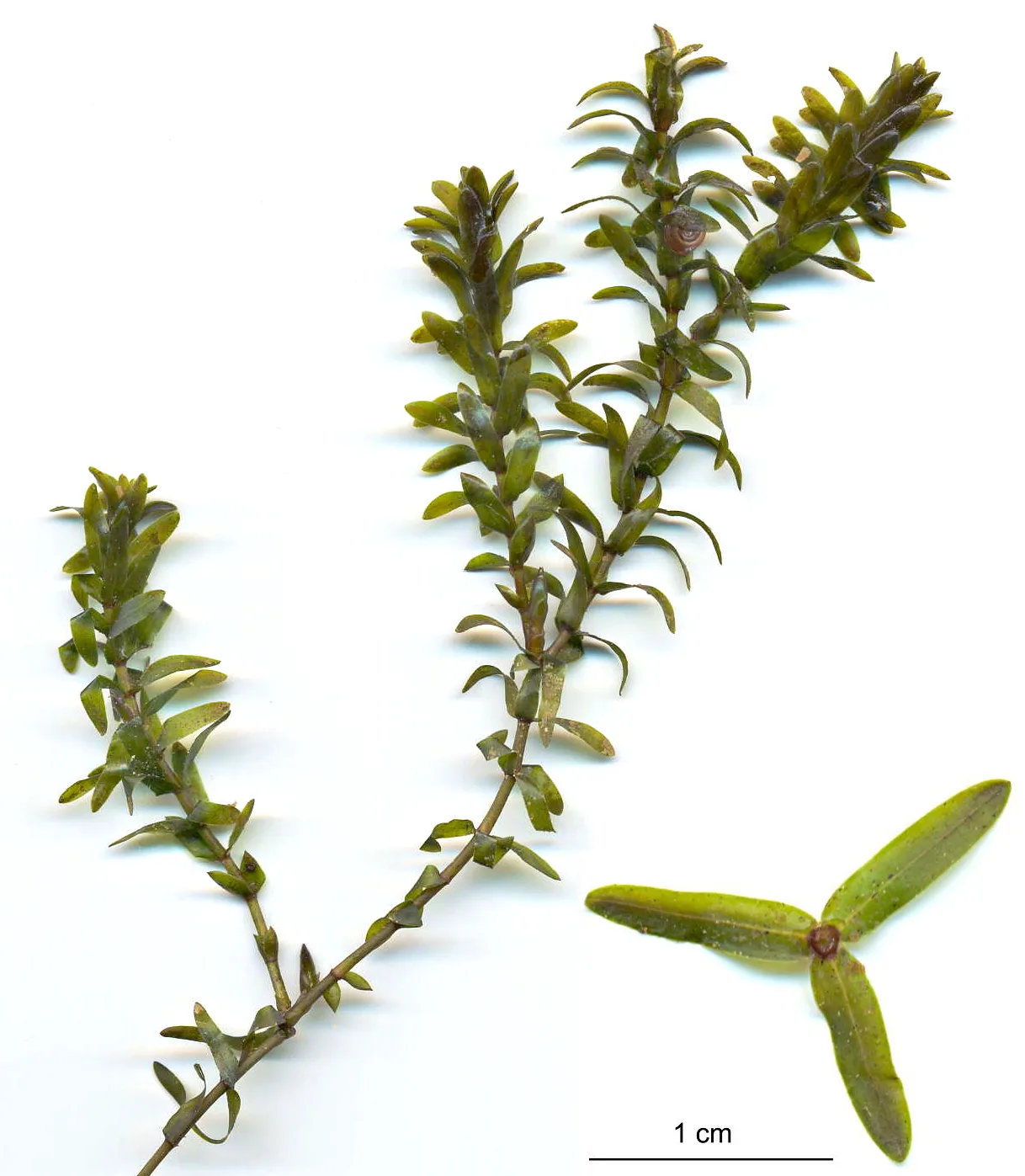
Alternate water-milfoil
Myriophyllum alterniflorum
1 view
A dainty water-milfoil from soft, nutrient-poor lakes. Finer and smaller than the other native species.
- Temperature
- 8 – 22 °C
- pH
- 5.5 – 7.5 pH
- Lighting
- Medium light
- CO₂
- Low CO₂
- Growth rate
- Medium
- Placement
- Background
1 min read · 155 words
Care profile
Growth form
Stem plantsPlanting and propagation
- Cuttings Cut off shoot tips and replant them. This keeps the stand dense and propagates it at the same time.
Placement in the aquarium
Highlighted are the areas where the species is typically used.
- Background Along the back wall and the sides. Forms the tall, dense backdrop.
Home & range
Hatched countries are where the species occurs. It lives in particular waters there, not across the whole country. The points name known waters for orientation, not collection sites.
- Country of origin
- Water for orientation
Native
Botanical overview
Alternate water-milfoil forms thin stems with whorls of three to four delicate, pinnate leaves. The shoots stay slender and branch loosely. The small flowers sit at the tip of a short spike, male above and female below.
In the tank it looks light and airy. It needs soft water and copes with few nutrients.
Natural origin
This describes the origin, not how to furnish the aquarium.
The species is found mainly in Atlantic Europe, from Iceland and Scandinavia through the British Isles to France, Spain and Portugal, and also in north-eastern North America. It grows in clear, lime-poor and nutrient-poor lakes and streams.
Light, CO₂ and position
Light
Medium light.
Water
Soft, lime-poor water.
Temperature
8 to 22 °C.
Position
Background.
Layout and neighbours
Together with shoreweed, quillwort and water lobelia it makes a natural soft-water tank modelled on clear Nordic lakes.
Common mistakes
Hard tap water and strong all-in-one fertiliser: the plant struggles.
Growth and trimming
Moderate growth. It declines in hard water and under heavy fertilisation.