Brazilian waterweed
Egeria densa
25 views
A fast stem plant from southeastern South America, also listed as Elodea densa.
- Temperature
- 16 – 26 °C
- pH
- 5.8 – 9.2 pH
- Lighting
- High light
- CO₂
- Low CO₂
- Growth rate
- Fast
- Placement
- Background
3 min read · 494 words
Care profile
Growth form
Stem plantsPlanting and propagation
- Cuttings Cut off shoot tips and replant them. This keeps the stand dense and propagates it at the same time.
Placement in the aquarium
Highlighted are the areas where the species is typically used.
- Background Along the back wall and the sides. Forms the tall, dense backdrop.
Home & range
Hatched countries are where the species occurs. It lives in particular waters there, not across the whole country. The points name known waters for orientation, not collection sites.
- Country of origin
- Water for orientation
Native
Botanical overview
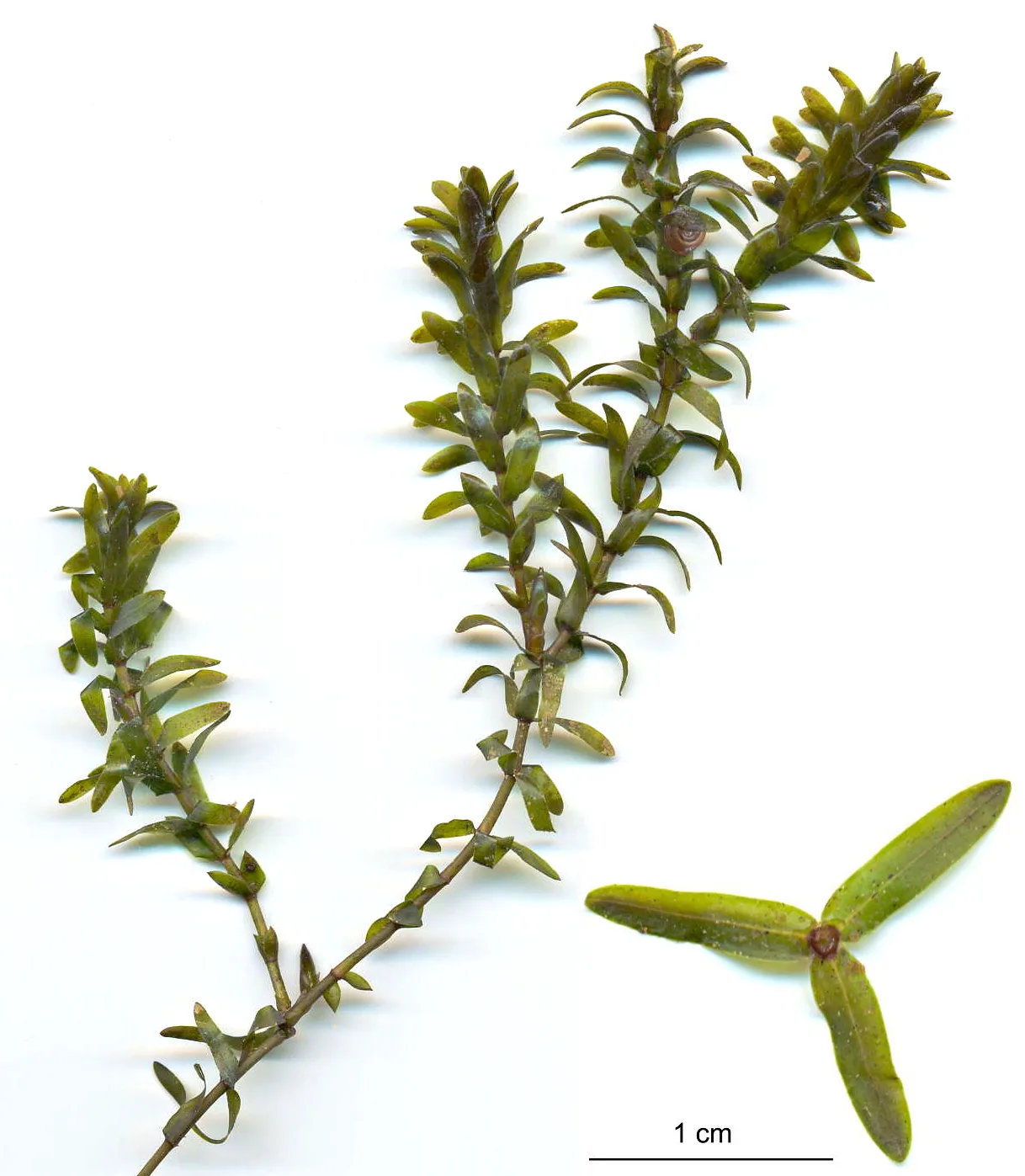
The plant usually roots at 2 to 3 m, exceptionally to 7 m. Unrooted fragments survive and root at nodes. The stems are 1 to 3 mm thick and up to 3 m long at home, 30 to 60 cm in Central Europe. Dense mats form at the surface. Leaves stand in whorls of four, 1 to 3, rarely 5 cm long. The species is dioecious. Flowers are lifted above the water on long stalks. In Europe only male plants occur, so there is no seed. The chromosome number is 2n = 48. It must not be released from the aquarium into natural waters.
Natural origin
This describes the origin, not how to furnish the aquarium.
Originally from southeastern Brazil, central Minas Gerais, to the coasts of Uruguay and Argentina, also in the Paraná basin and in Bolivia. Still and slow waters, mostly at 1 to 2 m. Since about 1900 it was deliberately introduced. It is now established in large parts of the world. The first North American record is 1893 on Long Island. In Germany 1914, now scattered. Central Europe knows only male plants. Introduced countries are not drawn as the native map.
Light, CO₂ and position
It grows best at 16 to 28 °C. After adaptation it survives up to 35 °C. That is survival, not the recommended upper limit. It can overwinter under ice. It is not frost hardy. It avoids shade and in the field stands almost only in clear, well-lit waters with pH above 5.5. In the laboratory an adaptation to low light can be shown. At low dissolved CO₂, high temperature and strong light it switches to C4 photosynthesis. C3 and C4 forms cannot be told apart by eye. It likes high light best. Extra CO₂ is not needed.
Filling and limiting
Brazilian waterweed is the plant that greens an empty tank in days and visibly uses nitrate. The same trait makes it a danger in the wild. In Europe it is naturalised and must not be released. Every cutting stays in the household waste.
In the tank it wants light, including in cooler water than most tropical plants. 16 to 26 °C fit. It does not need a CO₂ system, but it does benefit from light. Without a trim it lies as a mat on the surface and takes the light from everyone else.
Growth and trimming
It takes nutrients through roots and leaves, phosphorus in particular. It grows in oligotrophic and eutrophic waters. In Europe it prefers mud and silt, rarely sand or gravel. Hard cutting back is the practical consequence of the mats. A trimming height in centimetres is missing.
A hard cut-back
Cutting back here means taking half the mass, not shortening one tip. Bare, brittle stems are pulled. The healthy tips are replanted. A tank that consists only of waterweed is not an aquascape. It is a sign that the trim was left too long.
Further care
At very high nutrients Hydrilla verticillata displaces it. Its performance is then below that of Elodea. It can clear turbid water and limit phytoplankton.
Propagation
In Europe only vegetative, by brittle shoot pieces. Cuttings are the same route. Seed does not form there, because the female plants are absent.