Anubias
Anubias barteri
25 views
A rhizome plant from West Africa. Anubias barteri comprises several varieties, not a single trade form.
- Temperature
- 22 – 28 °C
- pH
- 6 – 8 pH
- Lighting
- Low light
- CO₂
- No CO₂
- Growth rate
- Slow
- Placement
- Midground
3 min read · 479 words
Care profile
Growth form
EpiphytesPlanting and propagation
- Attach Fix it to wood or stone with cotton thread, fishing line or plant glue. The roots attach on their own after a few weeks.
- Rhizome The creeping rhizome stays free above the substrate. Buried, it rots.
Placement in the aquarium
Highlighted are the areas where the species is typically used.
- Midground Between foreground and background. Hides transitions and frames stones and wood.
- On rock or wood Tied onto wood or stones rather than planted in the substrate.
Home & range
Hatched countries are where the species occurs. It lives in particular waters there, not across the whole country. The points name known waters for orientation, not collection sites.
- Country of origin
- Water for orientation
Native
Botanical overview
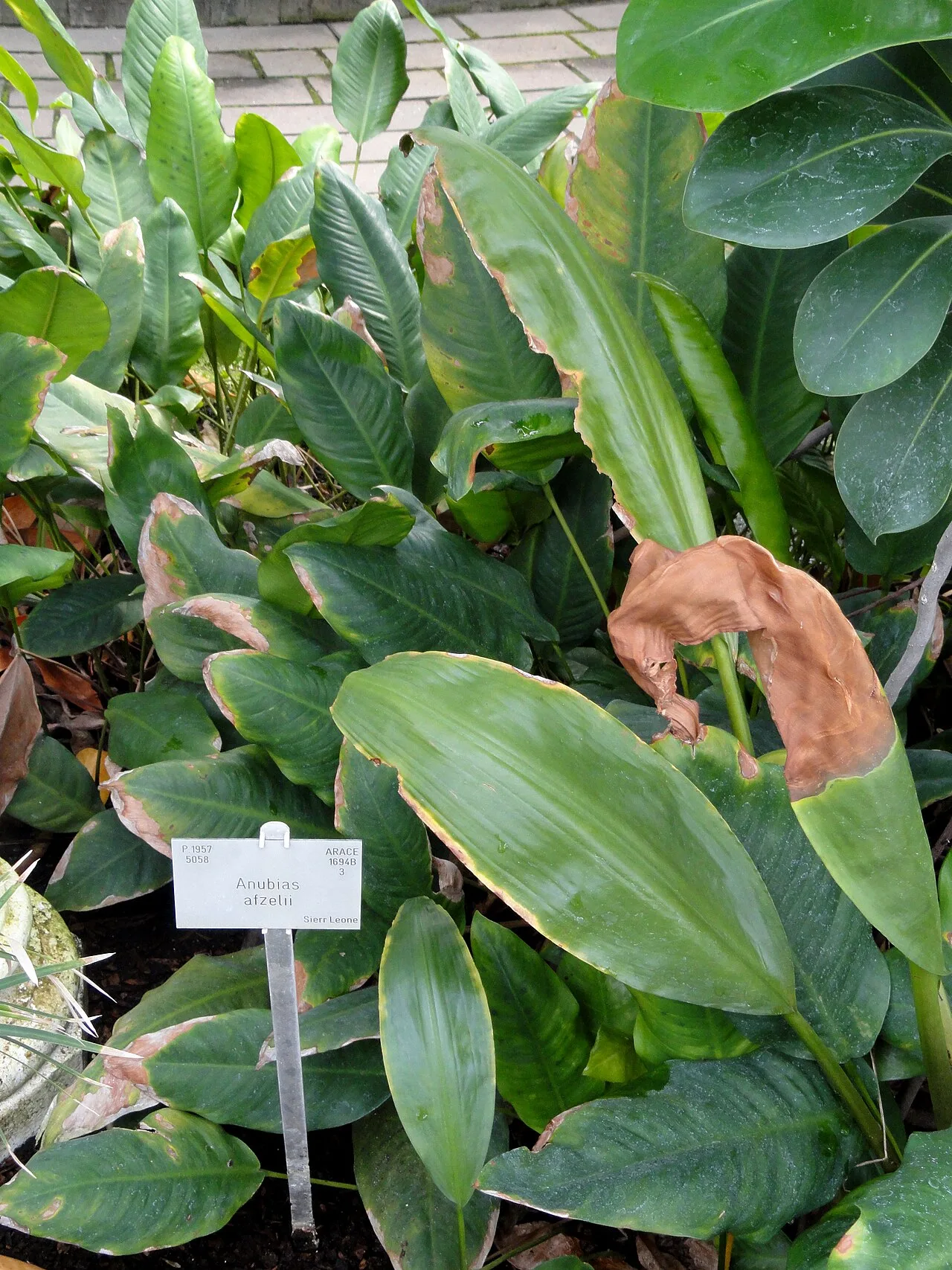
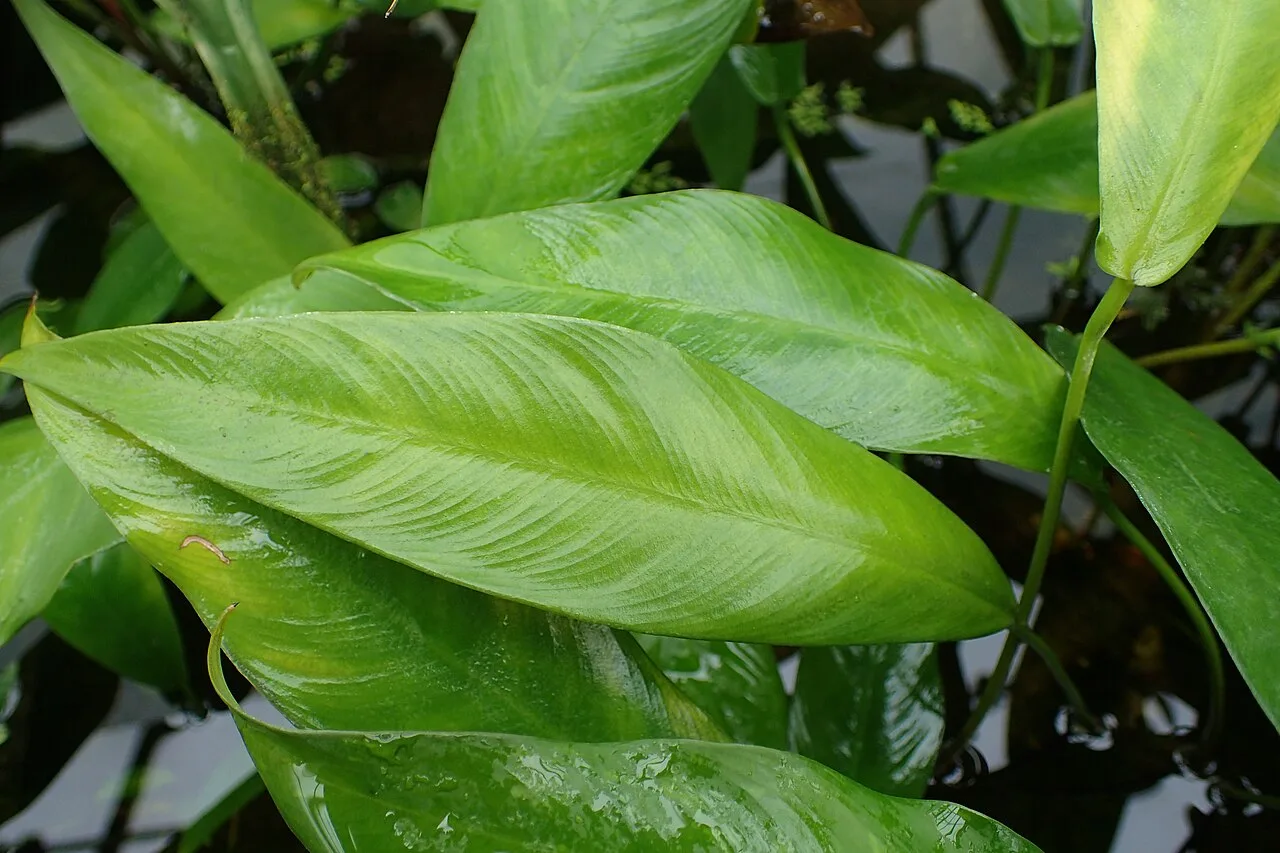
The genus Anubias was described in 1857 by Heinrich Wilhelm Schott. It is the only genus of the tribe Anubiadeae in the arum family. The plants form rhizomes, simple stalked leaves and a spadix with a spathe. Berries follow. Anubias barteri occurs in six varieties. Named are var. barteri, angustifolia, caladiifolia, glabra, nana and cofeifolia. Nana is restricted to Cameroon, barteri to southeastern Nigeria, Cameroon and Bioko. The catalogue lists the species, not one variety. The rhizome must not disappear into the substrate.
Natural origin
This describes the origin, not how to furnish the aquarium.
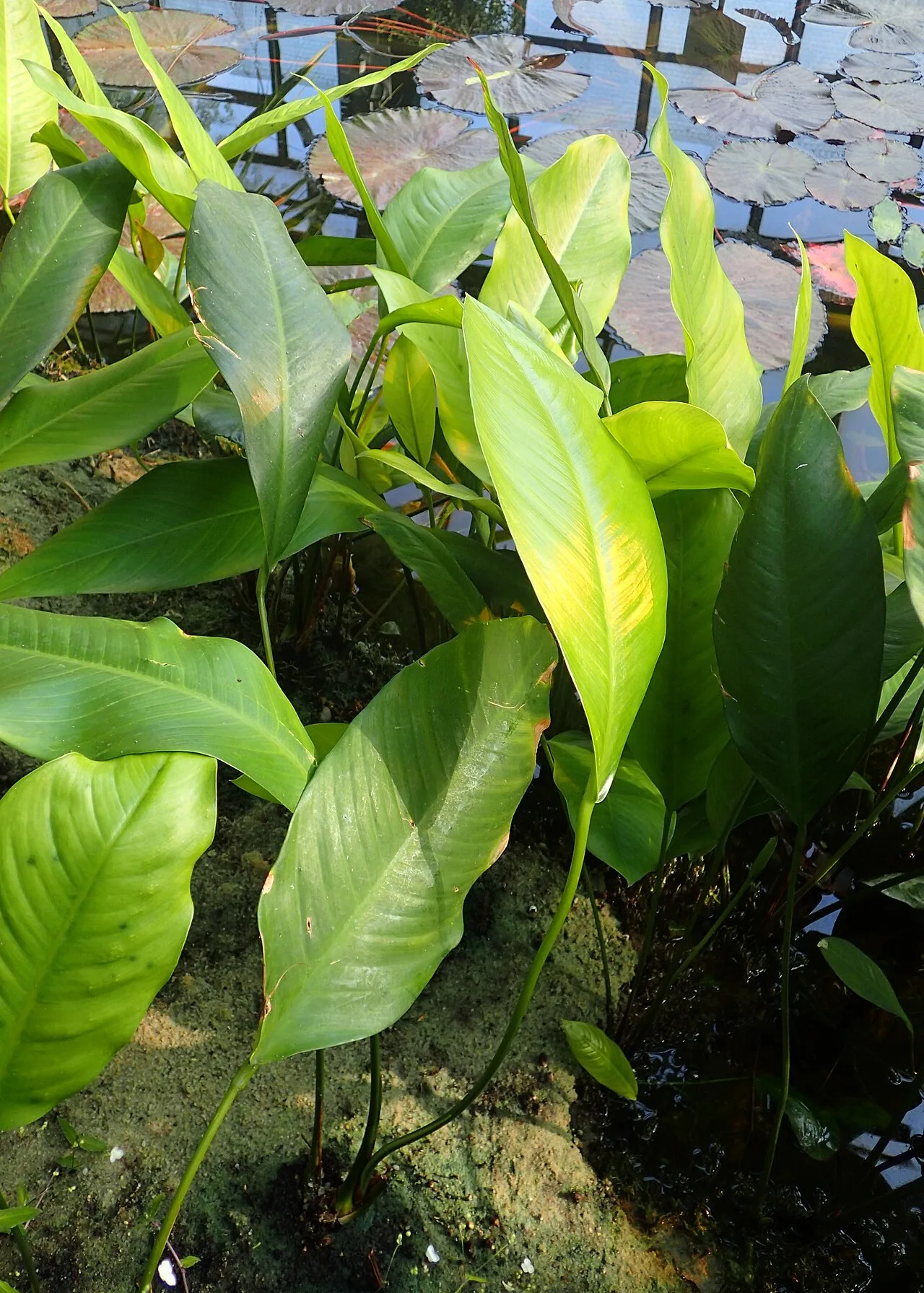
The genus grows in swamps and along water margins of tropical and subtropical West and Central Africa, often in shade, emersed, half-emersed or at times fully submerged. The rhizomes cling to stones or trunks. The varieties of A. barteri occur in Nigeria, Cameroon, on Bioko (Equatorial Guinea), in Gabon, Guinea, Liberia, Côte d’Ivoire and Congo. Congo here does not mean the Democratic Republic of the Congo.
Light, CO₂ and position
Anubias are regarded as tough and usable even under low light. Var. barteri thrives in little light, given as 0.25 W/L, and without added CO₂. That is not a PAR figure and not a value for every variety. The rating “low light”, “CO₂ not required” and 22–28 °C points the same way. The tough leaves are hardly eaten. They are popular as decoration for cichlid tanks.
Tying on and light
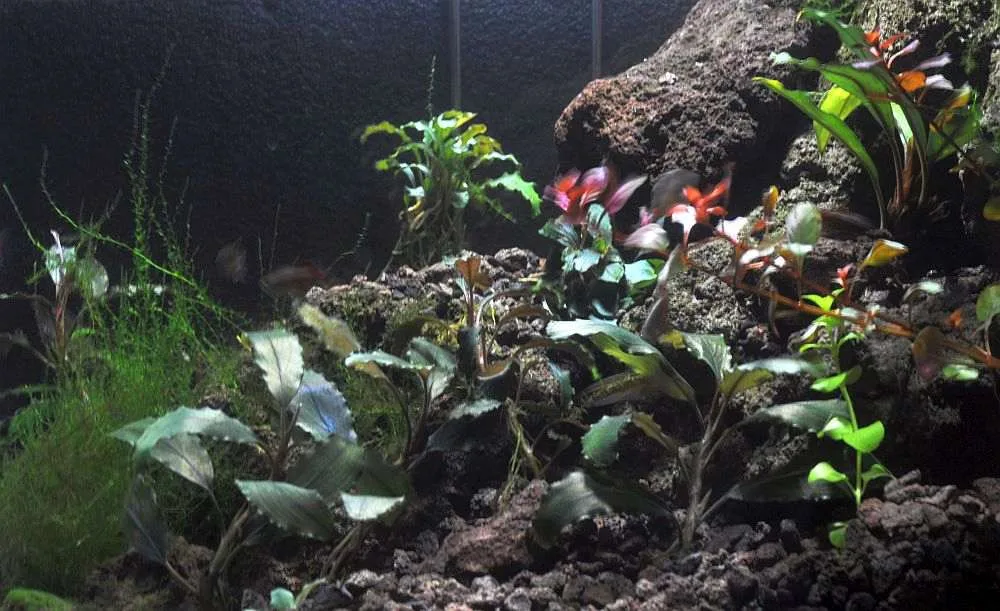
Anubias belongs on wood or stone, not deep in the gravel. The rhizome stays visible. Only the roots may attach or sit in a crack. Under a floating plant, or in the shade of a sword, the leaf stays dark green and cleaner of algae than directly under a strong lamp. Anyone who turns the lamp up for a Rotala carpet gets brush algae on the Anubias, not a prettier leaf.
Once it has attached, the plant is not moved again. Every removal tears the rhizoids, and the rhizome lies loose again, exactly where mulm rots.
Growth and trimming
Pruning is hardly needed. The rhizome stays free. The roots can attach.
Trimming and algae
Single old leaves are cut at the rhizome, not torn off. A leaf with brush algae that is otherwise healthy can be wiped. A whole rhizome full of algae is thinned, not poured over with an algaecide. The plant grows so slowly that a lost leaf takes months.
It takes fertiliser in the water column, but it is rarely the first to starve. Yellow leaves are often old leaves, or a rhizome that is stuck in the substrate.
Further care
After rhizomes were divided, losses of dwarf shrimp were occasionally reported. Calcium-oxalate crystals from injured cells are suspected to be responsible. That is a thesis, not a proven mechanism. The advice is to divide outside the tank, rinse the cuts under running water, and more safely soak the pieces for several days before they return.
Propagation
Propagation is by dividing the rhizome. The flowers are inconspicuous and stand in a spadix.