
Anubias
Anubias barteri
17 views
A rhizome plant from West Africa. The text that was read is the genus article. Anubias barteri comprises several varieties there, not a single trade form.
4 min read · 518 words
Care profile
The care profile is backed by one source.
Lighting
Low lightThe profile says low light.
CO₂
No CO₂Added CO₂ is not required.
Growth rate
SlowThe profile describes slow growth.
Nutrient demand
LowNutrient demand is low.
Beginner friendly
Beginner friendlyThe published judgement is suitable for beginners.
- Attach
- Rhizome
- The rhizome must not disappear into the substrate.
Placement in the aquarium
Only the stored position or growth form is highlighted, not every possible layout.
- Midground
- On rock or wood
Home & range
Every named country gets a frame and a circle around known waters in or near that area. Hotspots are orientation, not collection sites. A filled area is the range only when the source names a particular water body.
Coarse origin
The circle sits around the country or, a little wider, around known waters there. The points are orientation, not collection sites.
- Nigeria Wikipedia deutsch
- Cameroon Wikipedia deutsch
- Equatorial Guinea Wikipedia deutsch
- Gabon Wikipedia deutsch
- Guinea Wikipedia deutsch
- Liberia Wikipedia deutsch
- Côte d'Ivoire Wikipedia deutsch
- Republic of the Congo Wikipedia deutsch
- Nigeria Coarse region of origin
- Cameroon Coarse region of origin
- Equatorial Guinea Coarse region of origin
- Gabon Coarse region of origin
- Guinea Coarse region of origin
- Liberia Coarse region of origin
- Côte d'Ivoire Coarse region of origin
- Republic of the Congo Coarse region of origin
Botanical overview
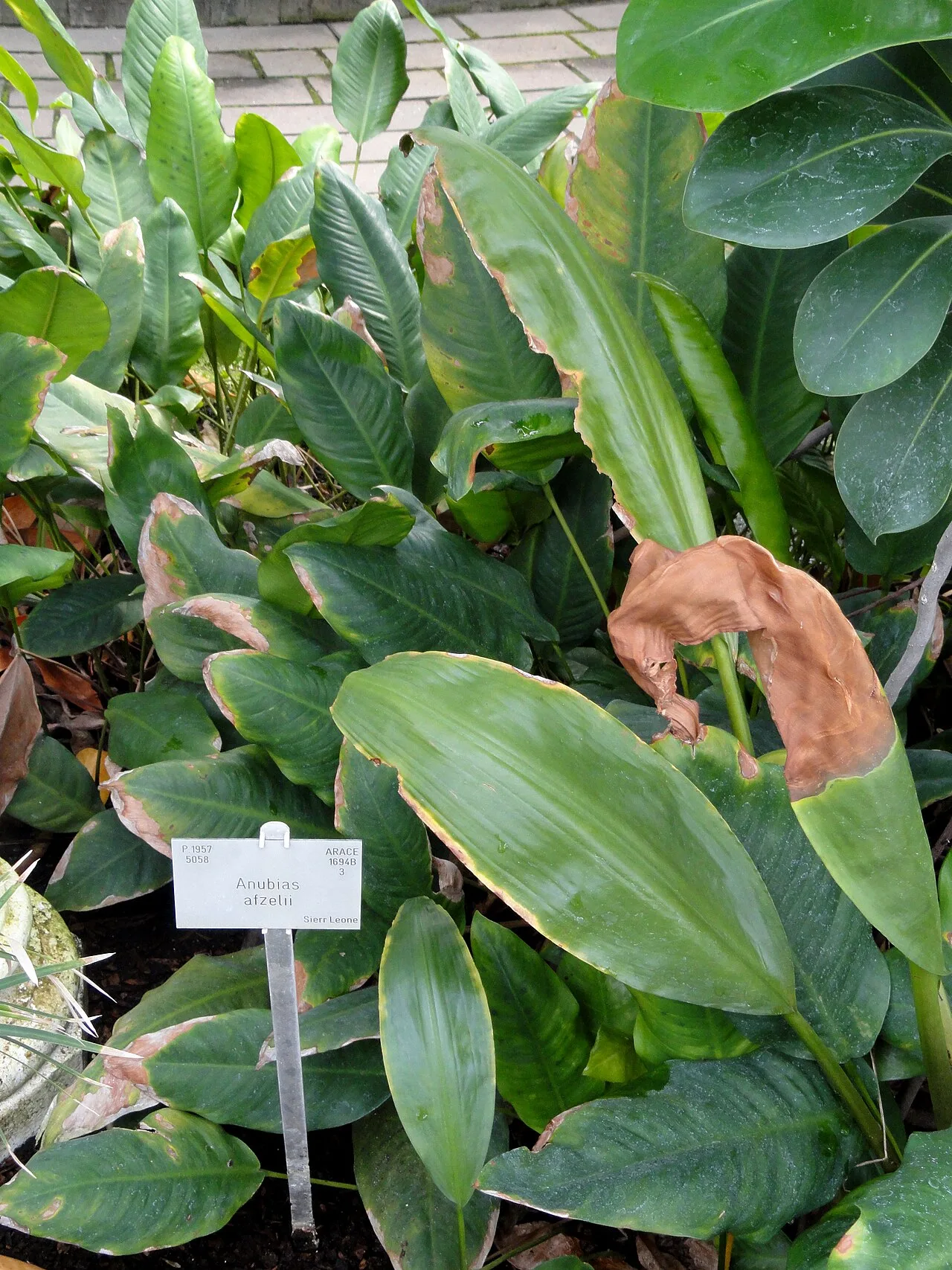
The genus Anubias was described in 1857 by Heinrich Wilhelm Schott. It is the only genus of the tribe Anubiadeae in the arum family. The plants form rhizomes, simple stalked leaves and a spadix with a spathe. Berries follow. Anubias barteri occurs in six varieties. Named are var. barteri, angustifolia, caladiifolia, glabra, nana and cofeifolia. Nana is restricted to Cameroon, barteri to southeastern Nigeria, Cameroon and Bioko. The catalogue lists the species, not one variety. The rhizome must not disappear into the substrate.
Natural origin
This describes the origin, not how to furnish the aquarium.
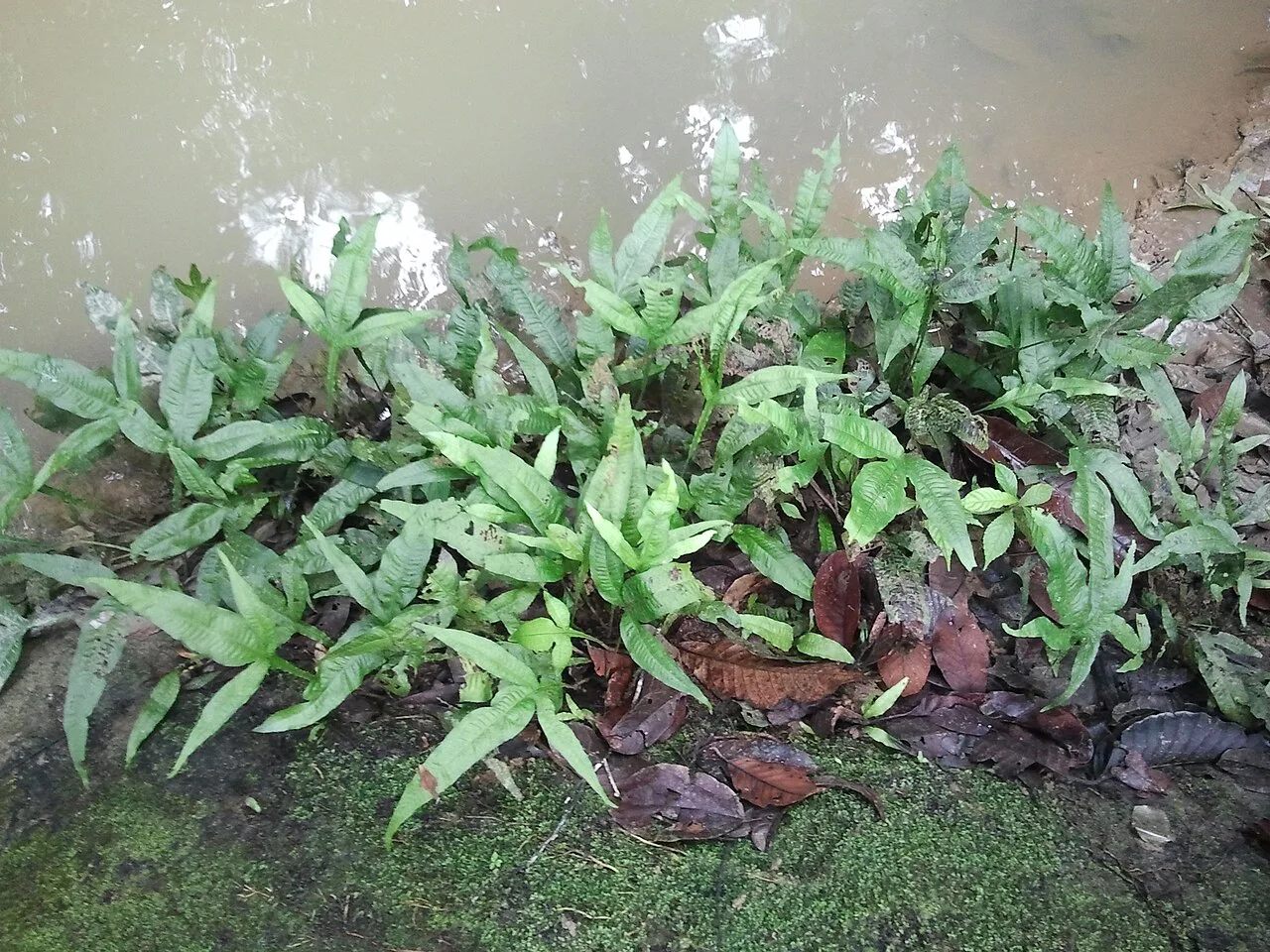
The genus grows in swamps and along water margins of tropical and subtropical West and Central Africa, often in shade, emersed, half-emersed or at times fully submerged. The rhizomes cling to stones or trunks. For the varieties of A. barteri the article names Nigeria, Cameroon, Bioko, Gabon, Guinea, Liberia, Côte d'Ivoire and Congo. Bioko is listed as Equatorial Guinea. “Congo” here is not the Democratic Republic of the Congo, which the article names explicitly for other species.
Light, CO₂ and position
The article calls Anubias tough and usable even under low light. For var. barteri it says the plant thrives in little light, given as 0.25 W/L, and without added CO₂. That is not a PAR figure and not a value for every variety. The older scale “low light”, “CO₂ not required” and 22–28 °C points the same way. The tough leaves are hardly eaten. They are named as decoration for cichlid tanks.
Tying on and light
Anubias belongs on wood or stone, not deep in the gravel. The rhizome stays visible. Only the roots may attach or sit in a crack. Under a floating plant, or in the shade of a sword, the leaf stays dark green and cleaner of algae than directly under a strong lamp. Anyone who turns the lamp up for a Rotala carpet gets brush algae on the Anubias, not a prettier leaf.
Once it has attached, the plant is not moved again. Every removal tears the rhizoids, and the rhizome lies loose again, exactly where mulm rots.
Growth and trimming
Pruning is hardly described. Algae on old leaves do not follow from a separate care guide in this article. The rhizome stays free. The roots can attach.
Trimming and algae
Single old leaves are cut at the rhizome, not torn off. A leaf with brush algae that is otherwise healthy can be wiped. A whole rhizome full of algae is thinned, not poured over with an algaecide. The plant grows so slowly that a lost leaf takes months.
It takes fertiliser in the water column, but it is rarely the first to starve. Yellow leaves are often old leaves, or a rhizome that is stuck in the substrate.
Further care
After rhizomes were divided, losses of dwarf shrimp were occasionally reported. The article presents the thesis that calcium-oxalate crystals from injured cells could be responsible. That is phrased as a thesis, not as a proven mechanism. The advice is to divide outside the tank, rinse the cuts under running water, and more safely soak the pieces for several days before they return.
Propagation
Propagation is by dividing the rhizome. The flowers are inconspicuous and stand in a spadix.
More species in this group
Sources & assertions 1
Wikipedia (deutsch)
Texte in Aquarisma sind eigenständig formuliert. Zahlenbereiche folgen den verlinkten Wikipedia-Artikeln, Lizenz CC BY-SA.
- Haltungsbereich nach https://de.wikipedia.org/wiki/Anubias