
Java fern
Microsorum pteropus
15 views
An epiphytic fern, listed in the article as Leptochilus pteropus. Microsorum pteropus is treated there as outdated. The catalogue name remains Microsorum pteropus.
3 min read · 496 words
Care profile
The care profile is backed by one source.
Lighting
Low lightThe profile says low light.
CO₂
No CO₂Added CO₂ is not required.
Growth rate
SlowThe profile describes slow growth.
Nutrient demand
LowNutrient demand is low.
Beginner friendly
Beginner friendlyThe published judgement is suitable for beginners.
- Attach
- Rhizome
- The rhizome must not disappear into the gravel.
- The rhizome must not disappear into the gravel, or growth stalls and the leaves become smaller and glassy.
Placement in the aquarium
Only the stored position or growth form is highlighted, not every possible layout.
- Midground
- On rock or wood
Home & range
Every named country gets a frame and a circle around known waters in or near that area. Hotspots are orientation, not collection sites. A filled area is the range only when the source names a particular water body.
Botanical overview
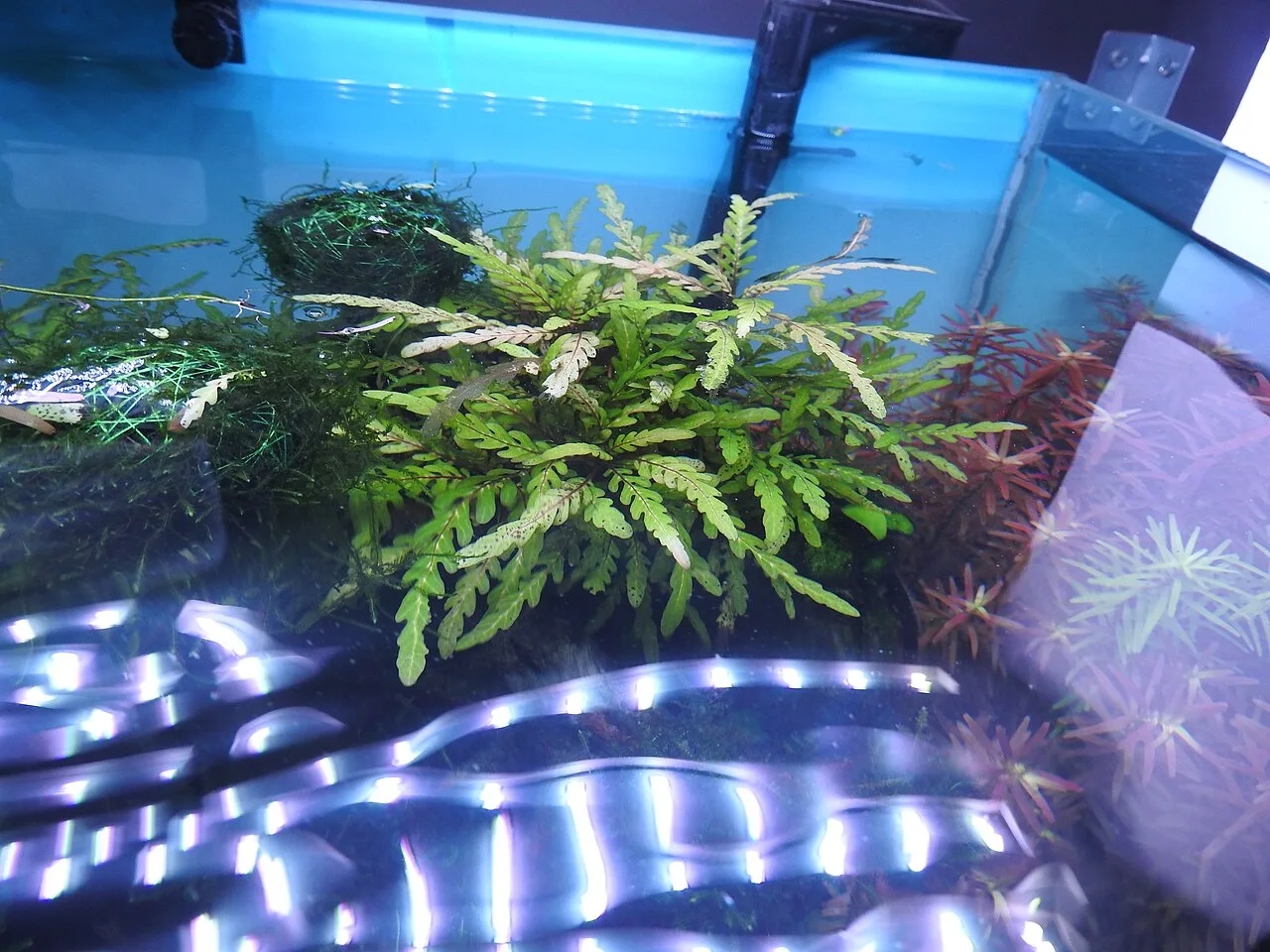
Java fern is an amphibious, variable polypody fern. The rhizome creeps and is densely scaly. The hard leaves reach 21 cm, lanceolate, with an irregularly wavy margin. Young tips are sometimes transparent and colour in within a few weeks. Spores form only above water, in almost round sori about 2 mm across on the leaf underside. The rhizome must not disappear into the gravel.
Natural origin
This describes the origin, not how to furnish the aquarium.
The species is widespread in tropical Asia. It grows in stony rivers and streams, flooded at times, also on the roots of plants standing in water. The distribution paragraph names no individual countries. No country list is built from that. The “philippine” variant is linked with brackish water on Panay, “undulata” presumably with Thailand. Those are variants, not the whole species.
Light, CO₂ and position
The fern is kept on stone or wood. Plants set in gravel decline, and the rhizome grows poorly there. In paludaria a loose substrate can work. It does best in medium-hard to hard water. In soft water fertiliser may be needed. The temperature span in the article is 20 to 28 °C and matches the existing sheet. CO₂ and a light step in the words low, medium or high are not stated that way. The older rating “low light” and “CO₂ not required” remains the previous sheet.
Rhizome and forms
Java fern is tied on or wedged into a crack. The rhizome must not disappear into the gravel, or growth stalls and the leaves become smaller and glassy. Windelov, narrow leaf and other trade forms differ in leaf width and in the tip. They are not separate species and want the same care: low to medium light, clean water, patience.
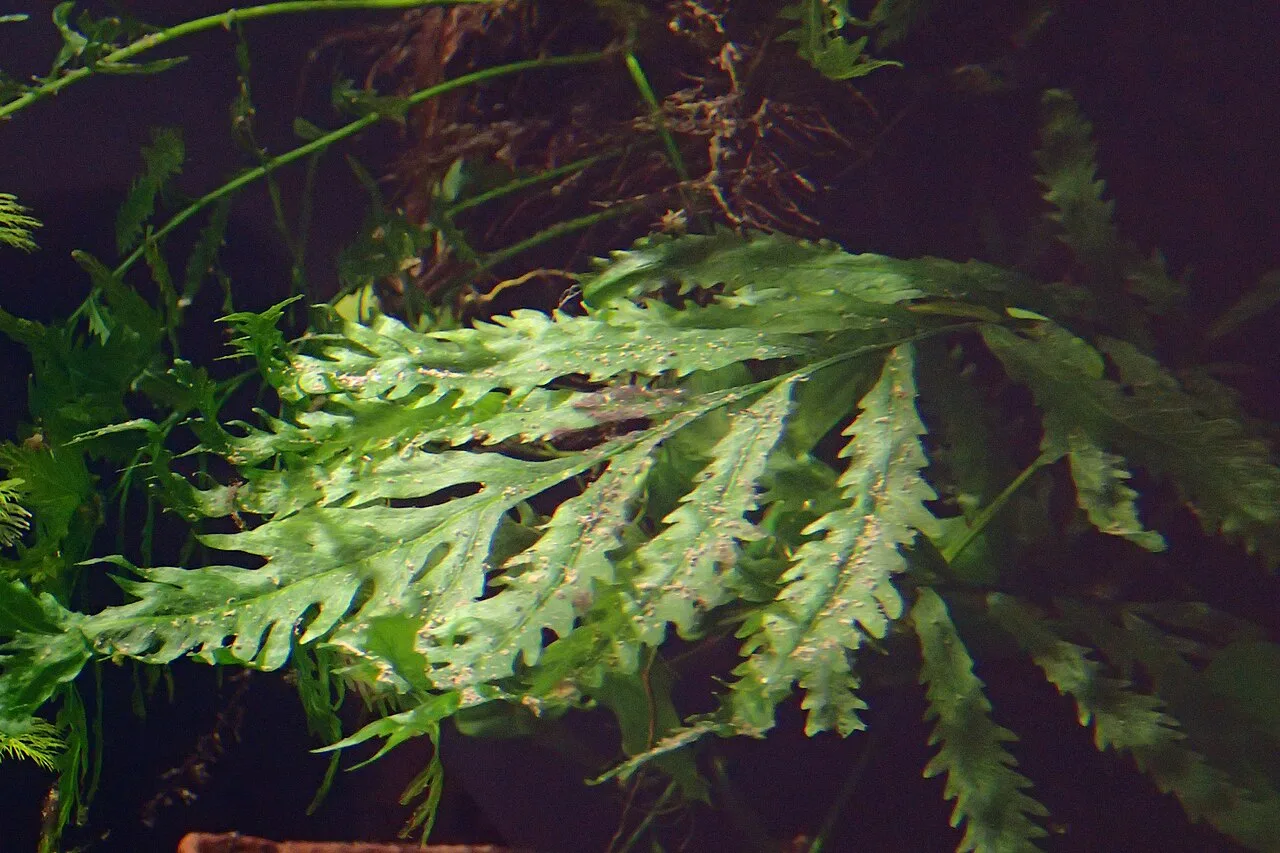
Young plants appear as dark dots on older leaves. The leaf may stay until the plantlets have their own rhizomes. Then they are taken off and tied on again.
Growth and trimming
Old leaves are taken off at the rhizome. Cultivars differ in leaf size. “Windelov” stays smaller, with branched tips and 10 to 20 cm, and like “Tropica” is under variety protection of the firm Tropica. “Tropica” is described at 15 to 50 cm with deeply lobed leaves. “Narrow leaf” reaches about 1.5 cm leaf width, “needle leaf” 5 to 7 mm. Trade names separate these forms. They are not separate species in the catalogue.
Old leaves
Black, holed or heavily algal leaves are cut at the rhizome. The rhizome itself stays. Clearing every leaf at once sets the plant back, but it is better than a rhizome that can no longer be seen under a cover of algae. Fertilising is sparing. The fern does not show overfeeding as faster growth, but as algae on the tough surfaces.
Further care
Plantlets form on old leaves. For “undulata”, no sporangia are said to have been seen in aquarium culture so far, but especially many plantlets on the leaves. Young leaves of the “red” form are brown-red and later turn green.
Propagation
Propagation in the aquarium runs through plantlets on the leaves and division of the rhizome. Sexual reproduction by spores is tied to the emersed form.
More species in this group
Sources & assertions 1
Wikipedia (deutsch)
Texte in Aquarisma sind eigenständig formuliert. Zahlenbereiche folgen den verlinkten Wikipedia-Artikeln, Lizenz CC BY-SA.
- Haltungsbereich nach https://de.wikipedia.org/wiki/Javafarn