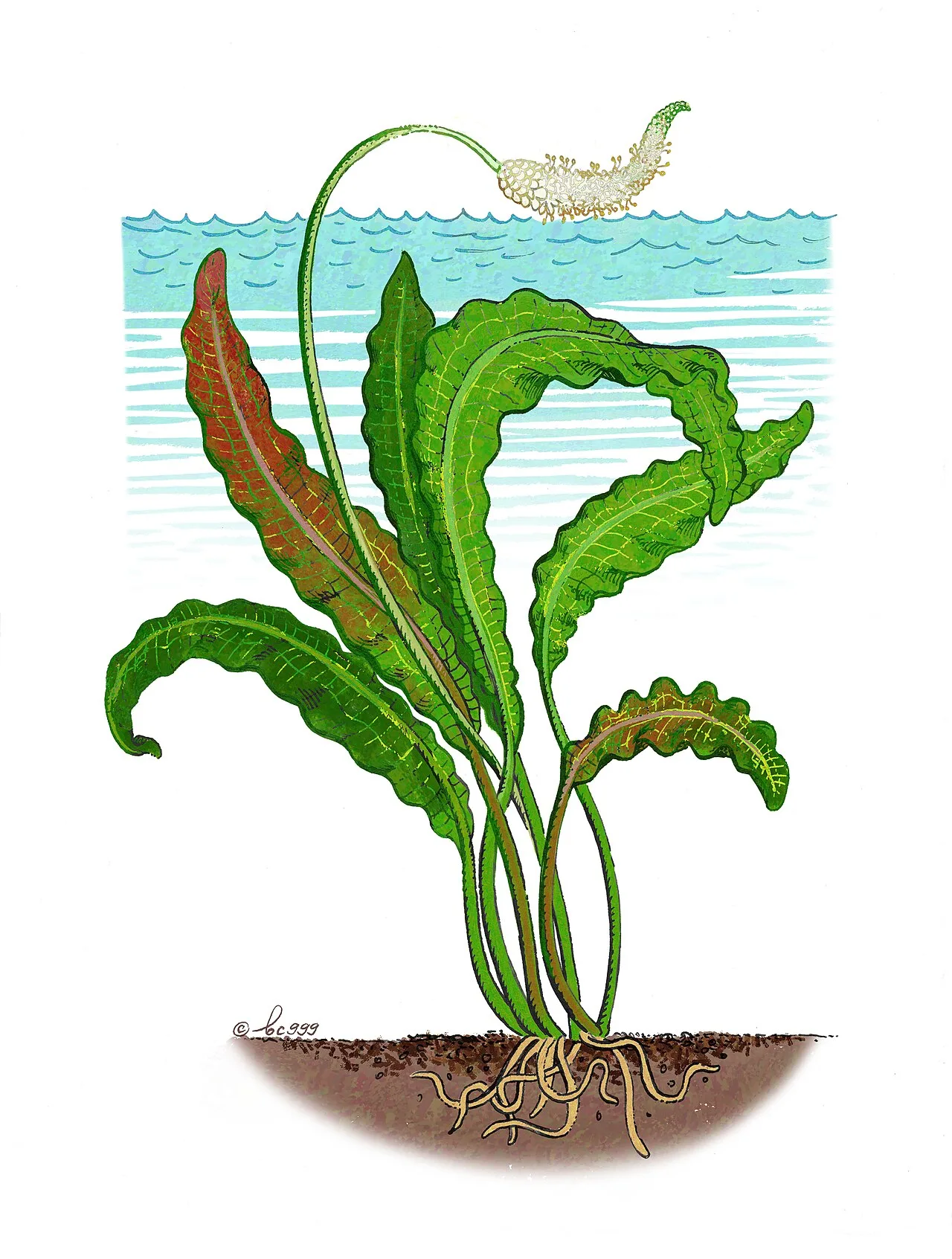
Japanese sweet flag
Acorus gramineus
5 views
A marsh plant from East Asia with narrow, grass-like leaves. Only lasts a limited time under water and belongs in a paludarium.
- Temperature
- 15 – 25 °C
- pH
- 6 – 8 pH
- Lighting
- Medium light
- CO₂
- No CO₂
- Growth rate
- Slow
- Placement
- Foreground
1 min read · 113 words
Care profile
Growth form
RosettesPlanting and propagation
- Rhizome The creeping rhizome stays free above the substrate. Buried, it rots.
Placement in the aquarium
Highlighted are the areas where the species is typically used.
- Foreground At the front of the tank, where the plant stays low and keeps the view open.
Home & range
Hatched countries are where the species occurs. It lives in particular waters there, not across the whole country. The points name known waters for orientation, not collection sites.
- Country of origin
- Water for orientation
Native
Botanical overview
Acorus gramineus forms fans of narrow, leathery leaves. Dwarf forms stay below 10 cm. It is often sold as an aquarium plant but is a marsh plant that slowly dies when kept permanently submersed.
In a paludarium, on the bank or emersed in a riparium it is long-lived.
Natural origin
This describes the origin, not how to furnish the aquarium.
The species comes from East Asia: Japan, Korea, China, Taiwan and Indochina. It grows on stream banks and in damp rock crevices.
Light, CO₂ and position
Light
Medium light.
Temperature
15 to 25 °C.
Position
Bank area, emersed.
Layout and neighbours
In a paludarium or on the bank of a riparium. The dwarf forms suit aquaterrariums.
Common mistakes
Kept permanently submersed it dies after months.
Growth and trimming
Slow growth. Only temporary under water.