Java fern
Microsorum pteropus
23 views
An epiphytic fern, now listed botanically as Leptochilus pteropus. Microsorum pteropus is treated as an outdated name that is still common in the trade.
- Temperature
- 20 – 28 °C
- pH
- 5.5 – 8 pH
- Lighting
- Low light
- CO₂
- No CO₂
- Growth rate
- Slow
- Placement
- Midground
3 min read · 467 words
Care profile
Growth form
EpiphytesPlanting and propagation
- Attach Fix it to wood or stone with cotton thread, fishing line or plant glue. The roots attach on their own after a few weeks.
- Rhizome The creeping rhizome stays free above the substrate. Buried, it rots.
- Adventitious plantlets Forms daughter plants on leaves or rhizome. Remove them once they carry a few roots.
Placement in the aquarium
Highlighted are the areas where the species is typically used.
- Midground Between foreground and background. Hides transitions and frames stones and wood.
- On rock or wood Tied onto wood or stones rather than planted in the substrate.
Home & range
Hatched countries are where the species occurs. It lives in particular waters there, not across the whole country. The points name known waters for orientation, not collection sites.
- Country of origin
- Water for orientation
Native
Botanical overview
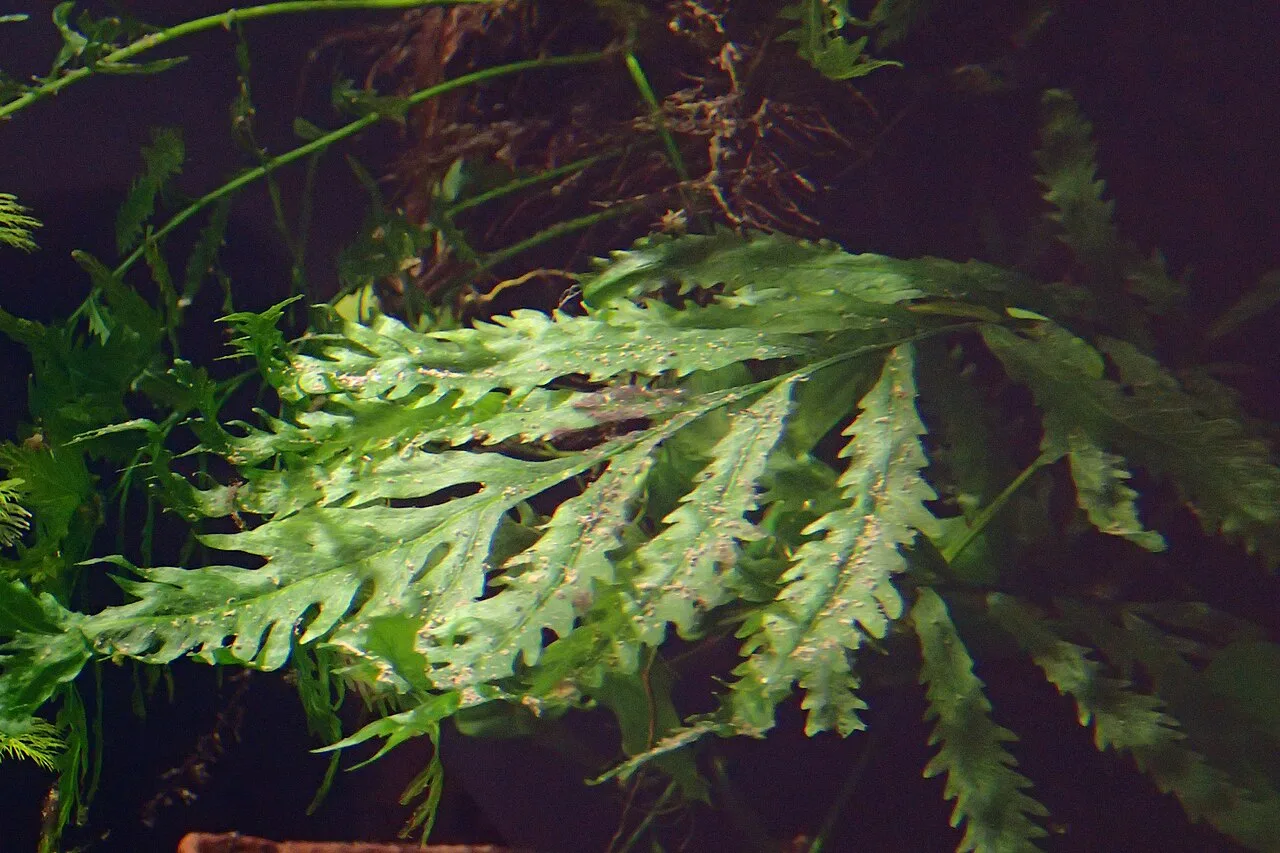
Java fern is an amphibious, variable polypody fern. The rhizome creeps and is densely scaly. The hard leaves reach 21 cm, lanceolate, with an irregularly wavy margin. Young tips are sometimes transparent and colour in within a few weeks. Spores form only above water, in almost round sori about 2 mm across on the leaf underside. The rhizome must not disappear into the gravel.
Natural origin
This describes the origin, not how to furnish the aquarium.
The species is widespread in tropical Asia. It grows in stony rivers and streams, flooded at times, also on the roots of plants standing in water. The distribution paragraph names no individual countries. No country list is built from that. The “philippine” variant is linked with brackish water on Panay, “undulata” presumably with Thailand. Those are variants, not the whole species.
Light, CO₂ and position
The fern is kept on stone or wood. Plants set in gravel decline, and the rhizome grows poorly there. In paludaria a loose substrate can work. It does best in medium-hard to hard water. In soft water fertiliser may be needed. It grows at 20 to 28 °C. The rating “low light” and “CO₂ not required” suits it.
Rhizome and forms
Java fern is tied on or wedged into a crack. The rhizome must not disappear into the gravel, or growth stalls and the leaves become smaller and glassy. Windelov, narrow leaf and other trade forms differ in leaf width and in the tip. They are not separate species and want the same care: low to medium light, clean water, patience.
Young plants appear as dark dots on older leaves. The leaf may stay until the plantlets have their own rhizomes. Then they are taken off and tied on again.
Growth and trimming
Old leaves are taken off at the rhizome. Cultivars differ in leaf size. “Windelov” stays smaller, with branched tips and 10 to 20 cm, and like “Tropica” is under variety protection of the firm Tropica. “Tropica” is described at 15 to 50 cm with deeply lobed leaves. “Narrow leaf” reaches about 1.5 cm leaf width, “needle leaf” 5 to 7 mm. Trade names separate these forms. They are not separate species in the catalogue.
Old leaves
Black, holed or heavily algal leaves are cut at the rhizome. The rhizome itself stays. Clearing every leaf at once sets the plant back, but it is better than a rhizome that can no longer be seen under a cover of algae. Fertilising is sparing. The fern does not show overfeeding as faster growth, but as algae on the tough surfaces.
Further care
Plantlets form on old leaves. For “undulata”, no sporangia are said to have been seen in aquarium culture so far, but especially many plantlets on the leaves. Young leaves of the “red” form are brown-red and later turn green.
Propagation
Propagation in the aquarium runs through plantlets on the leaves and division of the rhizome. Sexual reproduction by spores is tied to the emersed form.