Utricularia graminifolia
Utricularia graminifolia
21 views
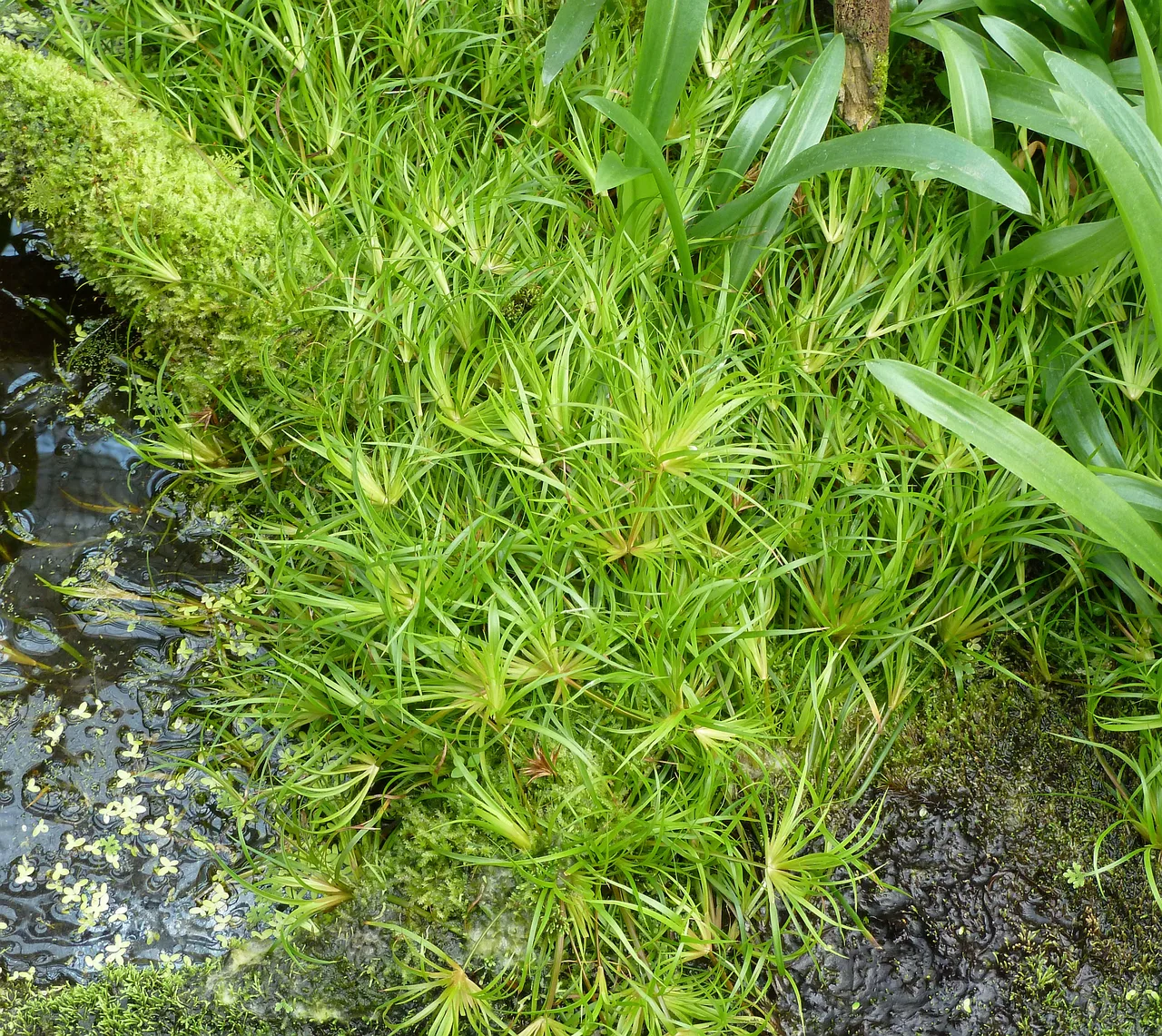
A fine-leaved ground cover that first attaches and then forms a lawn. It is not a grass and not hairgrass.
- Temperature
- 20 – 26 °C
- pH
- 5.5 – 7 pH
- Lighting
- High light
- CO₂
- High CO₂
- Growth rate
- Medium
- Placement
- Foreground
3 min read · 375 words
Care profile
Growth form
Ground coverPlanting and propagation
- Attach Fix it to wood or stone with cotton thread, fishing line or plant glue. The roots attach on their own after a few weeks.
- Cuttings Cut off shoot tips and replant them. This keeps the stand dense and propagates it at the same time.
- Runners Forms runners in the substrate that grow into new plants. Separate them once they have their own roots.
Placement in the aquarium
Highlighted are the areas where the species is typically used.
- Foreground At the front of the tank, where the plant stays low and keeps the view open.
- Ground cover Spreads flat over the ground and can form a closed lawn.
Home & range
Hatched countries are where the species occurs. It lives in particular waters there, not across the whole country. The points name known waters for orientation, not collection sites.
- Country of origin
- Water for orientation
Native
Botanical overview
Utricularia graminifolia sends thread-fine, pale green leaves and a creeping shoot. Small bladders sit on the shoots, with which the plant catches tiny animals. That is the biology of a bladderwort and not a reason to fear it as a fish-eating plant. The bladders are too small for fish and shrimp.
A freshly set pot often looks unchanged for weeks or even partly comes apart. Afterwards, when the values are stable, the plant closes areas faster than the first impression suggests.
Natural origin
This describes the origin, not how to furnish the aquarium.
Damp, nutrient-poor to moderately rich banks and shallows in Asia, often on poor soils. Asia stays the coarse origin. In the aquarium it grows denser on a leaner substrate and with CO₂ than on a heavily fertilised soil under a weak lamp.
Light, CO₂ and position
The start
High light, CO₂, 20 to 26 °C. Set it in small portions on the foreground, with the rock wool completely removed. Do not fertilise the first period like a Rotala bush. Too much nitrate at the start and an unsettled water change are the common reasons the portions fall apart.
After it attaches
Once the carpet is running, it grows into the neighbouring areas. Tall plants that cast shade hold it back. So does a dense floating cover. Shrimp and small fish bother it little. Digging corydoras lift it off.
Layout and neighbours
In good conditions it forms a dense, grassy carpet. It is carnivorous and traps tiny animals in bladders.
Common mistakes
Unsuitable in breeding tanks with fish larvae.
Growth and trimming
Threads that are too long are shortened like a fine lawn once the area can carry it. Before that it is left alone. Yellow, mushy patches are siphoned and replaced by a healthy runner from the edge. The plant takes little fertiliser. A normal complete fertiliser in a low dose is enough. A shock dose sets it back.\n\nAlgae in the attaching phase often mean too much light on too little plant mass. Then shorten the lighting period until the area is denser, instead of adding still more fertiliser.
Propagation
Separate runners a few centimetres long and lay them on the substrate or press them lightly. They attach by themselves. A classic cutting with a node in the gravel is unnecessary and often the reason the shoots float up.