
Scarlet badis
Dario dario
25 views
A very small perch-like fish from India. The males are patterned red and blue and need a quiet species tank with fine food.
- Temperature
- 22 – 26 °C
- pH
- 6.5 – 7.5 pH
- General hardness
- 5 – 15 °dH
- Maximum size
- 2.5 cm
- Minimum tank size
- 30 L
3 min read · 452 words
Fresh water
Quick facts
Place in the aquarium
Highlighted are the water layer and the spots where the species usually stays in the tank.
- Near the bottom Mostly stays just above the bottom. Food has to reach the substrate.
- Dense plants Looks for dense planting as cover, retreat or grazing ground.
Shrimp in the tank
Shrimplets at risk
- Not shrimp safe
- Dwarf shrimp at risk
- Shrimplets at risk
- Shrimp safe
- Adult dwarf shrimp
- Safe
- Shrimplets
- Get eaten
- Safe from shrimp size
- about 1 cm
Adult shrimp are safe with the scarlet badis. It stays below 2 cm and eats very small invertebrates. Shrimp from about 1 cm are too large for it. Newly hatched shrimp, on the other hand, are exactly its prey.
The males defend small territories and may harass shrimp in the process. Dense plants, moss and leaf litter soften this and protect the young. Since the species needs fine live food, the tank should not hold so many shrimp that they eat the food first.
Home & range
Hatched countries are where the species occurs. It lives in particular waters there, not across the whole country. The points name known waters for orientation, not collection sites.
- Country of origin
- Water for orientation
Native
Overview
Dario dario stays at about 2.5 cm. The males wear red bars on a blue ground and a deeper body. The females are smaller and grey-brown. The species is not a dwarf cichlid of the genus Apistogramma, even though it shows a territory at a cave in a similar way. It rarely eats flakes and starves in a tank where only dry food arrives.
In the shop the males often look pale. The colour comes in dim light, with hiding places and without large tankmates.
Name and size
Francis Buchanan-Hamilton described the species in 1822. Besides Zwergblaubarsch it is also called Bengal dwarf badis or scarlet badis. It belongs to the badids (Badidae).
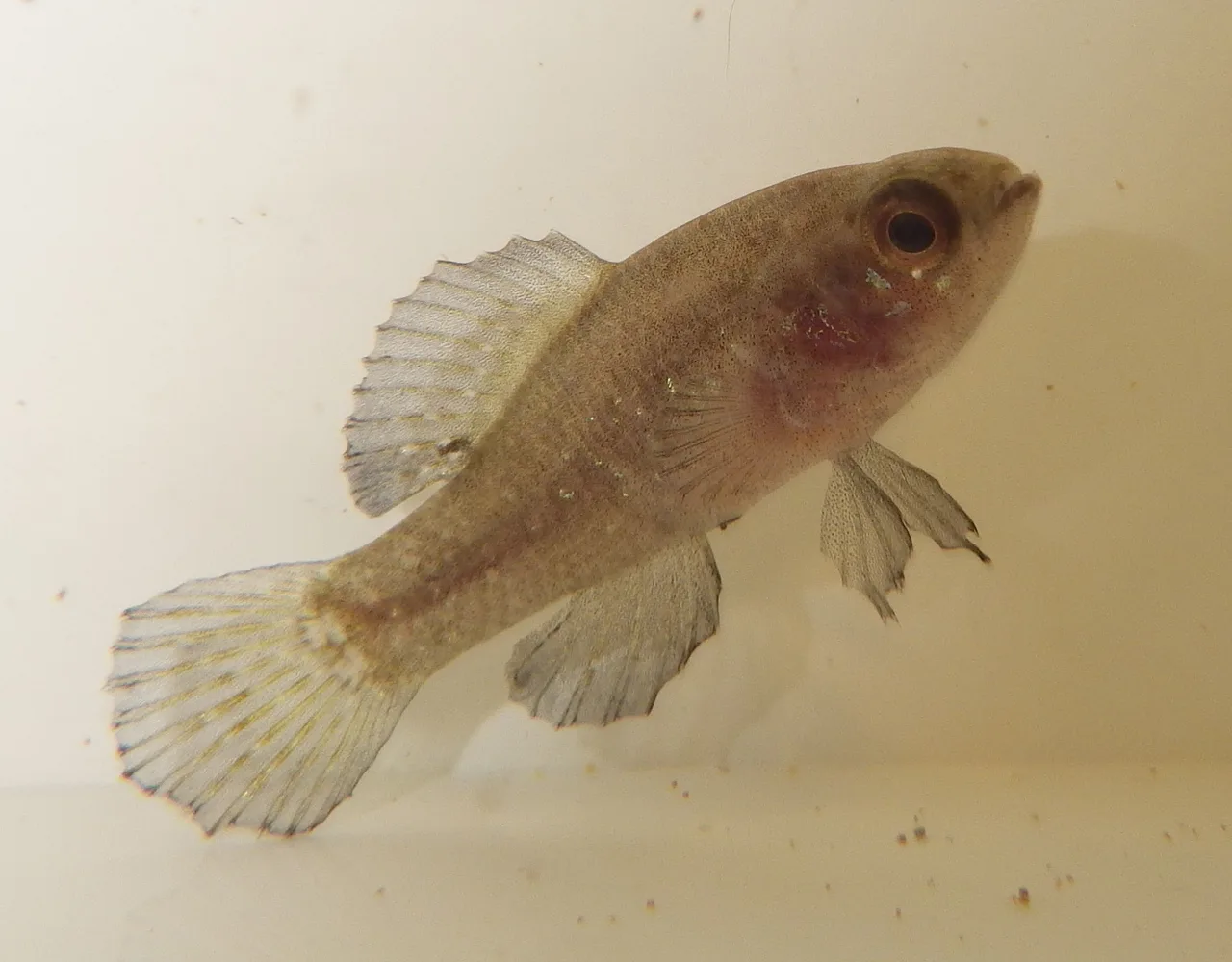
The species stays below 2 cm. The largest wild-caught male measured 14.8 mm, the largest female 13 mm, and aquarium-raised fish grew to 17.2 mm. The body is moderately elongated, the head round, the snout short and the large mouth slightly upturned. A short spine on the gill cover is usually hidden under a scale. Males carry seven vertical blue stripes on a reddish ground and blue-red fins. Females are grey with more or less visible dark barring and transparent fins.
Origin & habitat
This describes the origin, not how to furnish the aquarium.
Small, slow waters in West Bengal and the neighbouring areas, with a fine bottom and plants. India stays the coarse origin. The water is not extremely hard and not a Malawi tank.
The species lives in north-eastern India, in Bihar, West Bengal and western Assam, in small rivers and ponds over sand or fine gravel, densely grown with Limnophila, Hygrophila, Vallisneria, Ottelia and Rotala.
Care
Layout
22 to 26 °C, pH 6.5 to 7.5. From about 30 litres for one male with several females, dense growth, leaf litter, small caves, fine sand, little current. Several males only with visual barriers and more floor area.
Company
Best without fast fish. Shrimp can work, but the males sometimes harass them. Tetras take the food before the scarlet badis sees it. A species tank is the honest keeping.
Diet
Live food and frozen food that lands in front of the fish. Brine shrimp, cyclops, microworms. Dry food is often ignored. Feed with tweezers or a pipette at the territories. Several tiny feeds a day.
In the wild the species eats very small invertebrates.
Behavior
The males hold small territories and spread the fins. That is normal. A female that cannot get away is courted to death. Then hiding places are missing, not the colour in the food. The fish stand on the bottom and in the plants, not in an open school.
Reproduction
The female lays the eggs in a small cave or under a leaf. The male guards them briefly. The larvae are tiny. In a species tank with moss a few survive. Deliberate rearing needs infusoria and quiet.
Gallery
More species in this group

Similar water needs
Species with a similar temperature, a similar pH and a comparable adult size. Whether their behaviour fits as well is what the compatibility check is for.

