Banded archerfish
Toxotes jaculatrix
28 views
It shoots insects off bank plants with a jet of water. About 20 cm and up to twelve years. Coastal brackish water.
- Temperature
- 25 – 30 °C
- pH
- 7 – 8.5 pH
- General hardness
- 18 – 30 °dH
- Maximum size
- 20 cm
- Minimum tank size
- 300 L
3 min read · 496 words
Quick facts
Further published values
- Lifespan
- 12 a
Place in the aquarium
Highlighted are the water layer and the spots where the species usually stays in the tank.
- Water surface Stays just below the surface. The top needs a calm current and a cover.
- Upper water Usually stays in the top third of the tank.
Shrimp in the tank
Not shrimp safe
- Not shrimp safe
- Dwarf shrimp at risk
- Shrimplets at risk
- Shrimp safe
- Adult dwarf shrimp
- At risk
- Shrimplets
- Get eaten
- Safe from shrimp size
- No size is safe
The banded archerfish is not a shrimp companion. It grows to about 20, at most 30 cm, and besides insects it shoots down from branches it also eats crustaceans and small fish under water.
Shrimp of every size are eaten. There is no safe shrimp size. In addition, the species lives in brackish water, which is unsuitable for most freshwater shrimp. Shrimp belong in a tank of their own. Even putting them together for a while, for example to clean algae, is not a good idea, because added shrimp are quickly recognised as food. A small separate tank with moss and leaf litter is the most reliable solution for a stable shrimp colony and needs little effort to run.
Home & range
Hatched countries are where the species occurs. It lives in particular waters there, not across the whole country. The points name known waters for orientation, not collection sites.
- Country of origin
- Water for orientation
Native
Overview
An almost straight forehead-to-back line, superior mouth. The eyes stay under water and the refraction is allowed for.
Features
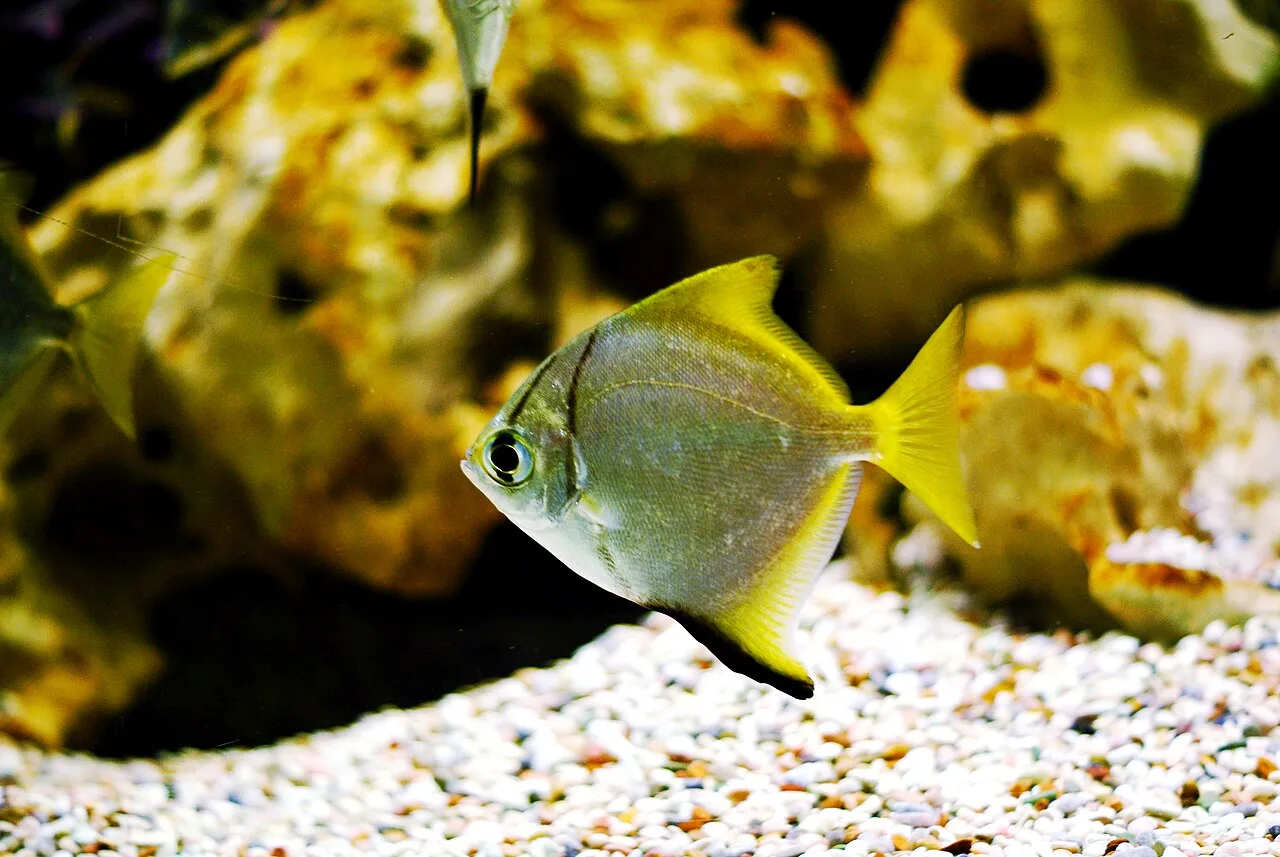
The banded archerfish grows on average to about 20 cm, at most 30 cm, and lives up to 12 years. The profile from forehead to back is almost straight, the mouth is upturned, and the large eyes allow binocular vision. The body is silvery white with four to six broad black bars on the upper side, which shorten with age. The back is olive green or brown. There are no external sex differences. The largescale archerfish has five dorsal spines and six or seven spots, and in the smallscale archerfish the bars do not reach the dorsal fin.
Pallas described the species in 1767 as Sciaena jaculatrix. Toxotes is Greek for archer, and jaculatrix means she who throws. The IUCN lists it as least concern, while mangrove destruction and pollution are named as threats.
Origin & habitat
This describes the origin, not how to furnish the aquarium.
Near the coast from the Red Sea through India, China, Thailand and the Philippines to Australia, mainly estuaries and mangrove lagoons. The named states stay coarse. The Red Sea is not a state.
The species lives in tropical coastal waters from the Red Sea through India, China, Thailand and the Philippines to Australia, also around the Solomon Islands, the Indonesian archipelago and Vanuatu. It lives mainly in brackish estuaries and lagoons of mangroves, occasionally moves up rivers and likes to stay under overhanging vegetation. The tides bring 23 to 28 °C and changing salinity.
Care
25 to 30 °C. The tank about 2 m long and only one third full, so insects have room above the water. Two metres are not converted to litres.
The species is kept at 25 to 30 °C in brackish water. A tank about 2 m long filled only to one third, or at least 170 to 210 litres, is recommended, with a tall cover, because the fish jump. They are kept in small groups of three to five, because they compete for food. Almost all fish in the trade are wild-caught, and the first rearing succeeded in 2011 at the Wilhelma zoo.
Diet
Insects, which it shoots off plants and quickly secures as its own prey.
The species eats mainly live insects that fall into the water, plus plant parts, crustaceans and small fish.
Behavior
The shot
To shoot, the fish raises itself almost vertically, presses its tongue against the palate and so forms a tube. By closing the gill covers quickly it fires a jet of water. Most hit up to 150 cm, large fish up to 2 to 3 m. It adjusts the amount of water to the size of the prey. The technique is learned, and watching other fish improves accuracy.
Trained fish hit moving targets more than half the time. Within 100 ms of the hit the fish starts swimming to the landing spot. When other fish are present it shoots more slowly and from closer range.
Reproduction
A school size is missing.
Little is known about reproduction in the wild. The fish mature at about 10 cm, and each spawning produces 20,000 to 150,000 eggs.
Gallery
More species in this group
Similar water needs
Species with a similar temperature, a similar pH and a comparable adult size. Whether their behaviour fits as well is what the compatibility check is for.