Salmon-red rainbowfish
Glossolepis incisus
17 views
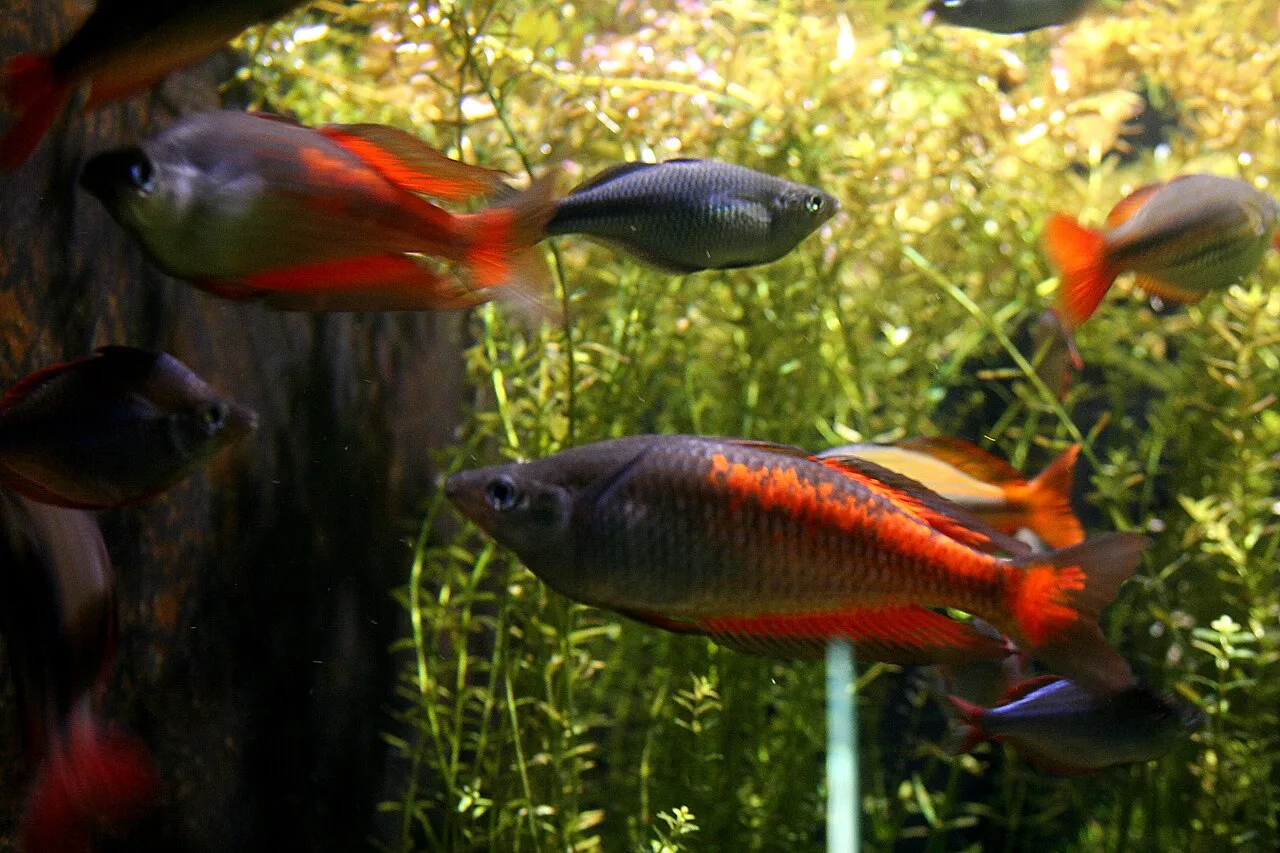
A rainbowfish from Lake Sentani. Males reach 15 cm and turn carmine.
- Temperature
- 29 – 30 °C
- pH
- 7.6 – 8.2 pH
- General hardness
- 10 – 20 °dH
- Maximum size
- 15 cm
- Minimum group size
- 6
- Minimum tank size
- 300 L
3 min read · 366 words
Fresh water
Quick facts
Place in the aquarium
Highlighted are the water layer and the spots where the species usually stays in the tank.
- Upper water Usually stays in the top third of the tank.
- Middle water Usually stays in the middle of the tank, between bottom and surface.
- Open swimming space Needs an open area without plants or decor to swim at length. Tank length matters more than height.
Shrimp in the tank
Dwarf shrimp at risk
- Not shrimp safe
- Dwarf shrimp at risk
- Shrimplets at risk
- Shrimp safe
- Adult dwarf shrimp
- At risk
- Shrimplets
- Get eaten
- Safe from shrimp size
- about 4 cm
The red rainbowfish is risky for dwarf shrimp. Males grow to 15 cm, and the species eats somewhat more animal food than most rainbowfishes. Young shrimp and smaller adult dwarf shrimp are therefore easily eaten. Larger shrimp from about 4 cm, such as Amano shrimp, are usually safe. The active groups need large tanks with plenty of open space, which offers small shrimp little protection. Dwarf shrimp are better kept separately, while larger shrimp can suit with dense planting.
Home & range
The filled area shows the water body the species comes from.
- Named water body
- Water for orientation
Water bodies
- Lake Sentani
- The origin text names Lake Sentani near Jayapura. The shape is the OpenStreetMap outline of that lake, not an extended species range.
Overview
Adult males are carmine on the body and fins, with silver scales. The top-ranking male is often the most intense. Females are yellowish olive with gold scales and clear fins, and they stay smaller. Male colour starts at about 5 cm and is complete around 8 cm. Juveniles are weakly olive.
Classification and name
The red rainbowfish is one of the largest rainbowfishes and belongs to the family Melanotaeniidae. Max Weber described it in 1907. It is the type species of the genus Glossolepis. The specific name is almost always misspelt as incisus. Because the genus name is feminine, the correct form is incisa.
Features
Males are deeper-bodied than females and develop the high back with age. The colour changes with mood, and subordinate males do not show the bright red. The fish grow up to 15 cm, but typically about 12 cm. Today the species is bred commercially worldwide, including fish without silver scales, piebald varieties and hybrids.
Origin & habitat
This describes the origin, not how to furnish the aquarium.
The species lives only in Lake Sentani, about one hundred square kilometres, west of Jayapura in West Papua. Fish gather in large groups along the shore near plants or sunken branches. At the surface 29 to 32 °C and pH 6.2 to 6.8 were measured. Those are lake measurements, not an aquarium recommendation.
Threats
The species lives in Lake Sentani and its tributaries near Jayapura, where the related Chilatherina sentaniensis also occurs. The IUCN lists it as endangered. The human population around the lake is growing fast and increasingly pollutes the water, and introduced species such as tilapia add to the pressure. At local markets the fish has limited importance as food.
Care
Adult males reach 15 cm.
In the early 1970s the aquarists A. Werner and E. Frech brought live fish to Germany and bred them. Because of their size and the at times territorial behaviour of the males, the species should be kept in groups in larger aquariums.
Diet
The species is an omnivore and readily takes most common aquarium foods. It eats somewhat more animal food than most Australian rainbowfishes.
Reproduction
The sexes are clearly distinct.
The red rainbowfish is an egg scatterer and spreads its eggs among clumps of plants. The larvae hatch after about seven days. In captivity breeding is regarded as easy.
Gallery
More species in this group

Similar water needs
Species with a similar temperature, a similar pH and a comparable adult size. Whether their behaviour fits as well is what the compatibility check is for.