
Zebrafish
Danio rerio
10 views
Striped schooling fish from the Ganges basin. It tolerates cooler water than many tropical fish and is a laboratory animal.
2 min read · 238 words
Quick facts
The profile values are backed by one source.
Home & range
Every named country gets a frame and a circle around known waters in or near that area. Hotspots are orientation, not collection sites. A filled area is the range only when the source names a particular water body.
Coarse origin
The circle sits around the country or, a little wider, around known waters there. The points are orientation, not collection sites.
- Pakistan Wikipedia deutsch
- India Wikipedia deutsch
- Nepal Wikipedia deutsch
- Bangladesh Wikipedia deutsch
- Pakistan Coarse region of origin
- India Coarse region of origin
- Nepal Coarse region of origin
- Bangladesh Coarse region of origin
Overview
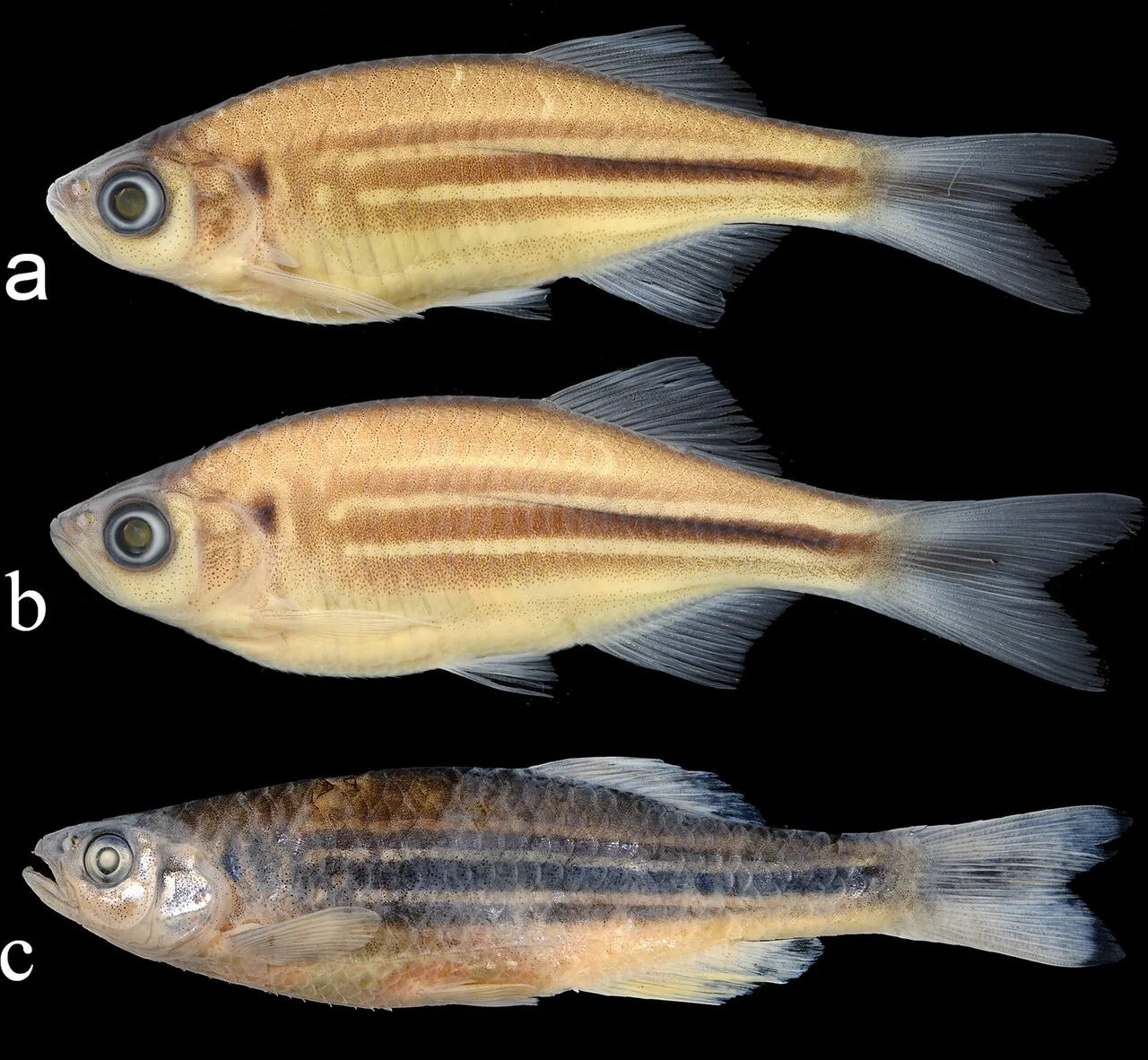
The species reaches 5 cm. Olive-brown back, yellow-white belly, blue-iridescent black stripes from the gill cover into the tail. Two pairs of barbels. Females are deeper, a little larger and paler. The leopard danio is a mutant in which the stripes break into spots, not a separate species. A visible lateral line is absent. Cover the tank, because the fish jump.
Origin & habitat
This describes the origin, not how to furnish the aquarium.
The article names the Ganges drainage in Pakistan, northern India, southern Nepal and Bangladesh, slow or still water and rice fields. Those four countries are a coarse origin and are not filled. Records in the United States are traced to fish farms and are not mapped.
Care
Keeping is possible from about 18–20 °C. The sheet stays at 18–25 °C. Outside 25–31 °C the fish do not breed, or breed less. The warmer window is reproduction, not general keeping. Groups of at least eight are.
Diet
Omnivore. Flakes and small frozen food are the practical feeding. The article itself does not list those foods.
Behavior
A peaceful school that can be kept with other tankmates. Keeping a single fish contradicts the group size in the article.
Reproduction
Egg scatterer without brood care. In good conditions a female lays up to 300 eggs a week. The embryos develop outside the body and are transparent. The fish mature at twelve to sixteen weeks. That explains the use as a laboratory animal. It is not an instruction to turn a community tank into a breeding setup.
More species in this group
Sources & assertions 2
Wikipedia (deutsch)
Texte in Aquarisma sind eigenständig formuliert. Zahlenbereiche folgen den verlinkten Wikipedia-Artikeln, Lizenz CC BY-SA.
- Haltungsbereich nach https://de.wikipedia.org/wiki/Zebrab%C3%A4rbling
Wikipedia
Texte in Aquarisma sind eigenständig formuliert. Zahlen folgen dem genannten Artikel, Lizenz CC BY-SA. Deutsch und Englisch sind dieselbe Enzyklopädie, keine zweite unabhängige Quelle.
- Haltung ist ab etwa 18 bis 20 °C möglich. Außerhalb von 25 bis 31 °C vermehren sich die Tiere nicht oder nur eingeschränkt.
- Der Artikel empfiehlt Gruppen von mindestens acht Tieren.