Dwarf pencilfish
Nannostomus marginatus
17 views
A very small pencilfish with three dark longitudinal stripes. It stands quietly among plants and needs fine food.
- Temperature
- 23 – 28 °C
- pH
- 5.5 – 7 pH
- General hardness
- 1 – 10 °dH
- Maximum size
- 3 cm
- Minimum group size
- 8
- Minimum tank size
- 50 L
3 min read · 456 words
Fresh water
Quick facts
Place in the aquarium
Highlighted are the water layer and the spots where the species usually stays in the tank.
- Middle water Usually stays in the middle of the tank, between bottom and surface.
- Dense plants Looks for dense planting as cover, retreat or grazing ground.
Shrimp in the tank
Shrimplets at risk
- Not shrimp safe
- Dwarf shrimp at risk
- Shrimplets at risk
- Shrimp safe
- Adult dwarf shrimp
- Safe
- Shrimplets
- Get eaten
- Safe from shrimp size
- about 1 cm
The dwarf pencilfish is harmless to adult shrimp. It grows 3 to 4 cm long, is one of the smallest of its genus and needs fine food. Shrimp from about 1 cm do not fit its small mouth. Newly hatched shrimp may be eaten.
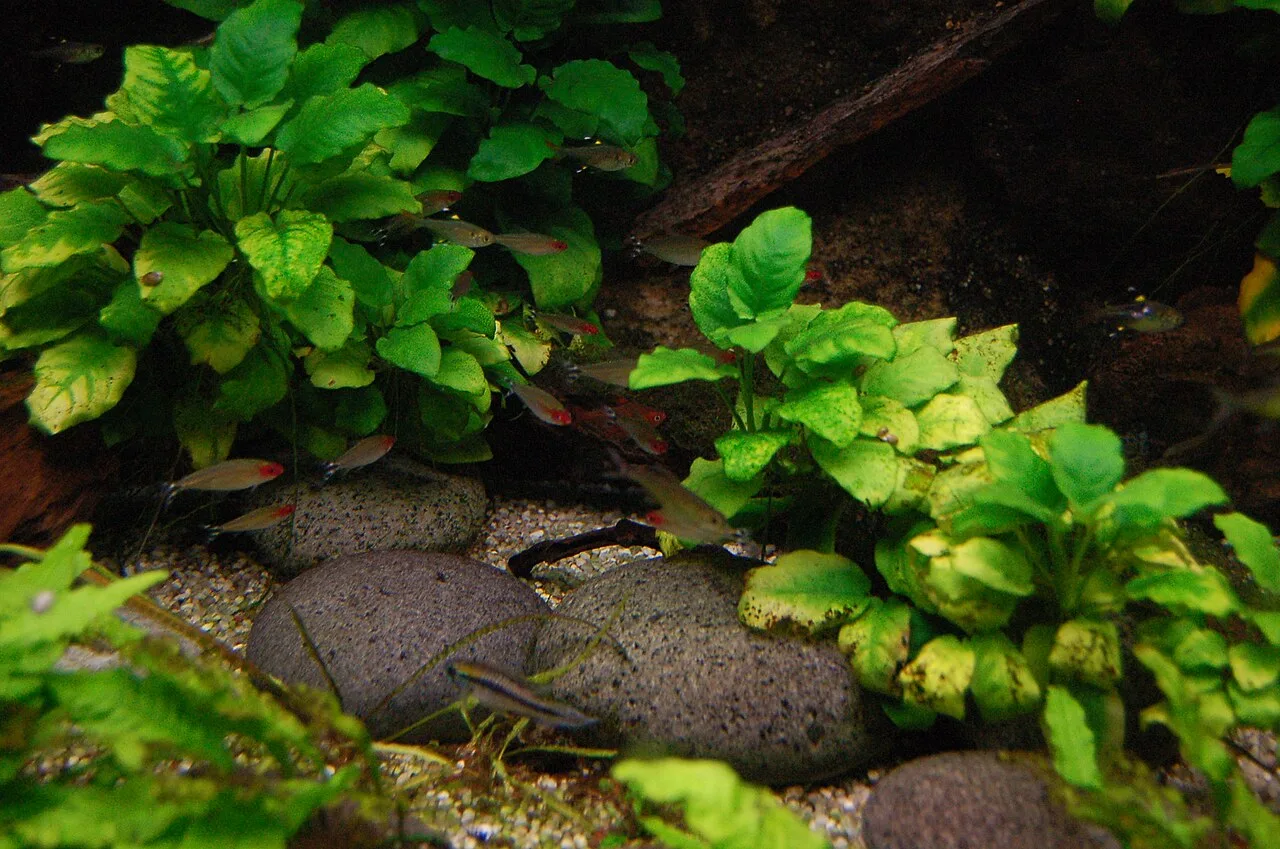
The species stands calmly among fine-leaved plants in midwater. Moss and dense planting on the bottom let most of the young survive. Soft-water Caridina suit its water values especially well, and so do Neocaridina.
Home & range
Hatched countries are where the species occurs. It lives in particular waters there, not across the whole country. The points name known waters for orientation, not collection sites.
- Country of origin
- Water for orientation
Native
Overview
Nannostomus marginatus stays at about 3 cm. Three dark bands run over a pale body, the fins often carry red. Males are slimmer and more colourful, females deeper. In a school the species looks like a fine pattern over a dark bottom and disappears on pale gravel.
It is not the hockeystick pencilfish Nannostomus eques, which stands at an angle and grows larger. The dwarf pencilfish holds itself level and stays in the plants.
Features
Carl H. Eigenmann described the species in 1909. Size figures range from 3 to 4 cm. The body is stockier than in other Nannostomus species. The ground colour is golden yellow with an olive-green back and white underside. Of the three black longitudinal stripes the middle one is the broadest and carries a short red line on its upper edge. The dorsal, anal and pelvic fins each have a red spot, and the front edges of the dorsal and anal fins are black. Fin formula: dorsal 2/8, anal 3/9, ventral 2/7. In males the anal fin is rounded at the back, in females straight and pointed.
Origin & habitat
This describes the origin, not how to furnish the aquarium.
Slow, plant-rich waters in northern South America, often soft and slightly acidic. The countries stay a coarse origin. Dim light, leaf litter and fine plants match that better than a glaring gravel bed.
The species lives on the lower and middle Amazon, in the lowlands east of the Andes in Venezuela, Colombia and Peru, and in Guyana and Suriname.
Care
Tank
23 to 28 °C, pH 5.5 to 7. A school from eight, tanks from about 50 litres if it is densely planted and quiet. Floating plants, moss, a dark bottom, little current. A cover. Large tankmates, even peaceful angelfish, are too much, because the mouth of a larger fish treats the pencilfish as food.
Company
Other very small, quiet species, or the species alone. Shrimp fit in a mature tank. Tiger barbs, danios and cichlids do not.
Diet
Dust-fine to fine food. Brine-shrimp nauplii, cyclops, crushed flakes. A normal food for guppies is often too coarse. The fish feed in midwater among the plants, not on the bottom as a waste disposal.
Several tiny feeds a day. They do not see one large flake in the morning.
Behavior
A quiet school with visual contact, not a tight ball. When startled they move into the moss. Too few fish stand singly and lose the pattern. Within the species they are peaceful. The males show small territories among the stems, without ruling the tank.
Reproduction
Egg scatterer in fine plants. The eggs are small, the parents eat them. Breeding is a separate, soft tank with rearing food. In a community tank young are not to be expected.
Spawning takes place among fine-leaved plants. With good feeding the fish spawn every three to four days in the aquarium.
Gallery
More species in this group



Similar water needs
Species with a similar temperature, a similar pH and a comparable adult size. Whether their behaviour fits as well is what the compatibility check is for.