Ruby tetra
Axelrodia riesei
18 views
A very small, red tetra. It stays in a school and does not tolerate large tankmates.
- Temperature
- 23 – 28 °C
- pH
- 5.5 – 7 pH
- General hardness
- 1 – 8 °dH
- Maximum size
- 2.5 cm
- Minimum group size
- 10
- Minimum tank size
- 30 L
3 min read · 359 words
Fresh water
Quick facts
Place in the aquarium
Highlighted are the water layer and the spots where the species usually stays in the tank.
- Middle water Usually stays in the middle of the tank, between bottom and surface.
- Dense plants Looks for dense planting as cover, retreat or grazing ground.
Shrimp in the tank
Shrimplets at risk
- Not shrimp safe
- Dwarf shrimp at risk
- Shrimplets at risk
- Shrimp safe
- Adult dwarf shrimp
- Safe
- Shrimplets
- Get eaten
- Safe from shrimp size
- about 1 cm
Adult dwarf shrimp are safe from the ruby tetra. At no more than 2.5 cm standard length it is among the smallest tetras in the trade and cannot handle any shrimp from about 1 cm.
It can, however, eat newly hatched baby shrimp as tiny food animals. In densely planted tanks with moss and leaf litter the losses stay small. The ruby tetra is therefore a good companion for dwarf shrimp in smaller, soft-water tanks. The more fine structure lies on the bottom, the more young grow up, and food given in the evening distracts the fish as well.
Home & range
Hatched countries are where the species occurs. It lives in particular waters there, not across the whole country. The points name known waters for orientation, not collection sites.
- Country of origin
- Water for orientation
Native
Overview
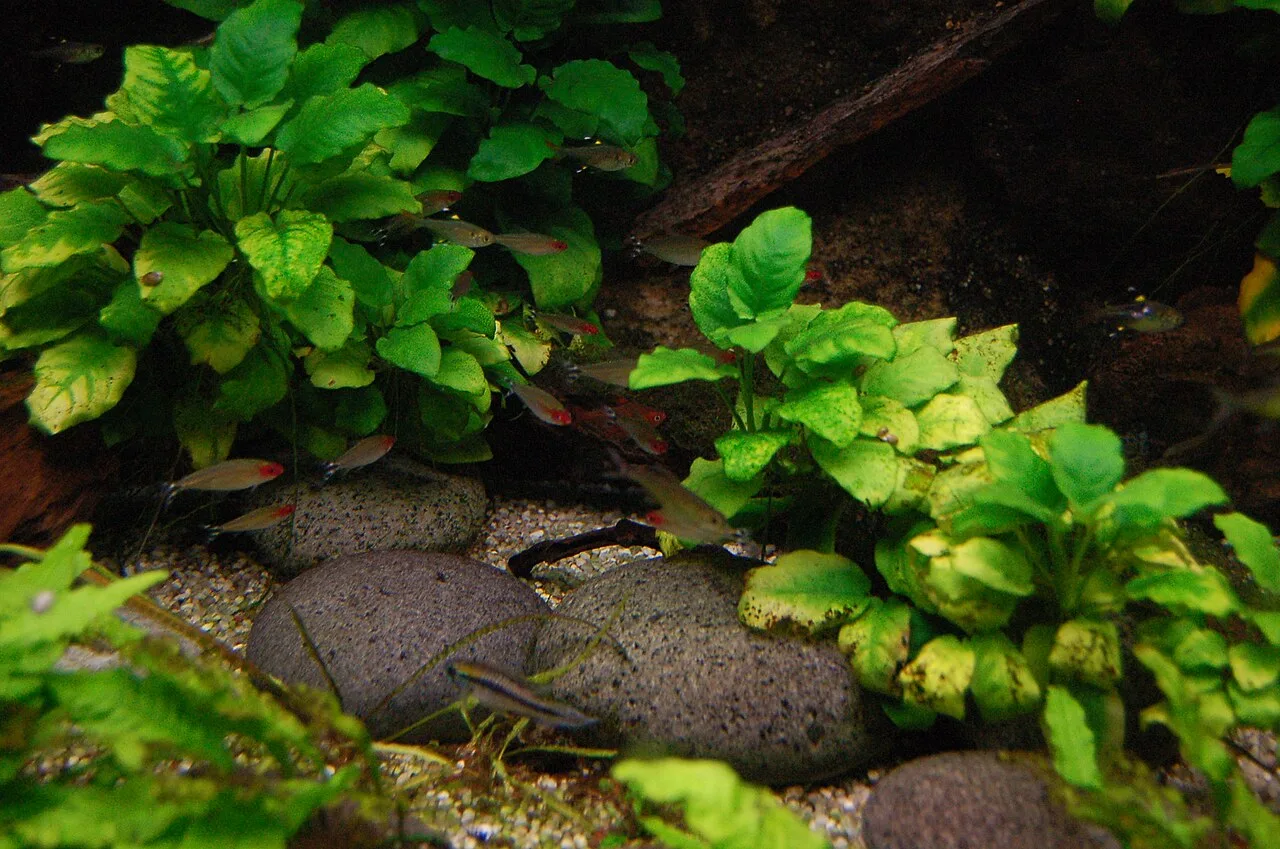
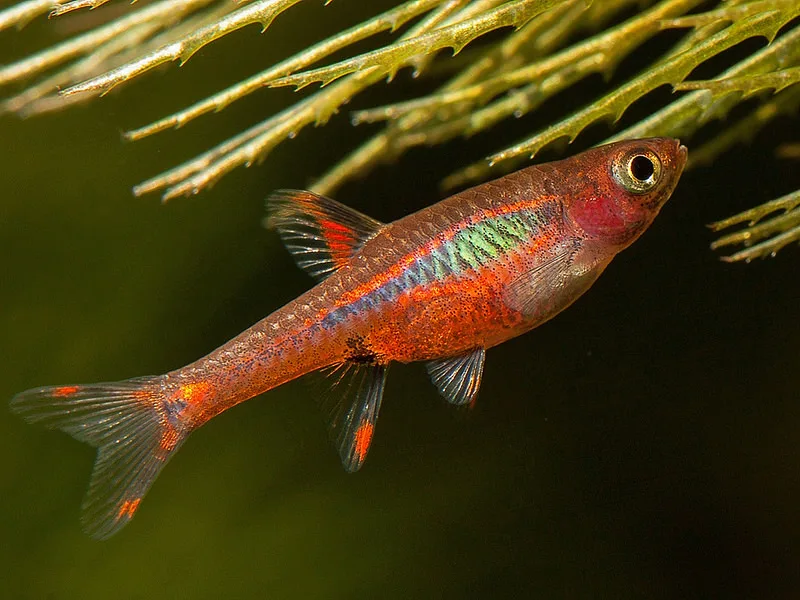
Axelrodia riesei reaches about 2.5 cm. The males are strongly red, especially on the fins. The females are paler and deeper. In a school against a dark bottom the colour glows. As a single fish and on pale gravel it disappears.
The species is not an ember tetra and not a dwarf rasbora. The body is stockier than in Boraras. The mouth is small. Coarse food is ignored.
Features
Axelrodia riesei reaches at most 2.5 cm standard length. The dominant colour is a ruby red that fades in captivity. It differs from Axelrodia stigmatias by 14 or 15 anal-fin rays, seven to ten premaxillary teeth, four or five maxillary teeth and a body more than three times as long as deep.
Jacques Géry described the species in 1965 from the upper Río Meta east of Villavicencio in Colombia. The genus honours the publisher Herbert R. Axelrod and the species name the ornamental fish exporter William Riese, who both collected the holotype. The species belongs to the Acestrorhamphidae. The IUCN lists it as least concern.
Géry set up the genus Axelrodia in 1965, at first with A. fowleri, now A. stigmatias, as its only species. The ruby tetra belongs to the subfamily Megalamphodinae.
Origin & habitat
This describes the origin, not how to furnish the aquarium.
Small waters in north-western South America, often soft and shaded. The origin stays coarse. A hard, bright community tank is the wrong place.
The species lives in the upper Orinoco basin in Colombia and Venezuela and prefers small tributaries. Whether it also occurs in the upper Rio Negro in Brazil is unconfirmed. It is widespread in the trade.
Care
Tank
23 to 28 °C, pH 5.5 to 7. A school from ten, tanks from about 30 litres, densely planted, without large fish, with a cover and little current.
Company
Only other very small species, or the species alone. Shrimp fit. Every larger fish treats them as food or takes the food away.
Diet
Dust-fine food. Nauplii, cyclops, crushed flakes. Several tiny feeds among the plants.
Behavior
A quiet school in the plants. Too few fish stand singly and lose the red. Within the species they are peaceful.
Reproduction
Egg scatterer in fine plants. The parents eat the eggs. Breeding needs a separate, soft tank and even finer rearing food.
Gallery
More species in this group






Similar water needs
Species with a similar temperature, a similar pH and a comparable adult size. Whether their behaviour fits as well is what the compatibility check is for.