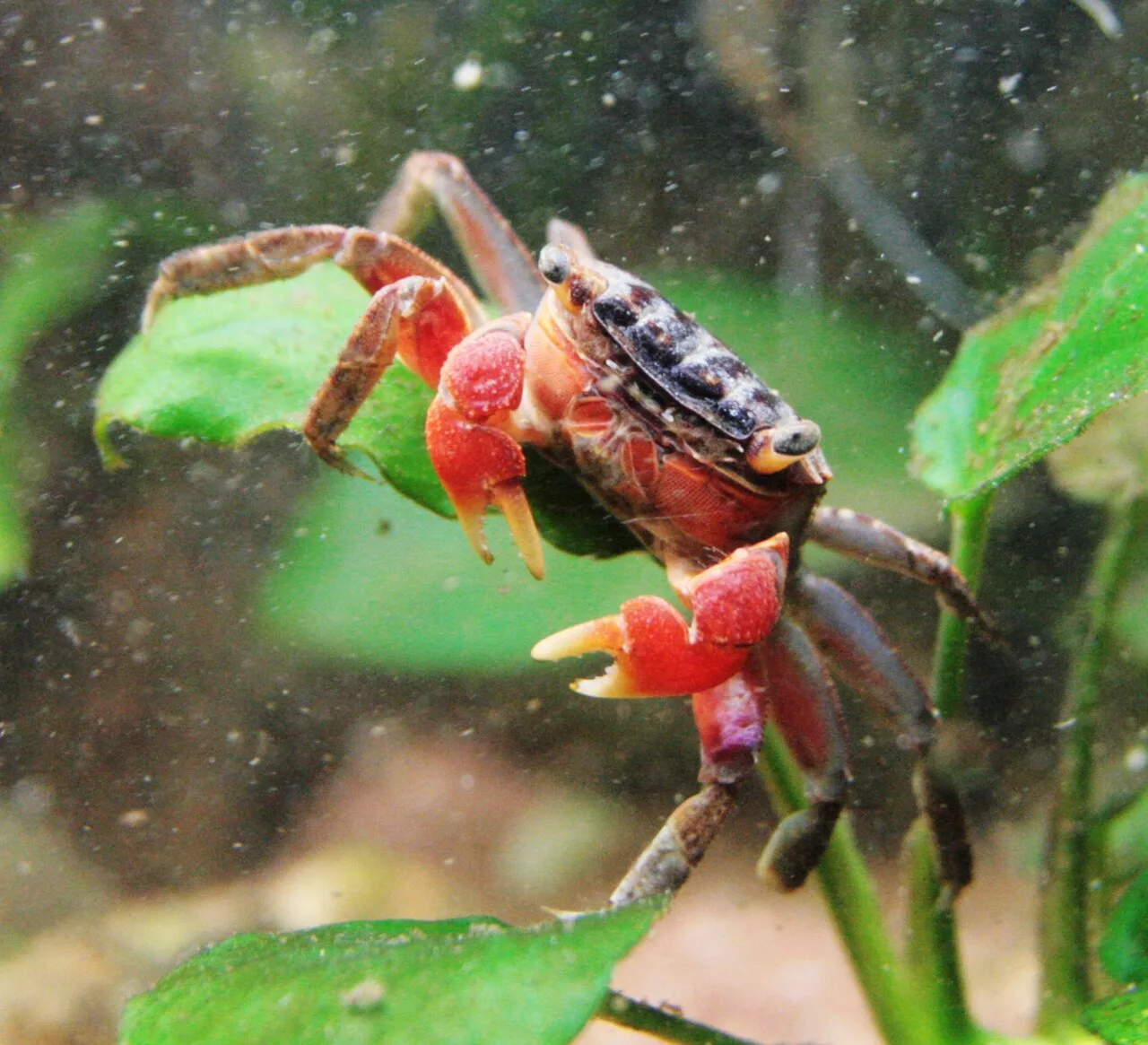
Vampire crab
Geosesarma dennerle
3 views
A small land crab from Java with purple claws and yellow eyes. It needs an aquaterrarium with plenty of land, not an aquarium.
- Temperature
- 20 – 27 °C
- pH
- 6.5 – 7.5 pH
- General hardness
- 4 – 12 °dH
- Maximum size
- 2.5 cm
- Social behavior
- Group
- Diet
- Carnivore
2 min read · 319 words
Fresh water
Quick facts
Further published values
- Minimum group size
- 3
- Minimum tank size
- 60 L
Place in the aquarium
Highlighted are the water layer and the spots where the species usually stays in the tank.
- Near the bottom Mostly stays just above the bottom. Food has to reach the substrate.
- Wood and roots Uses roots as shelter or grazes biofilm from them.
- Rocks and caves Needs caves, crevices or rockwork as hiding place, territory or spawning site.
Home & range
Hatched countries are where the species occurs. It lives in particular waters there, not across the whole country. The points name known waters for orientation, not collection sites.
- Country of origin
- Water for orientation
Native
- Central Java
- A river valley in central Java.
Overview
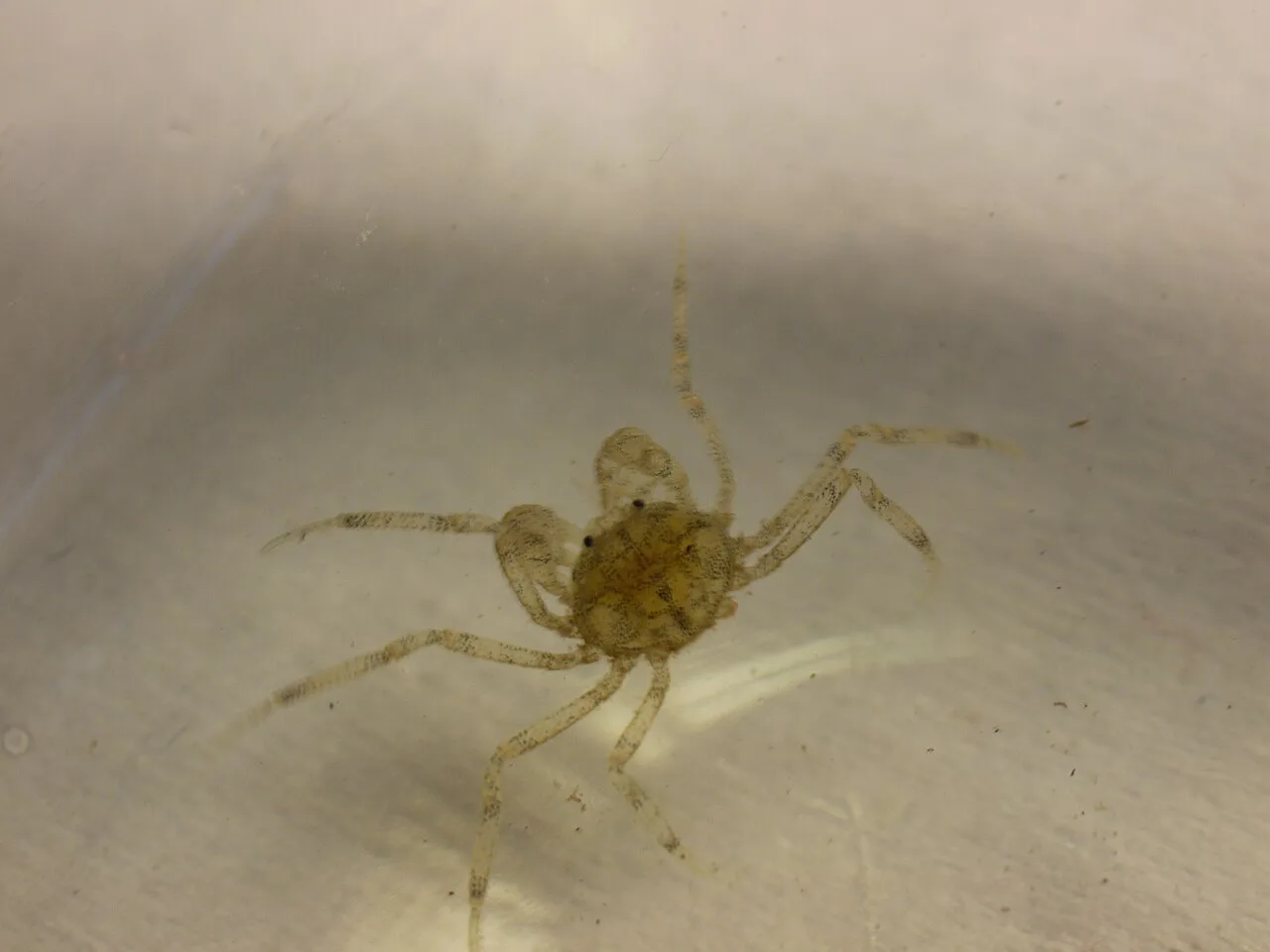
Both sexes carry light to deep purple claws. The almost square carapace measures 15 to 25 mm and in the typical form is coloured half dark purple and half cream yellow; the eyes are yellow. Animals with a blue carapace (Blue) and with a cream yellow carapace (Vampire) also belong to the species. Juveniles are brown and camouflaged. Males have broader claws and a narrow abdominal flap, females a broad one.
Name
Before its description in 2015 it was sold as Geosesarma sp. Vampire and wrongly as Geosesarma bicolor. It had been traded for ten years before without anyone knowing where it came from. The German name refers to the glowing eyes.
Range and habitat
This describes the origin, not how to furnish the aquarium.
A river valley in central Java. The crabs live nocturnally in moist areas along stream banks, on valley slopes under and between rocks and beneath dense vegetation. Juveniles are often found at the border of water and land.
Keeping
Aquaterrarium
From about 60 litres, most of it land with soil, leaves, moss, stones and caves, plus a shallow water section. 5 cm of water is enough. High humidity and a tight cover without gaps; the animals climb along cables and silicone seams.
Climate
20 to 27 °C. Water pH 6.5 to 7.5, GH 4 to 12 °dH.
Companions
Not with other Geosesarma species, towards which it is aggressive. A group with more females than males is favourable.
Diet
Mainly carnivorous. In the wild small land insects such as grasshoppers, probably also midge larvae and detritus. In captivity it hunts amphipods and dwarf shrimp. Dried leaves are part of the diet, plus insects, frozen food and food tablets.
Behaviour and moulting
Nocturnal, hides by day. Females dig burrows.
Reproduction and larvae
Like all Geosesarma it develops without free larvae. The female carries the eggs under the abdominal flap and releases 20 to 80 finished young crabs with a carapace width of about 1 mm. In an aquaterrarium with many hiding places breeding succeeds without problems. Wild populations are regarded as threatened, so captive-bred animals are preferable to wild catches.
Gallery
More species in this group
Similar water needs
Species with a similar temperature, a similar pH and a comparable adult size. Whether their behaviour fits as well is what the compatibility check is for.