Panther crab
Parathelphusa pantherina
2 views
A freshwater crab from Lake Matano on Sulawesi with dark red rosettes. Endangered, fully aquatic and predatory.
- Temperature
- 26 – 30 °C
- pH
- 7.5 – 8.5 pH
- General hardness
- 4 – 10 °dH
- Maximum size
- 5 cm
- Social behavior
- Territorial
- Diet
- Carnivore
2 min read · 208 words
Fresh water
Quick facts
Further published values
- Minimum tank size
- 80 L
Place in the aquarium
Highlighted are the water layer and the spots where the species usually stays in the tank.
- Near the bottom Mostly stays just above the bottom. Food has to reach the substrate.
- Rocks and caves Needs caves, crevices or rockwork as hiding place, territory or spawning site.
Home & range
Hatched countries are where the species occurs. It lives in particular waters there, not across the whole country. The points name known waters for orientation, not collection sites.
- Country of origin
- Water for orientation
Native
- Sulawesi, Lake Matano
- Lake Matano and waters south of it.
Overview
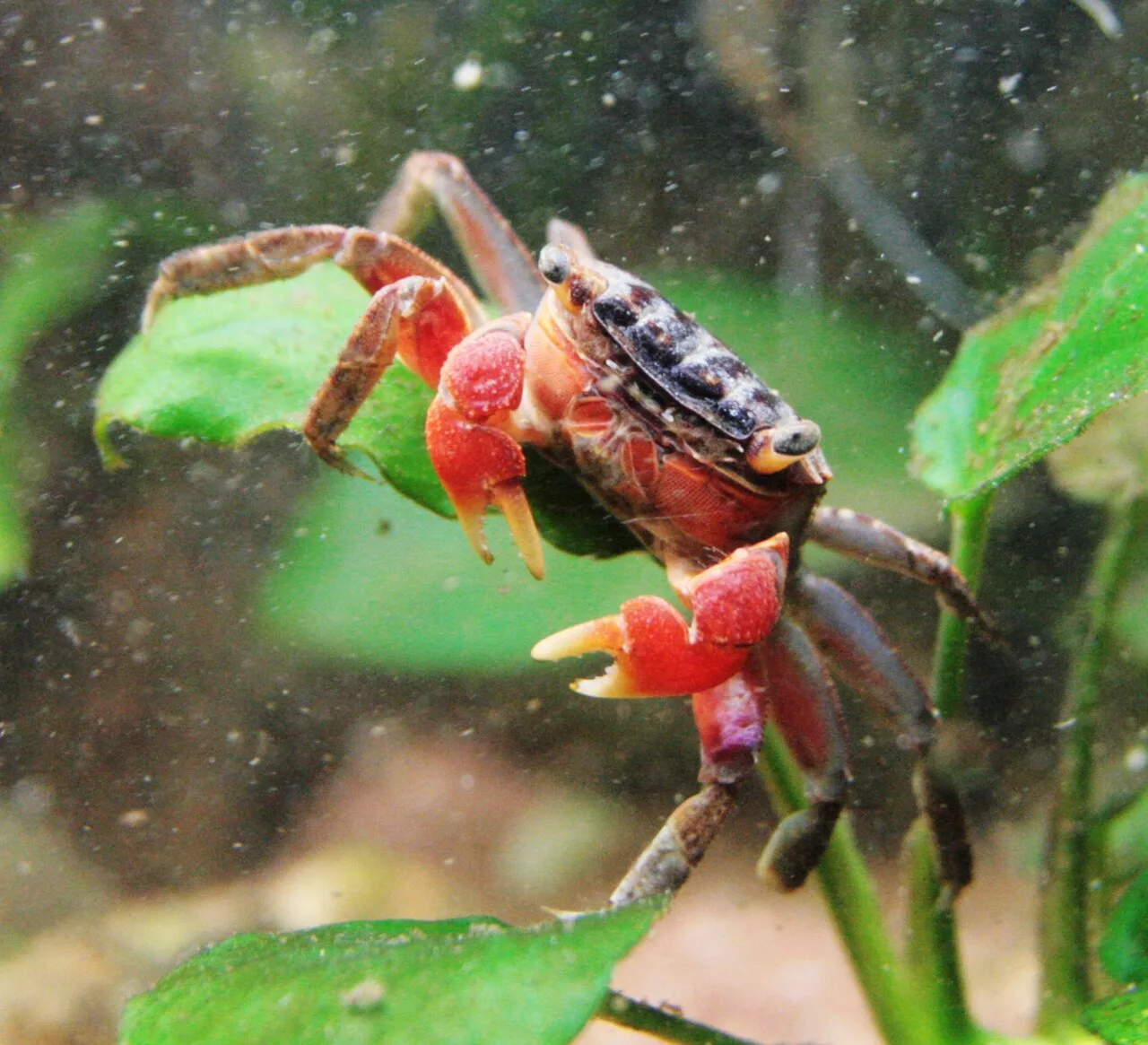
The base colour is yellow to light orange, with dark red rosettes from the flat carapace onto the walking legs. Claw and leg tips are often red; sometimes the red is missing entirely. It was described in 1902.
Range and habitat
This describes the origin, not how to furnish the aquarium.
Endemic to Sulawesi, in Lake Matano and waters south of it. It is one of five freshwater crab species in the lake and lives hidden under roots and wood. Lake Matano has a pH around 7.4 and 27 to 31 °C. The IUCN lists the species as endangered because nickel mining on the shores degrades the water.
Keeping
Tank
From about 80 litres for one animal or a pair, with many caves of stones and roots. It lives in the water; a land section is not needed. Tight cover.
Water
26 to 30 °C, pH 7.5 to 8.5, GH 4 to 10 °dH.
Companions
Shrimp, snails and small fish are eaten. Best in a species tank.
Diet
Omnivore with a large meaty share: frozen food, food tablets, shrimp and fish meat, some vegetables.
Behaviour and moulting
Mainly nocturnal and territorial. Several animals each need their own caves.
Reproduction and larvae
It reproduces by eggs and lives exclusively in fresh water. As in true freshwater crabs, small finished crabs hatch from the eggs under the abdominal flap. Many animals in the trade are wild-caught; captive-bred animals are preferable.
More species in this group
Similar water needs
Species with a similar temperature, a similar pH and a comparable adult size. Whether their behaviour fits as well is what the compatibility check is for.