
Blue tetra
Boehlkea fredcochui
28 views
A slender, blue-shimmering tetra from Peru. The colour comes in the school and in good water, not on a single juvenile.
- Temperature
- 23 – 28 °C
- pH
- 6 – 7.5 pH
- General hardness
- 5 – 12 °dH
- Maximum size
- 5 cm
- Minimum group size
- 8
- Minimum tank size
- 80 L
3 min read · 438 words
Fresh water
Quick facts
Further published values
- Lifespan
- 2 – 3 a
Place in the aquarium
Highlighted are the water layer and the spots where the species usually stays in the tank.
- Middle water Usually stays in the middle of the tank, between bottom and surface.
- Open swimming space Needs an open area without plants or decor to swim at length. Tank length matters more than height.
Shrimp in the tank
Shrimplets at risk
- Not shrimp safe
- Dwarf shrimp at risk
- Shrimplets at risk
- Shrimp safe
- Adult dwarf shrimp
- Safe
- Shrimplets
- Get eaten
- Safe from shrimp size
- about 1.5 cm
Adult dwarf shrimp are usually safe from Cochu's blue tetra. It grows to about 5 to 5.5 cm and has a small mouth, so shrimp from about 1.5 cm are too large for it. The lively school does pick up freshly hatched young, though, and it may nip at feeding time.
Dense moss and fine plants along the edges give the young cover while the tetras use the open centre. Anyone who wants to breed shrimp on purpose keeps them separately.
Home & range
Overview
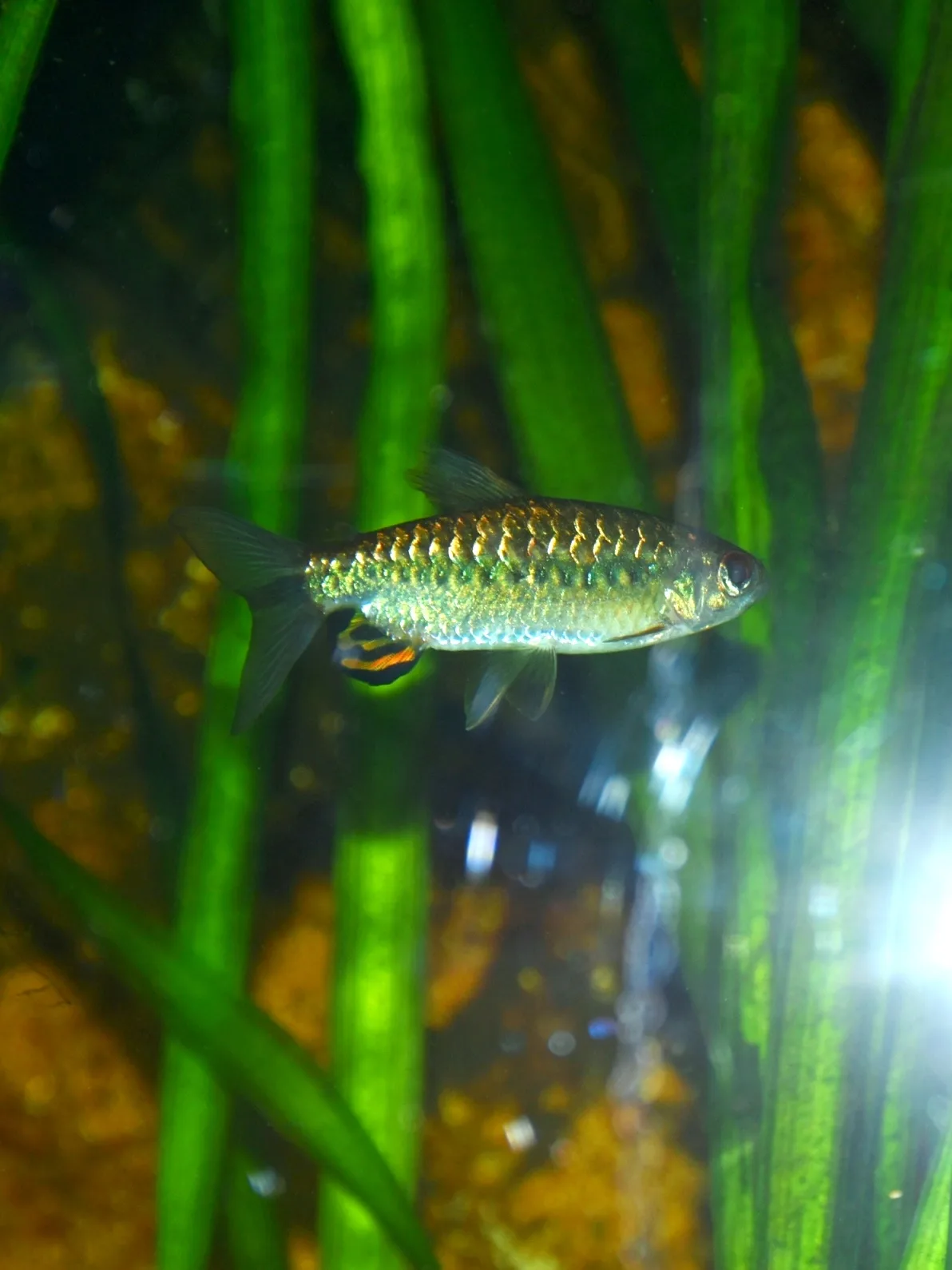
Boehlkea fredcochui reaches about 5 cm. A blue band runs over the silvery body. The fins of the males are longer. Females are deeper. The species is lively and stands in midwater. In a bare shop tank it looks grey.
It is not a Congo tetra. The body is slimmer. The blue lies as a band and not as a sheen over the whole body.
Two species under one name
The German name Blauer Perusalmler often refers to Knodus borki, described by Zarske in 2008. It was sold for years as Boehlkea fredcochui because of a misidentification. The two species are confusingly similar. Zarske also gave a supplementary description of Boehlkea fredcochui. One difference lies in the upper jaw: in Boehlkea fredcochui it carries 11 to 21 teeth, in most related species only three to four.
Features
Boehlkea fredcochui is coloured blue and pink and reaches 5.5 cm total length. Males are slimmer, more streamlined and more intensely coloured. Géry described the species in 1966. The name honours the importer Ferdinand (Fred) Cochu of Paramount Aquarium, who introduced it to the hobby around 1956.
Origin & habitat
This describes the origin, not how to furnish the aquarium.
Streams in the Peruvian Amazon, clear to lightly stained. Peru stays the coarse origin. Dim light and a dark bottom show the colour.
The natural range lies in the Amazon basin. Details on eastern Peru and the whitewater of the Marañón between Ecuador, Iquitos and Leticia concern Knodus borki.
Care
School
23 to 28 °C, pH 6 to 7.5. A group from eight, tanks from about 80 litres and 70 cm. Plants at the edge, an open middle, some current, a cover.
Company
Other peaceful, medium-small tetras and corydoras. Very small Boraras can be harassed. Large cichlids, no.
Diet
Fine prepared food. Flakes, granules, cyclops, brine shrimp. Several small feeds. The colour holds in clean water and with varied food.
Behavior
An active, peaceful school. The males show the fins. Too few fish stand shy. The species jumps at times.
The species is active and needs open swimming space. It is mostly peaceful but may nip fins when feeding or stressed. Aggression is directed mainly at its own kind and at other fish in tanks that are too small or with too few tetras. Recommended are groups of six or more, a tank of at least 90 cm, 22 to 27 °C, pH 6 to 7.5 and soft to medium water below 15 dGH without salt. Life expectancy is two to three years.
Reproduction
Egg scatterer without brood care. Softer water and fine plants can allow a spawning if the parents are removed. In a community tank the eggs are eaten.
Keeping is regarded as easy, breeding as very hard. The eggs are scattered over fine-leaved plants, and soft, acidic water is needed for hatching.
Gallery
More species in this group



Similar water needs
Species with a similar temperature, a similar pH and a comparable adult size. Whether their behaviour fits as well is what the compatibility check is for.



