Ember tetra
Hyphessobrycon amandae
29 views
A very small tetra from the Araguaia. The water figures of the habitat are not care values.
- Temperature
- 23 – 29 °C
- pH
- 6.6 pH
- General hardness
- 5 – 17 °dH
- Maximum size
- 2 cm
- Minimum group size
- 6
- Minimum tank size
- 30 L
3 min read · 430 words
Fresh water
Quick facts
Further published values
- Lifespan
- 2 – 4 a
Place in the aquarium
Highlighted are the water layer and the spots where the species usually stays in the tank.
- Upper water Usually stays in the top third of the tank.
- Middle water Usually stays in the middle of the tank, between bottom and surface.
- Dense plants Looks for dense planting as cover, retreat or grazing ground.
Shrimp in the tank
Shrimplets at risk
- Not shrimp safe
- Dwarf shrimp at risk
- Shrimplets at risk
- Shrimp safe
- Adult dwarf shrimp
- Safe
- Shrimplets
- Get eaten
- Safe from shrimp size
- about 1 cm
The ember tetra is one of the best partners for dwarf shrimp. At about 2 cm and with a tiny mouth it cannot harm adult shrimp, and shrimp from about 1 cm are safe. It swims in midwater and does not feed from the bottom. Freshly hatched young that wander into open water are eaten, though.
In a densely planted tank with moss and a dark substrate most young grow up. Caridina and Neocaridina both suit, depending on water hardness.
Home & range
Hatched countries are where the species occurs. It lives in particular waters there, not across the whole country. The points name known waters for orientation, not collection sites.
- Country of origin
- Water for orientation
Native
Overview
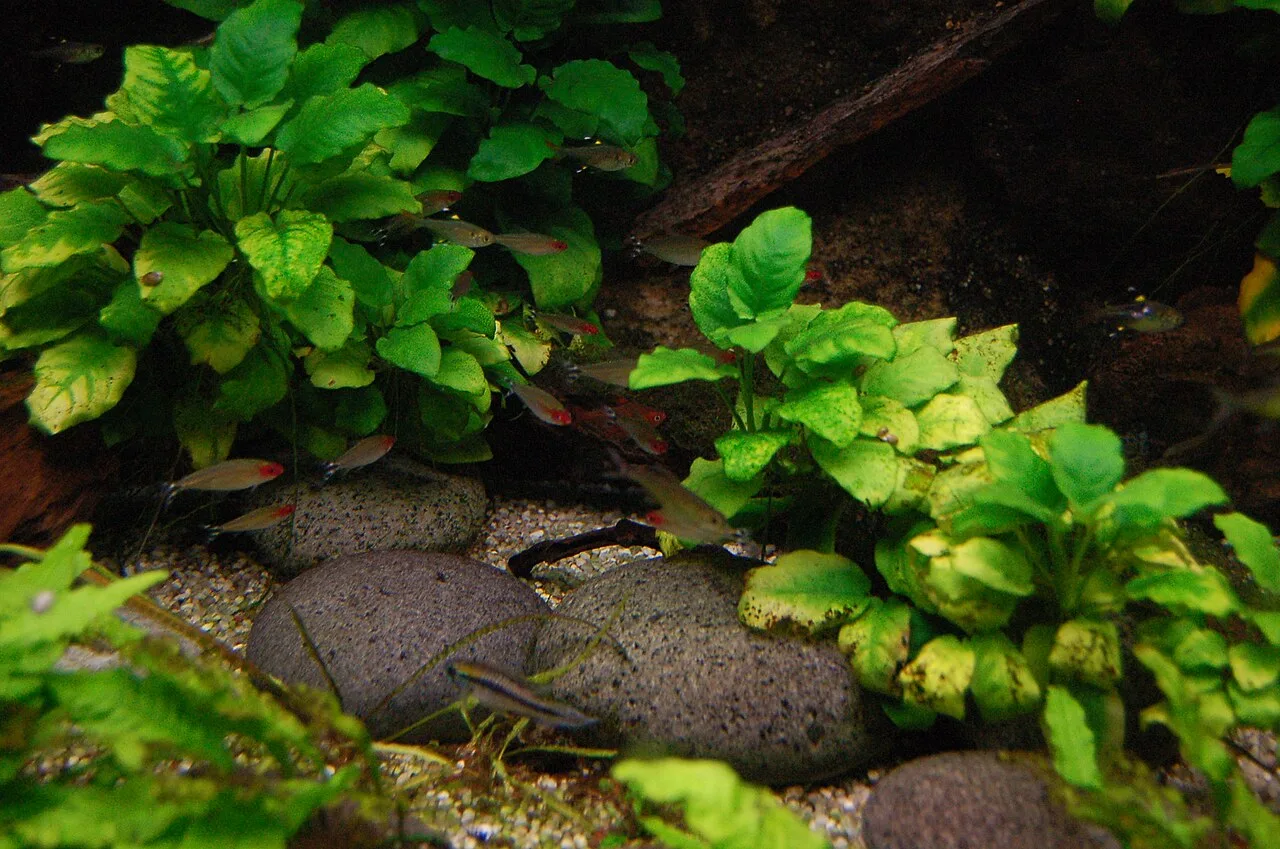
Maximum about 2 cm, males about 1.5 cm, females about 1.8 cm. Translucent, head and fins reddish. A schooling fish. Hemigrammus amandae is a synonym.
Features and name
The small body is translucent, and the spine is clearly visible. Head, belly, dorsal and tail fins are reddish, the eyes are large for the body and the mouth is terminal. Males are smaller and slimmer, females fuller and only slightly more colourful. Other reports give a maximum length of 2 to 3 cm. The eye takes on the body colour and is outlined in black. Géry and Uj described the species in 1987. The name honours Amanda Bleher, mother of the fish collector Heiko Bleher. In German it is also called Feuertetra or Feuersalmler.
Origin & habitat
This describes the origin, not how to furnish the aquarium.
Floodplains of the Araguaia, Rio das Mortes and Rio Garças in Mato Grosso. There pH 4.5 to 6.5, about 17 µS/cm, GH 1 to 8, 24 to 28 °C. These are values of the water, not care values. Brazil stays coarse.
The water is usually blue-green and turbid, a whitewater. The species lives in the Araguaia basin in Brazil and is listed as least concern by the IUCN.
Care
Orange in the school
The ember tetra stays at about 2 cm and is therefore food for almost every larger fish. 24 to 28 °C, pH 5.5 to 7, a school from ten, tanks from about 30 litres, densely planted, without large tankmates. The males are a stronger orange. The colour comes only in the group and in dim light.
The species jumps. Keep the cover on. A hard, bright community tank shows grey dots instead of ember tetras.
Diet
Only the finest food. Nauplii, microworms, dust food. What a neon tetra swallows is often already too coarse here.
Behavior
A school.
The ember tetra swims in midwater and does not feed from the bottom. It schools and also joins neon tetras, but can be stressed by much larger fish. Pygmy corydoras are recommended as bottom dwellers. Suitable conditions are 23 to 29 °C, pH around 6.6, a hardness of 5 to 17 dGH, at least six, better nine to ten fish, a dark substrate, many plants and a shaded corner. In a well-kept, heavily planted tank ten years or more are said to be possible. In the wild the species eats small invertebrates and plants.
Reproduction
A free spawner in fine plants. Exact field reports are missing. The existing notes are from aquarists and are not taken over as measurements.
Breeding is probably tied to the rainy season, but there are no exact reports from the wild. Based on aquarium observations the ember tetra is an egg scatterer that places its eggs in dense, finely divided plants. Dense planting protects the fry.
Gallery
More species in this group






Similar water needs
Species with a similar temperature, a similar pH and a comparable adult size. Whether their behaviour fits as well is what the compatibility check is for.