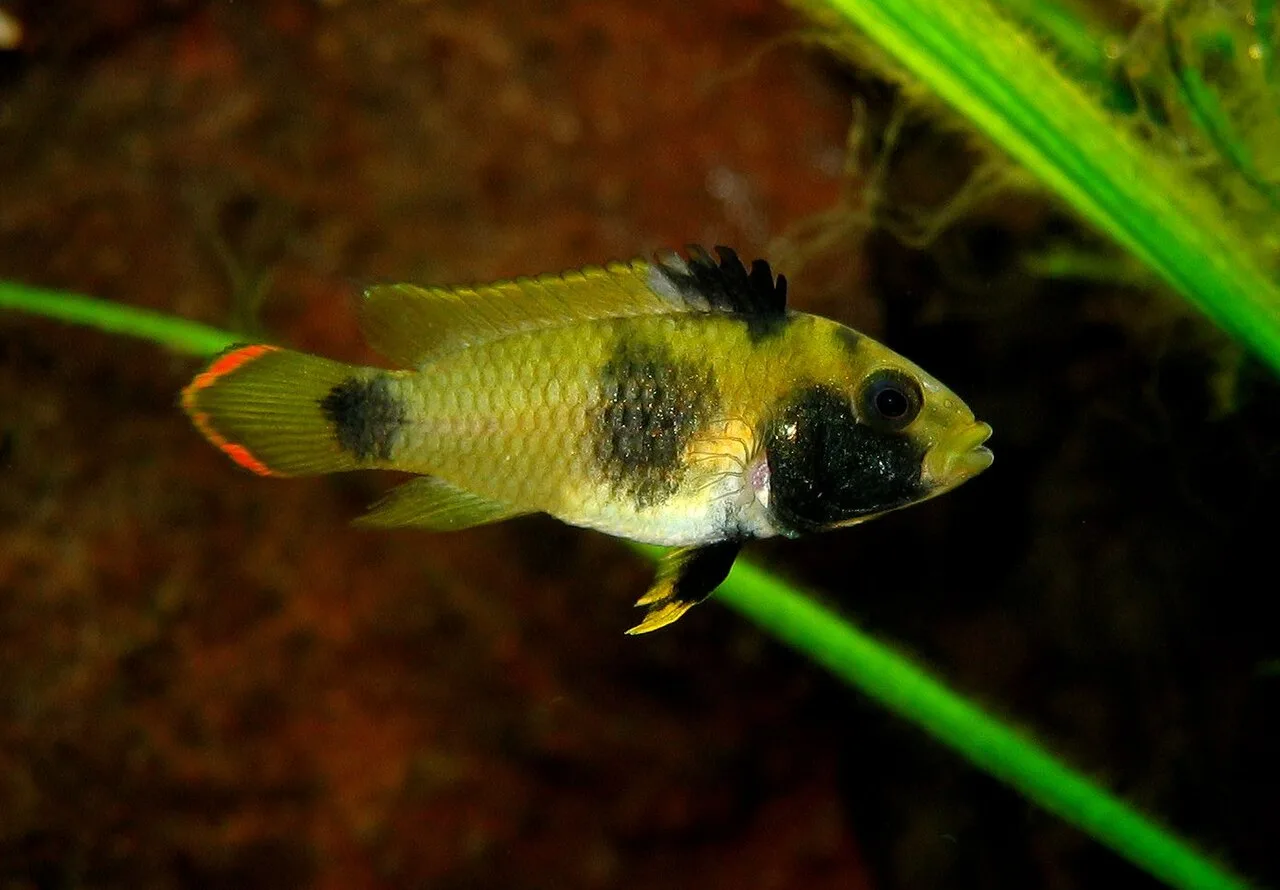
Hockeystick pencilfish
Nannostomus eques
13 views
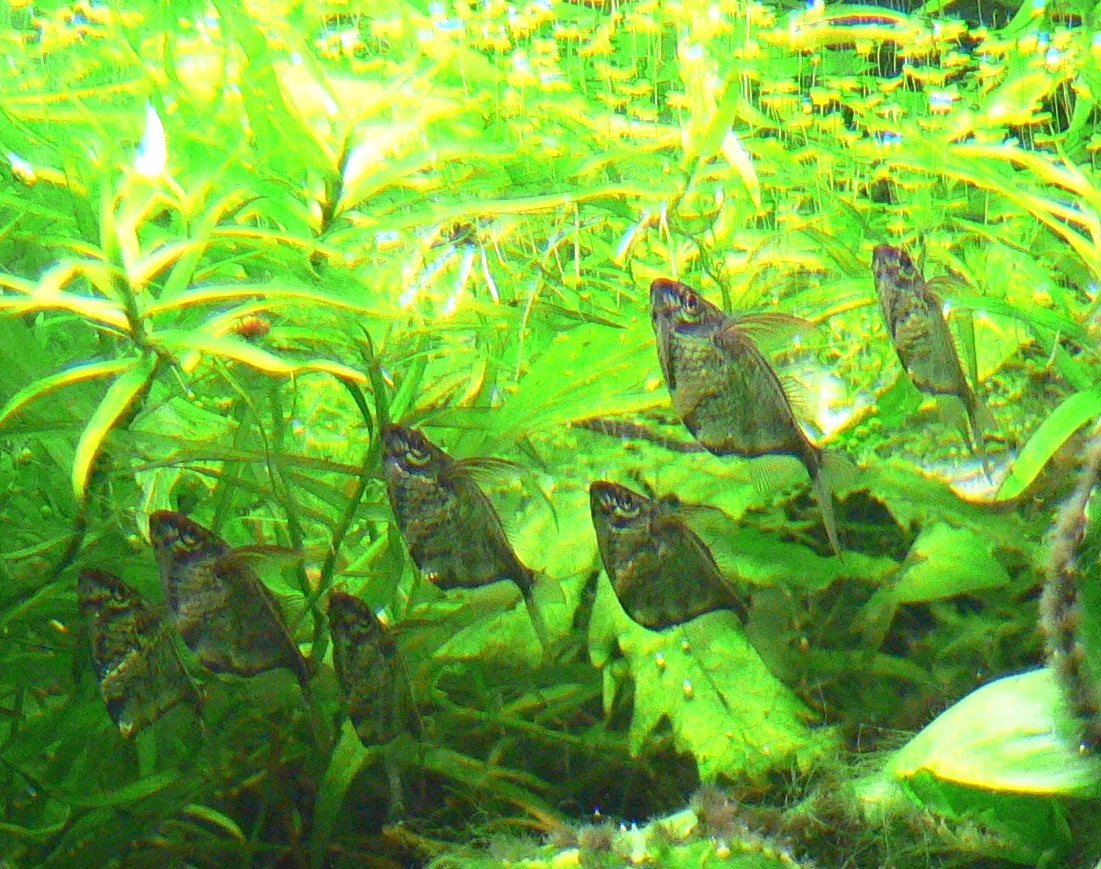
A pencilfish, also called a headstander at an angle. Not Nannostomus beckfordi.
- Temperature
- 24 – 28 °C
- pH
- 5 – 7 pH
- General hardness
- 1 – 10 °dH
- Maximum size
- 5
- Minimum group size
- 6
- Minimum tank size
- 60 L
3 min read · 413 words
Fresh water
Quick facts
Place in the aquarium
Highlighted are the water layer and the spots where the species usually stays in the tank.
- Upper water Usually stays in the top third of the tank.
- Dense plants Looks for dense planting as cover, retreat or grazing ground.
Shrimp in the tank
Shrimplets at risk
- Not shrimp safe
- Dwarf shrimp at risk
- Shrimplets at risk
- Shrimp safe
- Adult dwarf shrimp
- Safe
- Shrimplets
- Get eaten
- Safe from shrimp size
- about 1 cm
Adult shrimp are safe with the diptail pencilfish. It grows to about 5 cm, has a small mouth and eats only small food such as brine shrimp, cyclops and small mosquito larvae. Shrimp from about 1 cm do not fit. Newly hatched shrimp are taken, however.
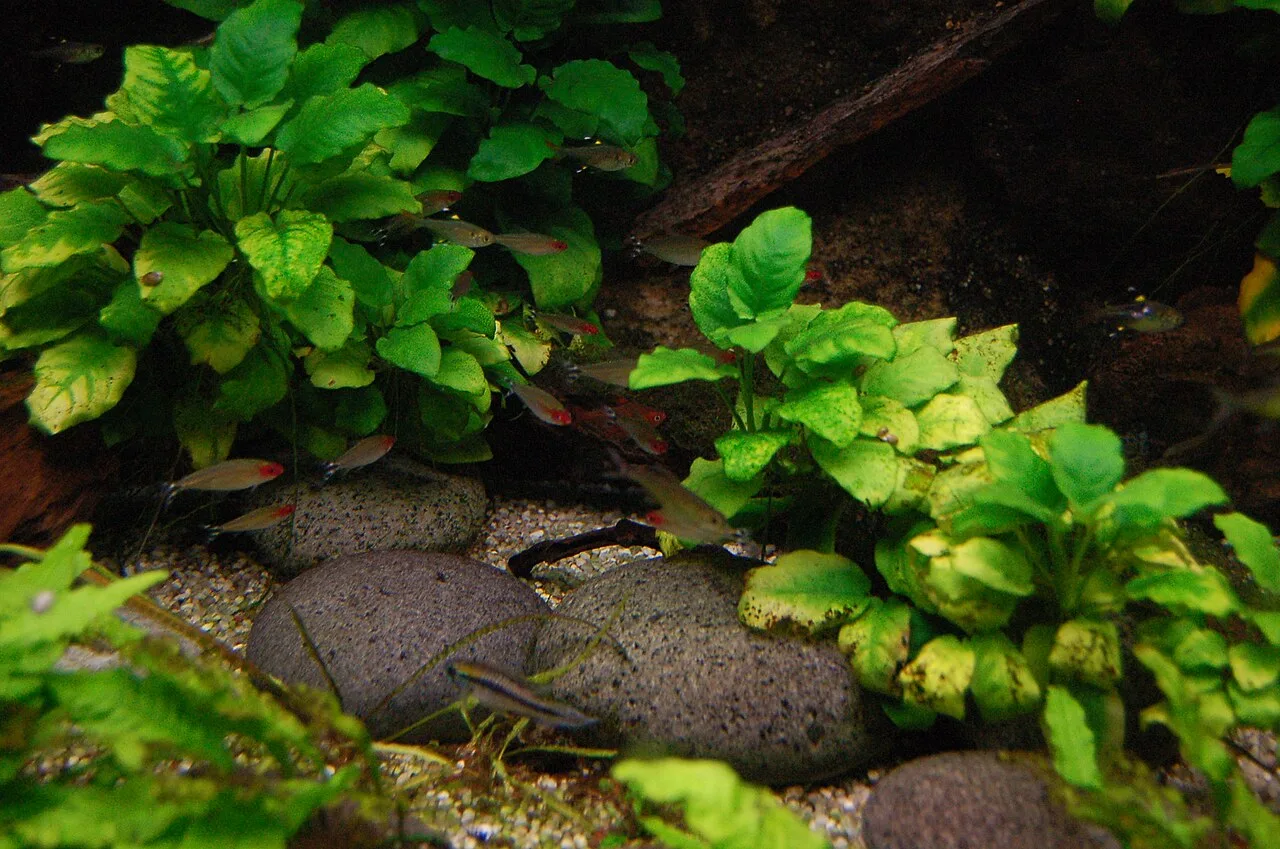
The species stands at an angle in the middle and upper water and does little searching on the bottom. Moss and fine plants on the ground let enough young survive. Soft-water Caridina suit its preferred water values.
Home & range
Overview
Three, sometimes four stripes. The widest is deep brown to black and runs into the lower tail and the anal fin. At night the underside becomes almost entirely brown, with a broad white line above and one to three dark spots. Males more strongly coloured, pelvic tips bluish white. Females with a rounder belly.
Systematics and markings
Franz Steindachner described the species in 1876. It belongs to the pencilfishes (Lebiasinidae), subfamily Pyrrhulininae. The top stripe is light brown to white, the one below slightly lighter. The two can merge. A thin white line runs along the underside. The anal fin carries one red and two brown to black bands.
In males the red band of the anal fin is broader and stronger and can be bluish white at its lower end. The males' belly line is straight and slimmer, the females' rounded. The sexes are easier to tell apart than in many other tetras.
Origin & habitat
This describes the origin, not how to furnish the aquarium.
Guiana, the Rio Negro and the Amazon. No state is added from them.
Care
For about six fish, better more females than males, 60 litres have proved enough. Larger tanks are better, because both sexes form territories. Acidic and soft. Captive-bred fish have also spawned in neutral, medium-hard water. Dark, floating plants, one or two broad-leaved plants per male.
Spawning plants
Limnobium stoloniferum works as a floating plant, Anubias barteri for example as a broad-leaved spawning plant. Subordinate fish need enough room to escape territorial fights. For breeding, a 25-litre tank without substrate with one male and one to three females is enough.
Diet
Small food: Artemia, cyclops, small bloodworms, fine flakes.
Behavior
Aggression only within the species. Other small tetras are named as company.
In the breeding tank the male claims a plant and cleans the leaf undersides by removing air bubbles. It courts the female by swimming beside her in the opposite direction and fanning its tail.
Reproduction
Breeding in a community tank is possible. A separate tank gives more survivors.
Sequence
The female slips under a leaf and turns on her side to release an egg. The male turns at the same time and releases sperm. The egg sticks to the underside of the leaf. Depending on the female's size and egg count this repeats up to about a hundred times, often on several leaves. From the start the young get newly hatched brine shrimp and powder food. Rearing temperature is somewhat lower than for the adults. Temperatures that are too high are said to stunt growth.
Gallery
More species in this group



Similar water needs
Species with a similar temperature, a similar pH and a comparable adult size. Whether their behaviour fits as well is what the compatibility check is for.