Leopard sailfin pleco
Pterygoplichthys gibbiceps
2 views
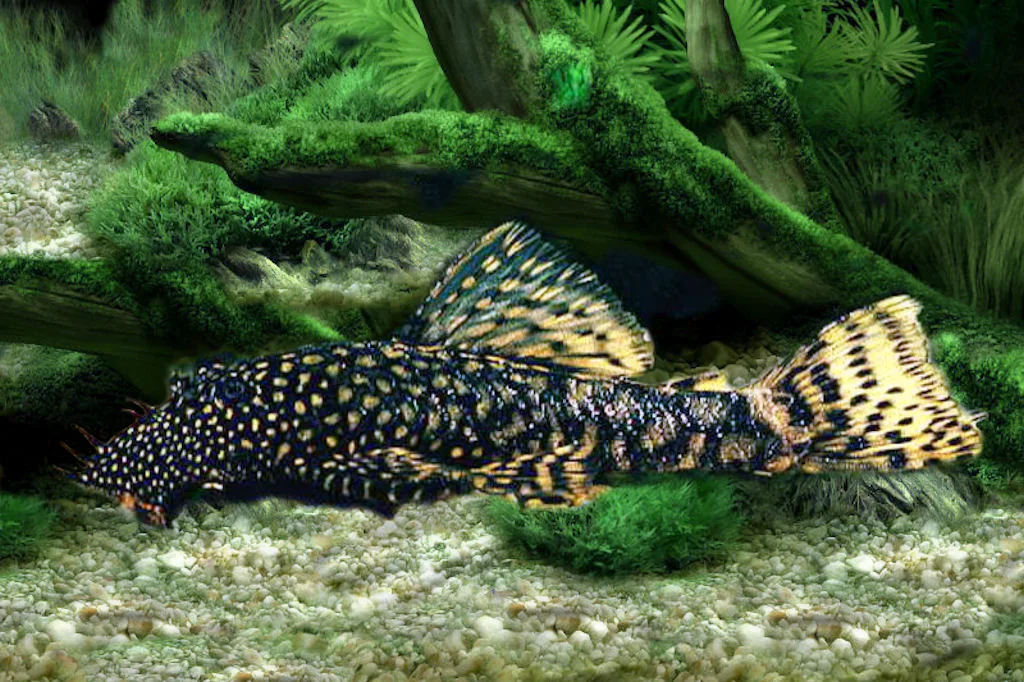
A large suckermouth catfish with a sail-like fin and a honeycomb pattern. The small juvenile from the shop becomes a fish of about half a metre.
- Temperature
- 23 – 28 °C
- pH
- 6 – 7.5 pH
- General hardness
- 2 – 15 °dH
- Maximum size
- 50 cm
- Minimum tank size
- 600 L
2 min read · 201 words
Quick facts
Place in the aquarium
Highlighted are the water layer and the spots where the species usually stays in the tank.
- Near the bottom Mostly stays just above the bottom. Food has to reach the substrate.
- Wood and roots Uses roots as shelter or grazes biofilm from them.
Shrimp in the tank
Shrimplets at risk
- Not shrimp safe
- Dwarf shrimp at risk
- Shrimplets at risk
- Shrimp safe
- Adult dwarf shrimp
- Safe
- Shrimplets
- Get eaten
- Safe from shrimp size
- about 2 cm
The leopard sailfin pleco does not hunt shrimp. It eats aufwuchs, plant food and leftovers on the bottom. Adult shrimp from about 2 cm are therefore usually safe. Juvenile shrimp sitting on wood and stones are taken in while it rasps, however.
The real problem is size. A tank for this catfish is usually full of large fish that eat shrimp, plus strong current, which dwarf shrimp do not like.
Home & range
Hatched countries are where the species occurs. It lives in particular waters there, not across the whole country. The points name known waters for orientation, not collection sites.
- Country of origin
- Water for orientation
Native
Overview
Pterygoplichthys gibbiceps reaches about 50 cm. The body carries a dark honeycomb pattern on a pale background, and the dorsal fin is tall and sail-like. Juveniles are sold at a few centimetres and grow quickly. Older names say Glyptoperichthys gibbiceps. It is the same species.
It is not the bristlenose pleco, which stays at about 15 cm. Anyone who buys a leopard sailfin pleco plans a tank for a very large fish, not an algae helper for 100 litres.
Origin & habitat
This describes the origin, not how to furnish the aquarium.
Calm stretches of large rivers in the Amazon and Orinoco basins. The origin stays coarse. Wood, a soft bottom and warm water match that.
Care
Size
23 to 28 °C, pH 6 to 7.5. One fish from about 600 litres and 180 cm. Strong filtration, large roots, a cave the adult fish can still use.
Company
Large, calm fish. Other large suckermouth catfish fight over caves and feeding spots. Plants get uprooted.
Diet
Plant food and aufwuchs. Vegetables, plant-based tablets, wood to rasp, plus occasional frozen food. The waste is plentiful, so filtration has to grow with the fish.
Behavior
Calm by day, active at night. Mostly peaceful toward other species, territorial toward its own kind and similar catfish.
Reproduction
Cave spawner in burrows along the bank. Practically no young in the aquarium.
Gallery
More species in this group


Similar water needs
Species with a similar temperature, a similar pH and a comparable adult size. Whether their behaviour fits as well is what the compatibility check is for.