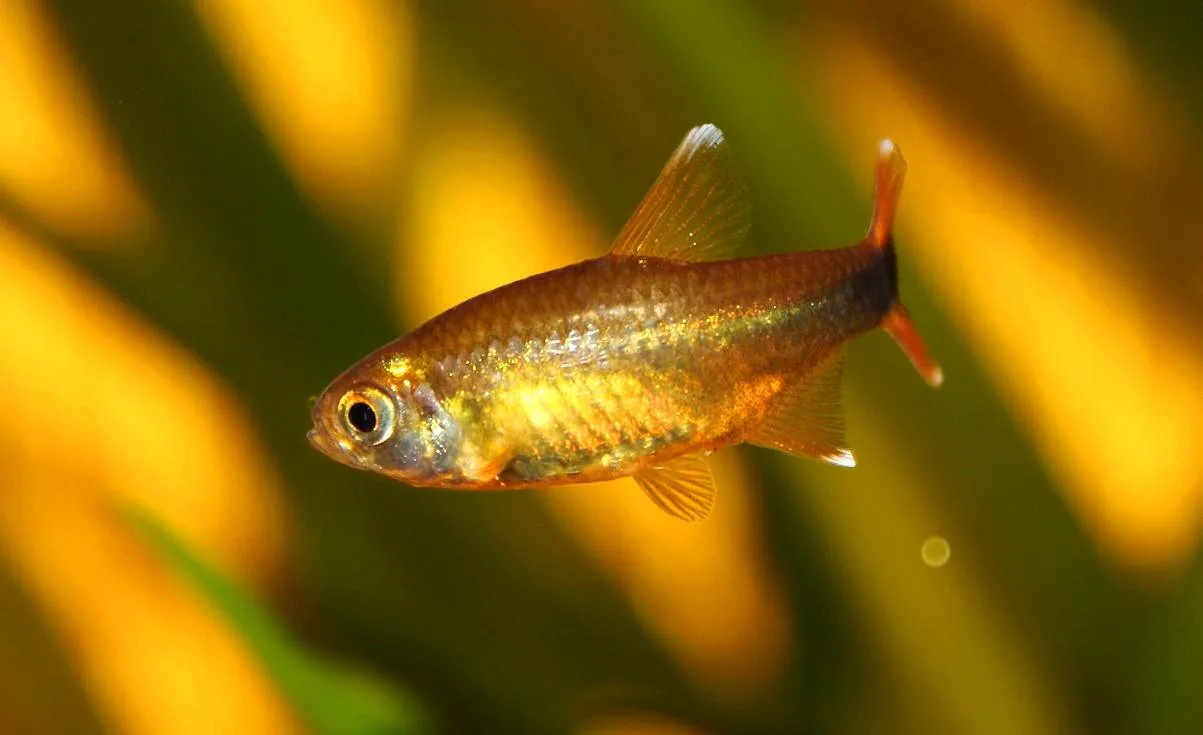
Rosy tetra
Megalamphodus rosaceus
14 views
A tetra of 3.5 to 4 cm. Hyphessobrycon rosaceus is the synonym. Not the rosy barb.
- Temperature
- 24 – 28 °C
- pH
- 6 – 7.5 pH
- General hardness
- 2 – 12 °dH
- Maximum size
- 4 cm
- Minimum group size
- 8
- Minimum tank size
- 60 L
2 min read · 283 words
Fresh water
Quick facts
Place in the aquarium
Highlighted are the water layer and the spots where the species usually stays in the tank.
- Middle water Usually stays in the middle of the tank, between bottom and surface.
- Dense plants Looks for dense planting as cover, retreat or grazing ground.
Shrimp in the tank
Shrimplets at risk
- Not shrimp safe
- Dwarf shrimp at risk
- Shrimplets at risk
- Shrimp safe
- Adult dwarf shrimp
- Safe
- Shrimplets
- Get eaten
- Safe from shrimp size
- about 1.5 cm
Adult dwarf shrimp are safe from the rosy tetra. It grows to only 3.5 to 4 cm and lives in clear, slow, plant-rich streams. Shrimp from about 1.5 cm are too big for it.
Baby shrimp that drift into open water can be eaten. In a densely planted tank with moss and leaf litter, however, they find enough hiding places. For productive breeding a separate shrimp tank is better. The more fine structure lies on the bottom, the more young grow up, and food given in the evening distracts the fish as well.
Home & range
Hatched countries are where the species occurs. It lives in particular waters there, not across the whole country. The points name known waters for orientation, not collection sites.
- Country of origin
- Water for orientation
Native
Overview
Rosy ground colour, moderately deep body, strongly flattened.
Features
The rosy tetra grows to 3.5 to 4 cm. The ground colour is rosy, the back somewhat higher, the eyes large, and the scales on the back dark-edged. The front rays of the dorsal and anal fins are orange, the tips of the second and third dorsal rays white, and a black spot sits on the drawn-out tip of the dorsal fin. The anal and pelvic fins have white tips, and the tail is deeply forked. There is no shoulder spot. Males develop elongated fins with maturity and are more intensely coloured, larger and slimmer.
Confusion
The species is easily confused with the olive-brown Megalamphodus bentosi. That species is marked by a dark shoulder spot, which the rosy tetra lacks, a different ground colour and smaller eyes. In 2014 Zarske found that most aquarium fish called H. bentosi are in fact H. rosaceus. The species is also confused with H. jackrobertsi.
Name
Marion Durbin Ellis described the species in 1909 as Hyphessobrycon rosaceus. In 2024 the rosy tetra group received its own genus, Megalamphodus. Rosaceus means made of roses and refers to the rosy scales of the lower flanks. The IUCN lists it as least concern.
The dorsal fin has 11 rays and the anal fin 26 to 27, and the middle longitudinal row holds 31 to 33 scales. An adipose fin is present. A further synonym is Hyphessobrycon ornatus Ahl, 1934.
Origin & habitat
This describes the origin, not how to furnish the aquarium.
Essequibo, Corantijn and Suriname. Guyana and Suriname stay coarse.
The species lives in northeastern South America in Guyana and Suriname, in the river systems of the Essequibo, Courantyne and Suriname. The type locality is Gluck Island in the Essequibo. It prefers clear streams with slow current and rich plant growth.
More species in this group
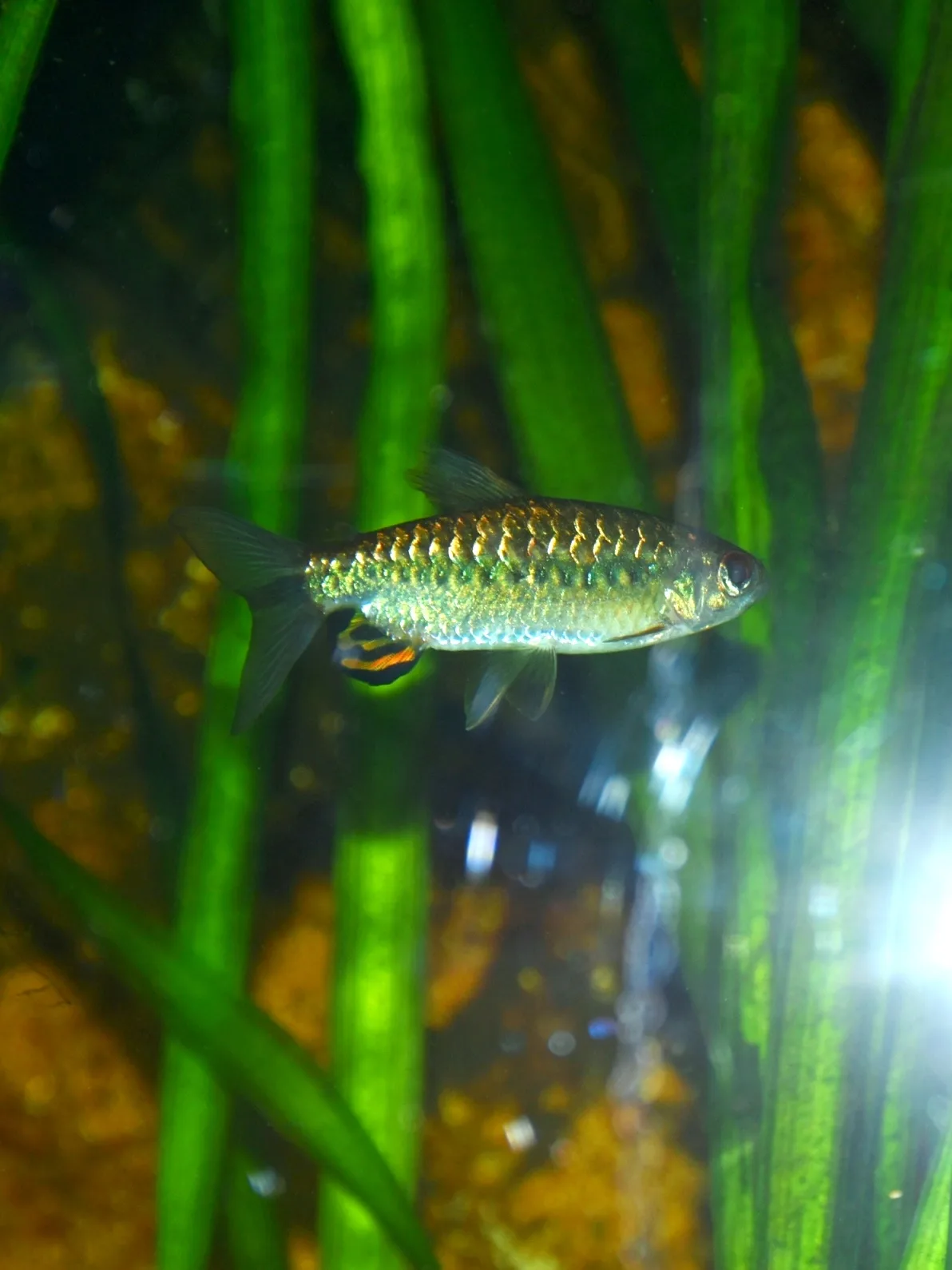
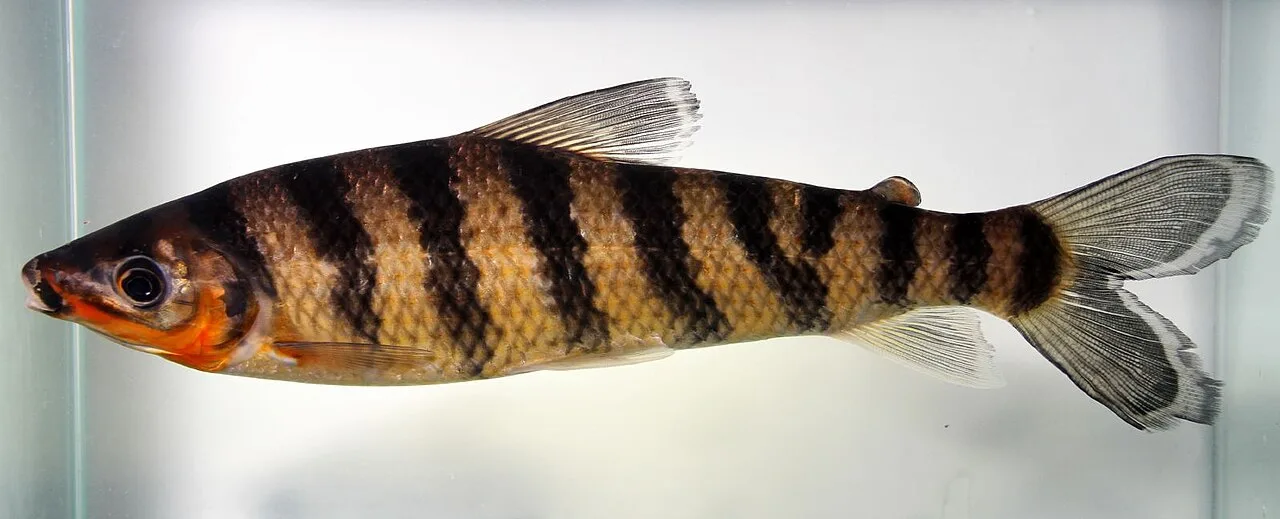


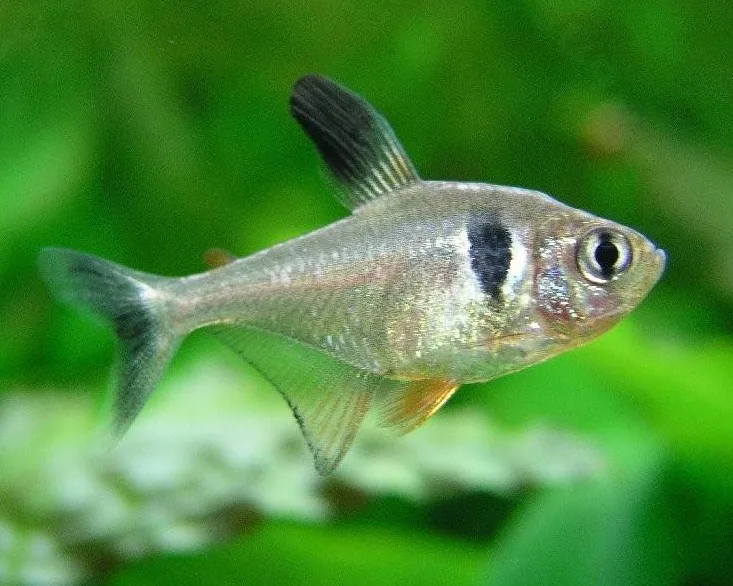

Similar water needs
Species with a similar temperature, a similar pH and a comparable adult size. Whether their behaviour fits as well is what the compatibility check is for.