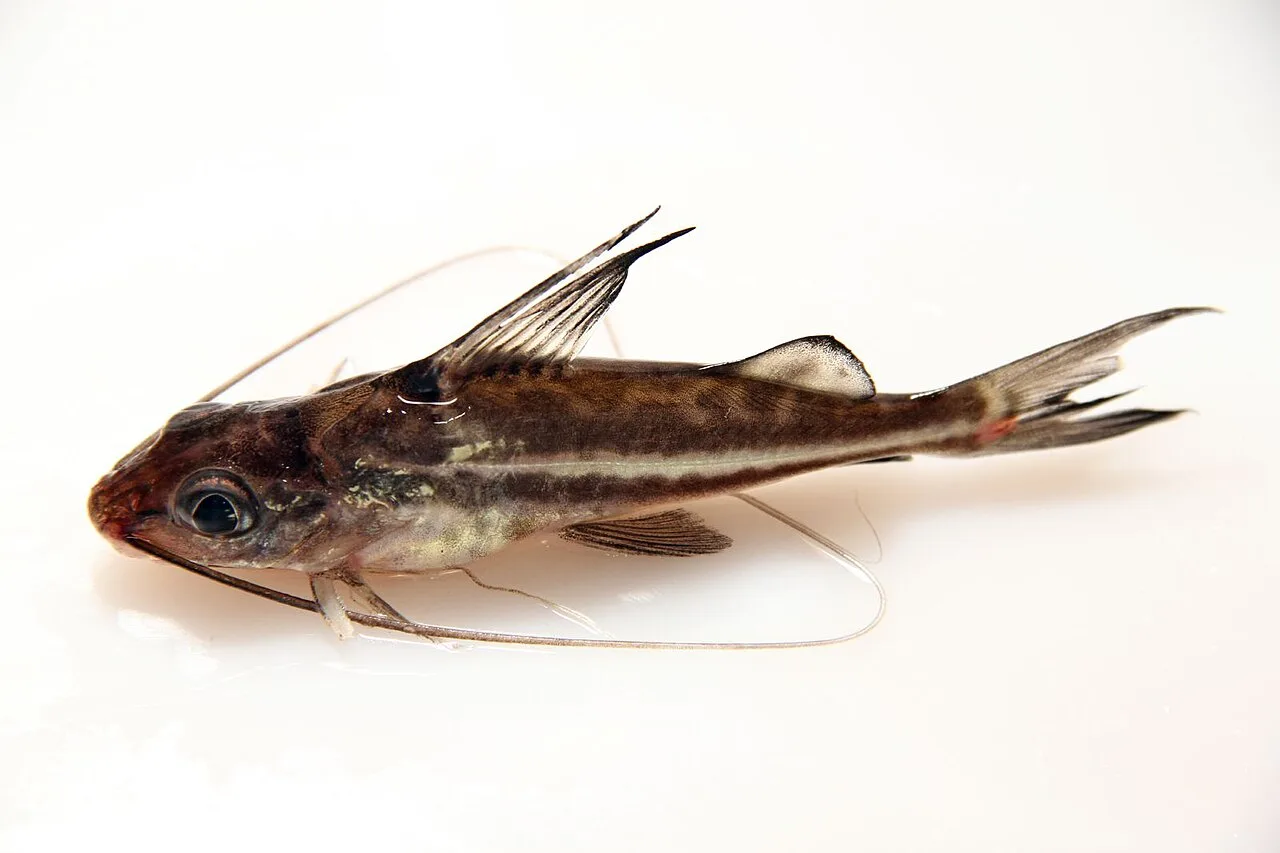
Striped catfish
Pangasianodon hypophthalmus
22 views
A shark catfish, to 150 cm and 44 kg. Unsuited to home aquariums, although juveniles are sold as shark catfish. Pangasius bocourti is another species.
- Temperature
- 22 – 26 °C
- pH
- 6.5 – 7.5 pH
- General hardness
- 2 – 29 °dH
- Maximum size
- 150 cm
- Minimum tank size
- 2000 L
3 min read · 500 words
Fresh water
Quick facts
Further published values
- Lifespan
- 20 a
Place in the aquarium
Highlighted are the water layer and the spots where the species usually stays in the tank.
- Middle water Usually stays in the middle of the tank, between bottom and surface.
- Open swimming space Needs an open area without plants or decor to swim at length. Tank length matters more than height.
Shrimp in the tank
Not shrimp safe
- Not shrimp safe
- Dwarf shrimp at risk
- Shrimplets at risk
- Shrimp safe
- Adult dwarf shrimp
- At risk
- Shrimplets
- Get eaten
- Safe from shrimp size
- No size is safe
The iridescent shark does not go with shrimp. It grows to 130 to 150 cm and eats crustaceans, molluscs and fish besides plants and algae. Even half-grown fish swallow any shrimp they find, including large species.
On top of that the species grows far too large for home aquaria and dashes blindly through the tank when startled. There is no safe shrimp size. Shrimp belong in a tank of their own, the iridescent shark in a very large system.
Home & range
Hatched countries are where the species occurs. It lives in particular waters there, not across the whole country. The points name known waters for orientation, not collection sites.
- Country of origin
- Water for orientation
Native
Overview
Scaleless, dark grey, paler belly. Adults toothless and without the barbels on the lower jaw. Active by day, in groups. It breathes air at the surface, depending on the oxygen. A maximum age a little over ten years. Mature after three to four years, over 50 cm and about 3 kg.
Features
The scaleless, elongated body is dark grey with a lighter belly, and the fins are dark grey to black. Very old fish turn uniformly grey. The anal fin and both tail lobes carry a black central stripe. Adults are toothless and lack lower-jaw barbels. Juveniles carry two black lateral stripes and shimmer, hence the name iridescent shark. The epithet hypophthalmus means below the eye and refers to the low-set eyes. The only other species of the genus is the much larger Mekong giant catfish with its broader head.
The species reaches 130 to 150 cm and up to 44 kg. Sauvage described the species in 1878, and the junior synonym Pangasius sutchi is still common in the hobby. The IUCN lists it as endangered.
Origin & habitat
This describes the origin, not how to furnish the aquarium.
Mekong and Chao Phraya in Thailand, Vietnam, Laos and Cambodia. Those four countries stay coarse. China, Myanmar, Bangladesh, India and the United States are farming countries, not the native range.
The species lives in the Mekong and the Chao Phraya in Thailand, Vietnam, Laos and Cambodia. At the Khone Falls in Laos the Mekong population divides into a southern and a northern stock. In the flood season the fish move onto the floodplains and return to deep river sections from September to December. The swim bladder works as a breathing organ, so the species tolerates oxygen-poor water.
Care
It is kept at 22 to 26 °C, pH 6.5 to 7.5 and 2 to 29 °dH. The fish are easily startled and injure themselves on the glass. A group and the adult size exclude a usual tank.
The species does not suit home tanks because of its final size and group life. It startles easily, dashes off blindly and injures itself on the glass. In aquaria the fish stay at 15 to 30 cm and often die early. Natural development would need a tank at least 12 m long.
Diet
Algae, aquatic plants, zooplankton, molluscs, insects, organic waste, and in large fish also fish, crustaceans and fruit.
In the wild the fish eat algae, aquatic plants, zooplankton, molluscs, insects and organic waste, and larger fish also take fish, crustaceans and fruit.
Behavior
A migrant. Upstream from October, spawning peak from May to July.
Reproduction
Up to 200,000 eggs per kilogram of body weight, on roots. The larvae, about 3 mm long, hatch after 24 to 36 days. Catching the brood for aquaculture has been banned in Cambodia since 1994 and in Vietnam since 2000.
The many sticky eggs are laid on tree roots hanging into the water from the bank, up to 200,000 per kilogram of body weight. The larvae, about 3 mm long, drift downstream. The fish mature at three to four years at over 50 cm. Late maturity makes stocks sensitive to overfishing, and the capture of fry for farms and injuries at hydropower plants add to this.