Raphael catfish
Platydoras armatulus
28 views
A thorny catfish, to 30 cm. Over 30 years, one known fish 34 years. The spines can release venom.
- Temperature
- 23 – 28 °C
- pH
- 6 – 7.5 pH
- General hardness
- 5 – 20 °dH
- Maximum size
- 30 cm
- Minimum group size
- 5
- Minimum tank size
- 250 L
3 min read · 454 words
Fresh water
Quick facts
Further published values
- Lifespan
- 30 – 34 a
Place in the aquarium
Highlighted are the water layer and the spots where the species usually stays in the tank.
- Near the bottom Mostly stays just above the bottom. Food has to reach the substrate.
- Rocks and caves Needs caves, crevices or rockwork as hiding place, territory or spawning site.
Shrimp in the tank
Not shrimp safe
- Not shrimp safe
- Dwarf shrimp at risk
- Shrimplets at risk
- Shrimp safe
- Adult dwarf shrimp
- At risk
- Shrimplets
- Get eaten
- Safe from shrimp size
- No size is safe
The striped Raphael catfish eats shrimp. It grows to 20 to 30 cm, is nocturnal and eats molluscs, crustaceans and organic debris in nature. In the aquarium it even mistakes small fish such as guppies and neons for food at night. Shrimp moving about the bottom at night therefore have little chance, and at this size Amano shrimp are overpowered too. Hiding places protect only partly, because the catfish itself likes to search the substrate and caves. Shrimp do not belong in its tank.
Home & range
Overview
A striking pattern, thorns and spines. The spines tangle in nets. A secretion can be lethal to tankmates, and stress encourages it. Do not catch it by hand or with a net, but with a glass. The sexes are hardly distinguishable from the outside.
Features and confusion
The striped Raphael catfish belongs to the thorny catfish family Doradidae. It is also called talking catfish, chocolate doradid or thorny catfish. It carries rigid spines in the pectoral fins and small curved protective spines along the body. The fin formula is dorsal I/6, anal 11, pectoral I/8 and pelvic 7.
A typical maximum is 20 to 24 cm standard length. Fish up to 43 cm from the Tocantins–Araguaia basin, together with populations from the Tapajós and Xingu, probably belong to an undescribed species. The striped Raphael was long confused with Platydoras costatus from Suriname and French Guiana, in which the pale body stripe does not reach the head. Because all fish are wild-caught, similar species also appear in the trade, such as Orinocodoras eigenmanni with a longer snout. Out of the water the catfish make grunting and squeaking sounds.
Origin & habitat
This describes the origin, not how to furnish the aquarium.
Orinoco, parts of the Amazon basin, especially the upper and middle Amazon with the Rio Solimões and the Rio Madeira, plus the Río Paraguay. The bottom of slow side arms, in sand or mud by day. No state is named.
The species lives in the Amazon, Paraguay–Paraná and lower Orinoco basins. The species frequently lives over sandy bottoms.
Care
In Germany since 1964. Many hiding places of roots, stones and clay tubes. Small fish such as guppies and neons are mistaken for food at night.
Denser planting at the back and a sandy bottom encourage natural behaviour. Because the fish are nocturnal, they should also be fed after the lights go out, since too little is left for them during the day. When caught, the catfish lock their pectoral spines rigidly under stress. Freeing them from a net is difficult and dangerous for fish and keeper.
Diet
In the wild the striped Raphael eats molluscs, crustaceans and organic debris. In the aquarium it is an omnivore that takes food tablets, algae, flakes and sticks, but does not refuse young fish and insect larvae either.
Behavior
Nocturnal and shy. In the wild groups of 5 to 15, and the same is recommended for the aquarium.
Young striped Raphaels have been observed cleaning predatory fish such as Hoplias malabaricus. Their stripe pattern probably serves as a signal identifying them as cleaners. In adults it is weaker, so cleaning probably occurs only in juveniles. Towards other catfish and fish the species is regarded as peaceful and sociable.
Reproduction
Captive breeding has rarely succeeded, once with hormones in the water. That is not a keeping protocol.
Sex differences are unknown.
Gallery
More species in this group
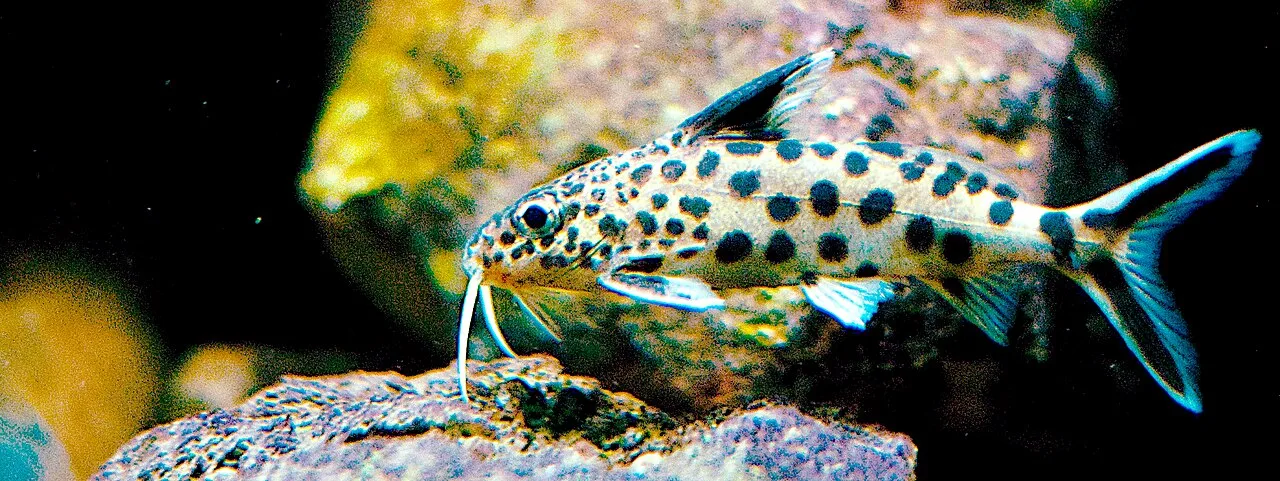
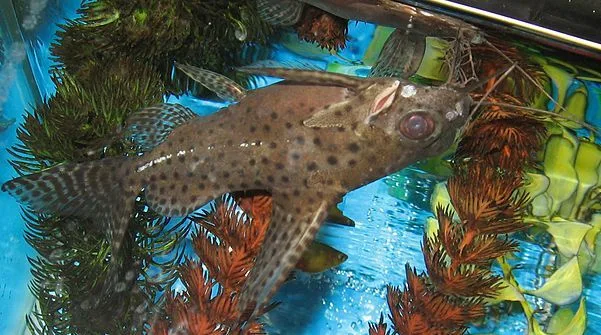
Similar water needs
Species with a similar temperature, a similar pH and a comparable adult size. Whether their behaviour fits as well is what the compatibility check is for.