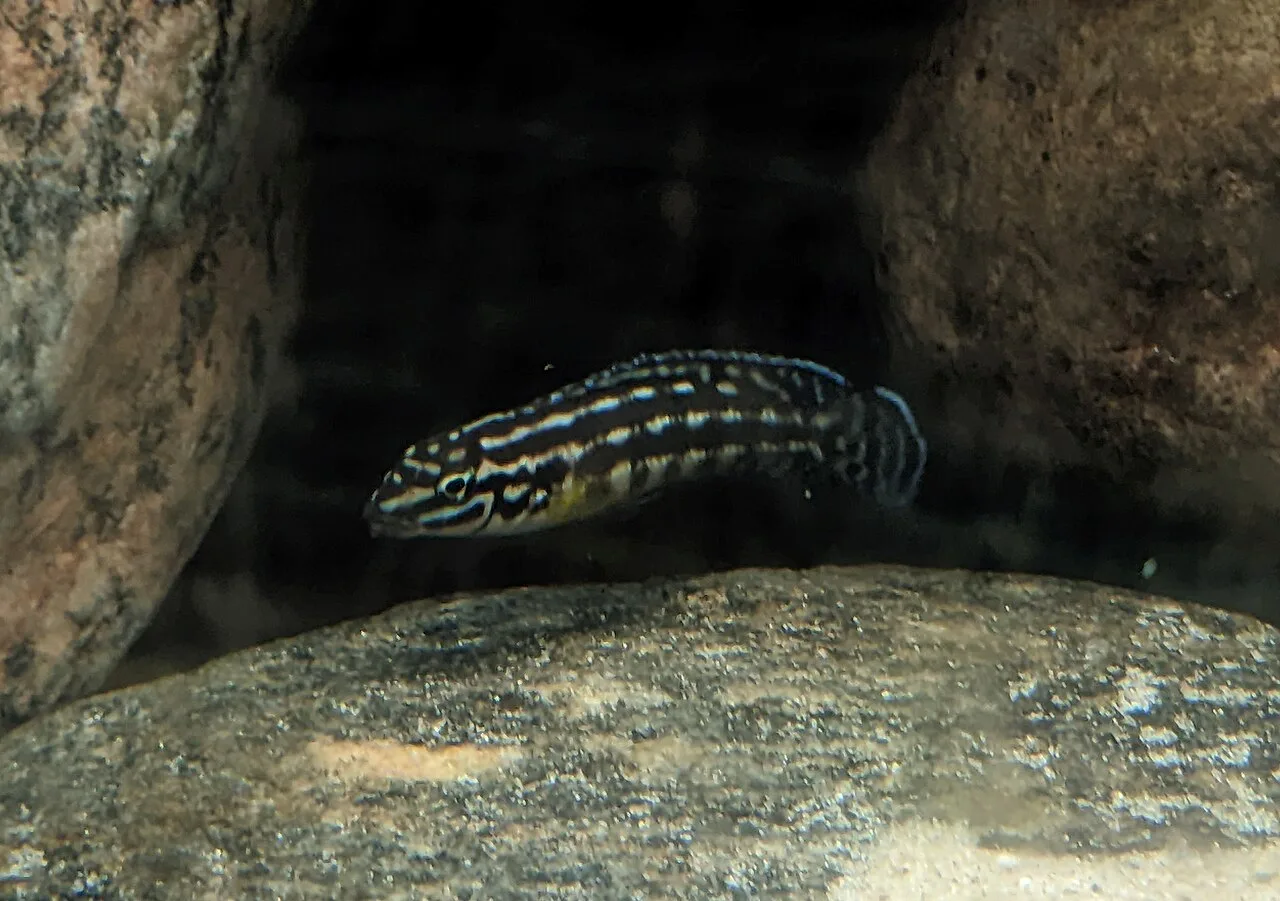
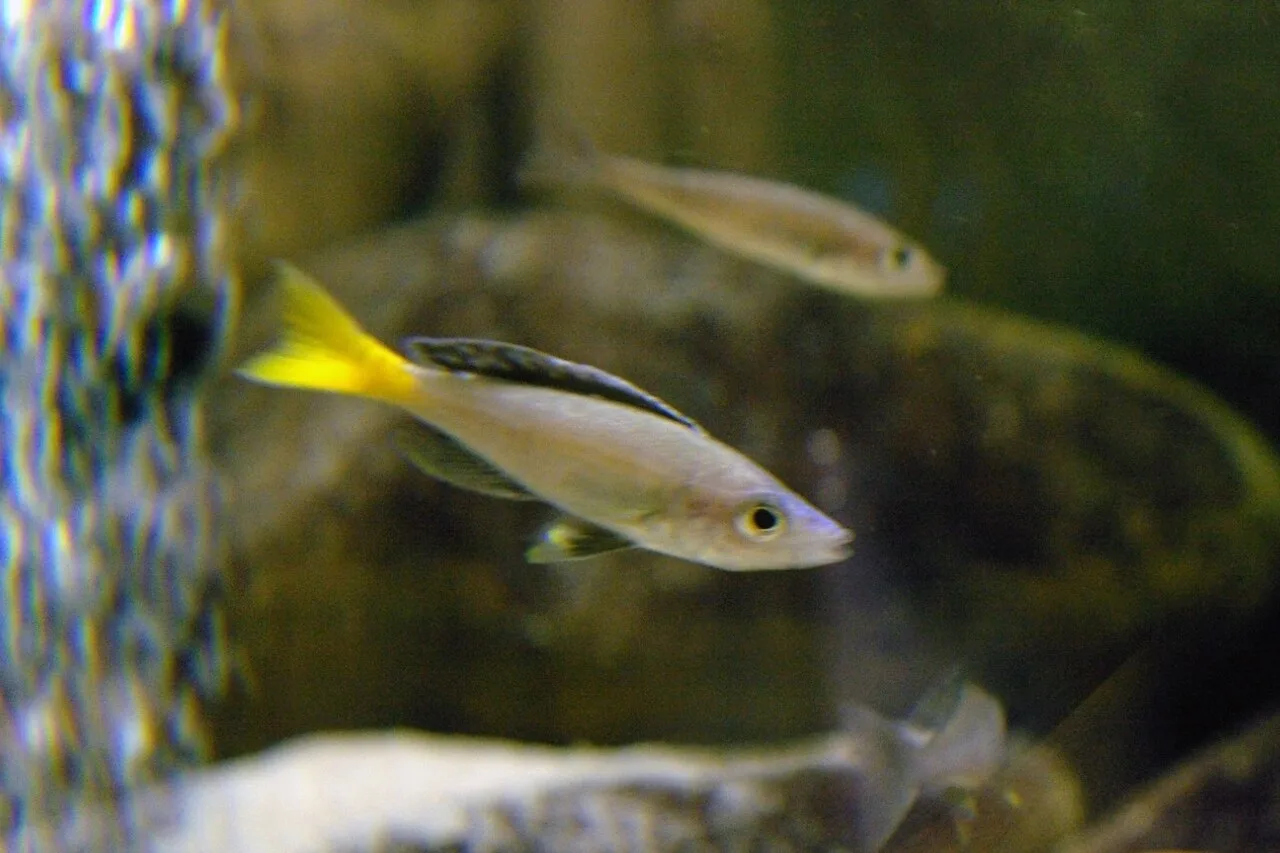
Petricola catfish
Synodontis petricola
27 views
A small squeaker catfish from Lake Tanganyika with dark spots. It needs hard water and hiding places and is not a glass cleaner.
- Temperature
- 24 – 27 °C
- pH
- 8 – 9 pH
- General hardness
- 4 – 15 °dH
- Maximum size
- 10 cm
- Minimum tank size
- 150 L
4 min read · 527 words
Fresh water
Quick facts
Place in the aquarium
Highlighted are the water layer and the spots where the species usually stays in the tank.
- Near the bottom Mostly stays just above the bottom. Food has to reach the substrate.
- Rocks and caves Needs caves, crevices or rockwork as hiding place, territory or spawning site.
Shrimp in the tank
Not shrimp safe
- Not shrimp safe
- Dwarf shrimp at risk
- Shrimplets at risk
- Shrimp safe
- Adult dwarf shrimp
- At risk
- Shrimplets
- Get eaten
- Safe from shrimp size
- No size is safe
Synodontis petricola is not a shrimp companion. It grows to 13.5 cm, searches for food among stones mainly at night and eats water mites, seed shrimp, insect larvae and other small crustaceans besides algae and sponges.
Shrimp it finds in crevices or on the bottom are eaten, including larger ones. There is no safe shrimp size. In addition, the hard, alkaline water of its habitat does not suit most dwarf shrimp. Even putting them together for a while, for example to clean algae, is not a good idea, because added shrimp are quickly recognised as food.
Home & range
Hatched countries are where the species occurs. It lives in particular waters there, not across the whole country. The points name known waters for orientation, not collection sites.
- Country of origin
- Water for orientation
Native
Overview
Synodontis petricola reaches about 10 cm. The body is pale with many dark spots, the fins often with a pale edge. The barbels are long. The species is clearly smaller than many other Synodontis and therefore one of the few that fit a medium Tanganyika tank. It is still not an otocinclus and does not eat algae as its main food.
Juveniles are shy and come out only at dusk. In a tank with many cracks they also stand at the cave mouth by day.
The petricola complex
Synodontis petricola grows to 13.5 cm. The body is brownish with many large dark brown spots, the fin spines are white, and black triangles sit at the bases of all fins except the adipose fin. The tail is deeply forked. The species complex also includes S. lucipinnis with the largest eyes, an undescribed dwarf petricola and a petricola big. Unlike these, S. petricola has an axillary pore. Hubert Matthes described the species in 1959. Petricola means rock dweller.
Origin & habitat
This describes the origin, not how to furnish the aquarium.
Rock and transition zones of Lake Tanganyika. Clear, alkaline, oxygen-rich water. The lake is the origin. Soft acidic water is the wrong chemistry, even if the fish survive for a while.
The species occurs only in Lake Tanganyika, on the shores of Burundi, Zambia, the Democratic Republic of the Congo and Tanzania. It lives on rocky shores in the littoral down to at most 30 m, and its slender body fits into rock crevices. For the lake 23 to 26 °C, pH about 8.5 to 9 and 4 to 15 °dH are given. The IUCN lists it as least concern, while locally overfishing and silting affect it.
Care
Layout
24 to 27 °C, pH 8 to 9, hard. From about 150 litres and 80 cm for a small group, with rock cracks, tubes and sand. More hiding places than fish. Current and oxygen must not be scarce.
Company
Other Tanganyika species. Shell dwellers below and leptosoma above can fit if the petricola has tubes of its own. Malawi mbuna are the poorer mix. Shrimp are eaten. The catfish digs little, but it pushes sand in front of the entrance.
Diet
Frozen food, granules and tablets that sink into the cave mouths. Mosquito larvae, brine shrimp. Food only at the surface misses it. Feed in the evening, when the tetras or mouthbrooders are less dominant.
Juveniles eat water mites, seed shrimps and insect larvae. Adults are generalists that rasp algae from stones and take small invertebrates. A study from 2026 ranks the food in descending order: sponges, algae, plant detritus and small arthropods.
Behavior
Social at dusk, cave-bound by day. Several fish share a large crack, but they argue over the best tube if too few exist. A fish that tumbles in open water all the time usually has a problem with oxygen or with the water chemistry.
Reproduction
The species is a cuckoo spawner: it gives eggs to mouthbrooders that guard a brood. That matters in a Tanganyika species tank and is not a behaviour to expect in a community tank with angelfish. Deliberate breeding is a matter for experienced keepers.
Breeding biology is little known because identification is uncertain. Presumably the fish spawn openly like other members of the complex, preferably in caves, with up to 800 eggs per spawning.
Gallery
More species in this group
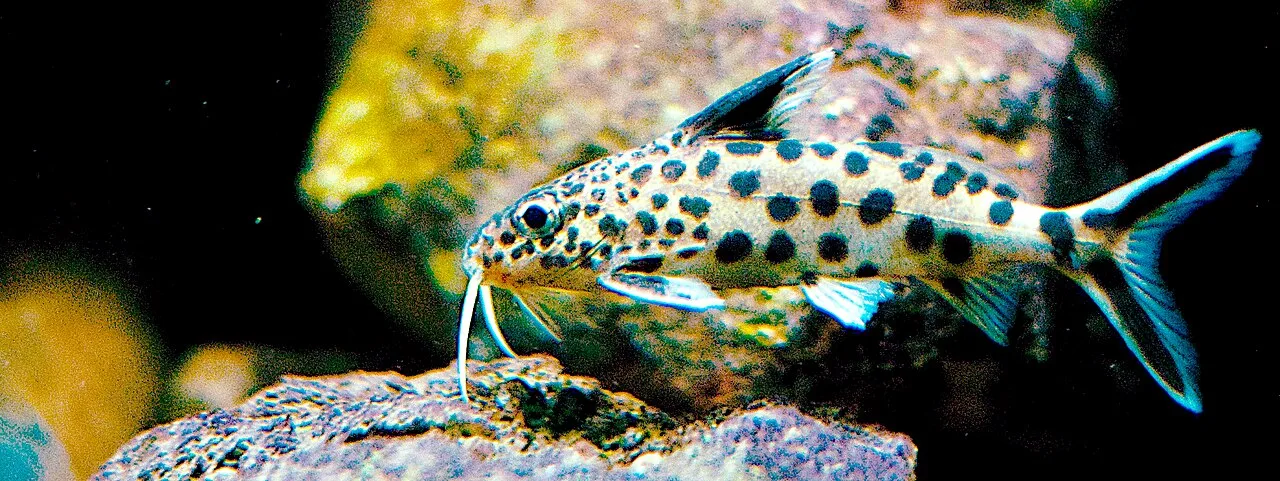
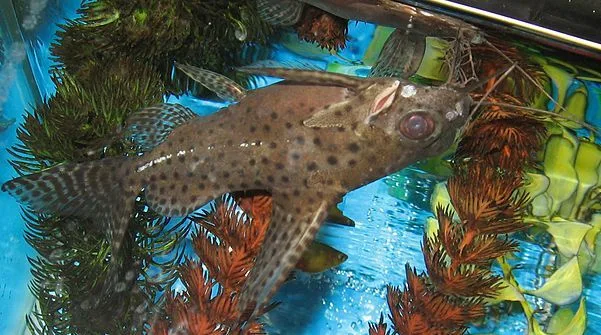

Similar water needs
Species with a similar temperature, a similar pH and a comparable adult size. Whether their behaviour fits as well is what the compatibility check is for.