Shell dweller
Neolamprologus multifasciatus
24 views
A tiny Tanganyika cichlid that builds a colony in empty snail shells. Without shells there is no keeping that deserves the name.
- Temperature
- 24 – 28 °C
- pH
- 8 – 9 pH
- General hardness
- 10 – 20 °dH
- Maximum size
- 4 cm
- Minimum tank size
- 60 L
4 min read · 536 words
Fresh water
Quick facts
Place in the aquarium
Highlighted are the water layer and the spots where the species usually stays in the tank.
- Near the bottom Mostly stays just above the bottom. Food has to reach the substrate.
- Rocks and caves Needs caves, crevices or rockwork as hiding place, territory or spawning site.
- Substrate Sifts through the substrate or burrows into it. Fine, rounded sand without sharp edges suits it.
Shrimp in the tank
Shrimplets at risk
- Not shrimp safe
- Dwarf shrimp at risk
- Shrimplets at risk
- Shrimp safe
- Adult dwarf shrimp
- Safe
- Shrimplets
- Get eaten
- Safe from shrimp size
- about 2 cm
Adult dwarf shrimp are usually safe from the multi. At 3 to 5 cm it is among the smallest cichlids and eats mainly zooplankton drifting past its shells.
Baby shrimp that come close to the shells are eaten, though, and the colony defends its shells. Shrimp from about 2 cm are usually safe. Because the hard, alkaline water of Lake Tanganyika does not suit every shrimp, only species that tolerate it come into question.
Home & range
Overview
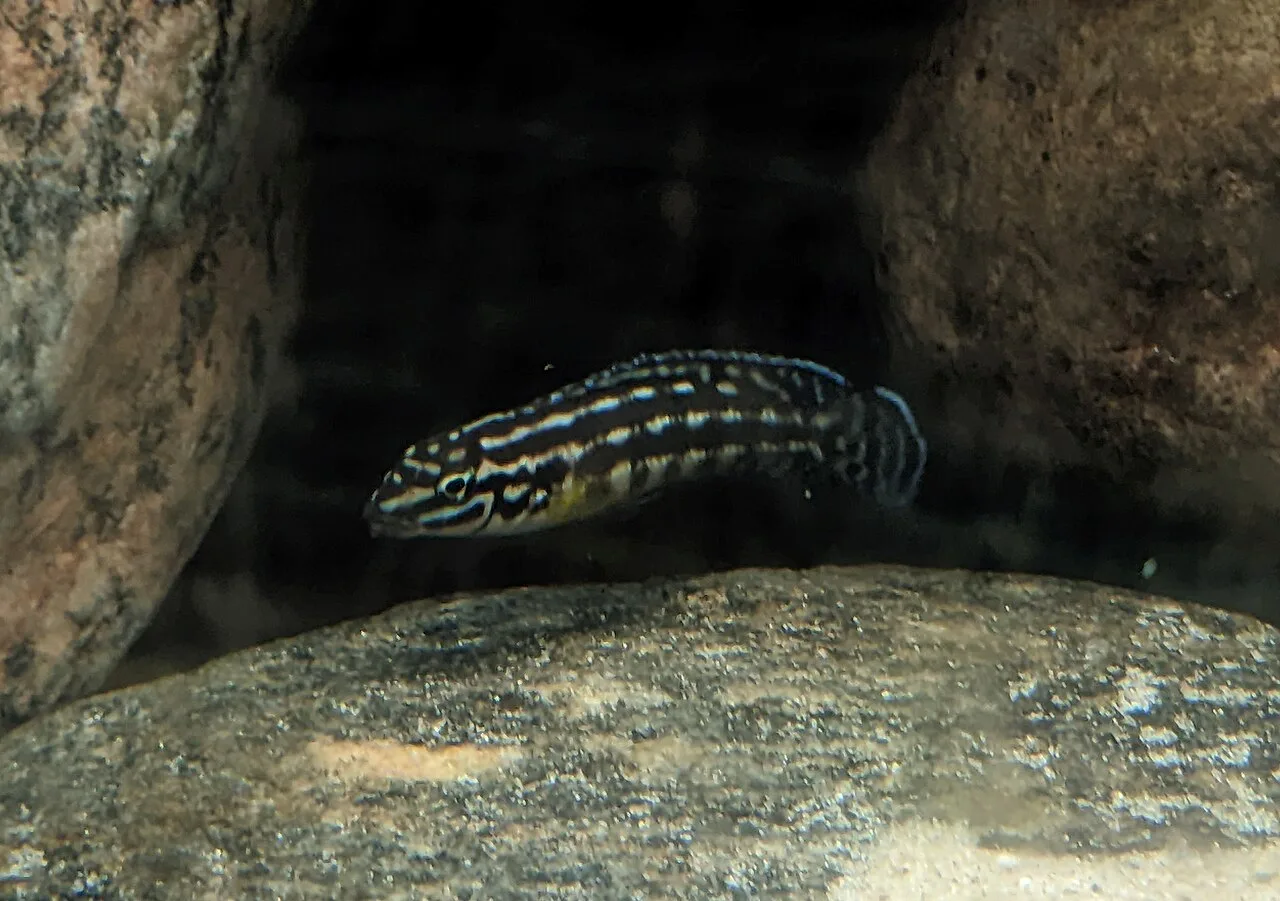
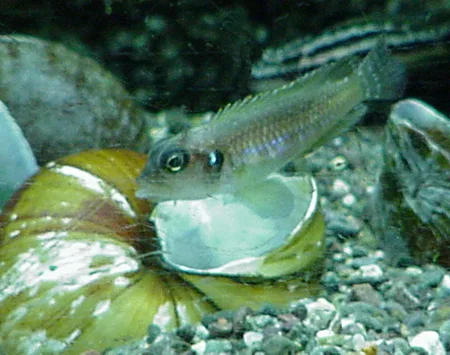
Neolamprologus multifasciatus stays at about 3 to 4 cm, males a little larger and more elongate than females. Pale bars on a sand-coloured ground break up the outline over the bottom. The species is not a general cichlid that spawns anywhere. It is a shell dweller.
Each fish claims at least one shell, dominant males often several. The colony grows sideways and downward, not upward. A tall, empty tank is the wrong shape even when the litres look large.
Similar species
Neolamprologus similis grows to 5 to 7 cm, its bands reach onto the gill cover, it has two to three dorsal spines instead of one, and it shows light bands on a dark ground instead of dark on light. N. brevis is similar too. All three are usually sold as shellies. Egg spots are absent because the eggs lie inside the shell. The species can live longer than four years.
Origin & habitat
This describes the origin, not how to furnish the aquarium.
The species lives in Lake Tanganyika on open sand where empty shells of the snail Neothauma lie. The water is hard and alkaline, clear and rich in oxygen. The fish dig the shells in until only a usable opening remains, and they build a small sand crater around each shell.
The origin is the lake, not a random East African water. Other shell dwellers such as N. similis or N. brevis are separate species with other shell sizes and other social behaviour.
Care
Layout
24 to 28 °C, pH 8 to 9, hard water. Tanks from about 60 litres for a starting group, better long than tall. The substrate is fine sand, several centimetres deep, because the fish dig. Add a field of empty snail shells, clearly more shells than fish. Escargot shells are the usual substitute when Neothauma shells are missing. The opening has to fit the fish.
Stocking
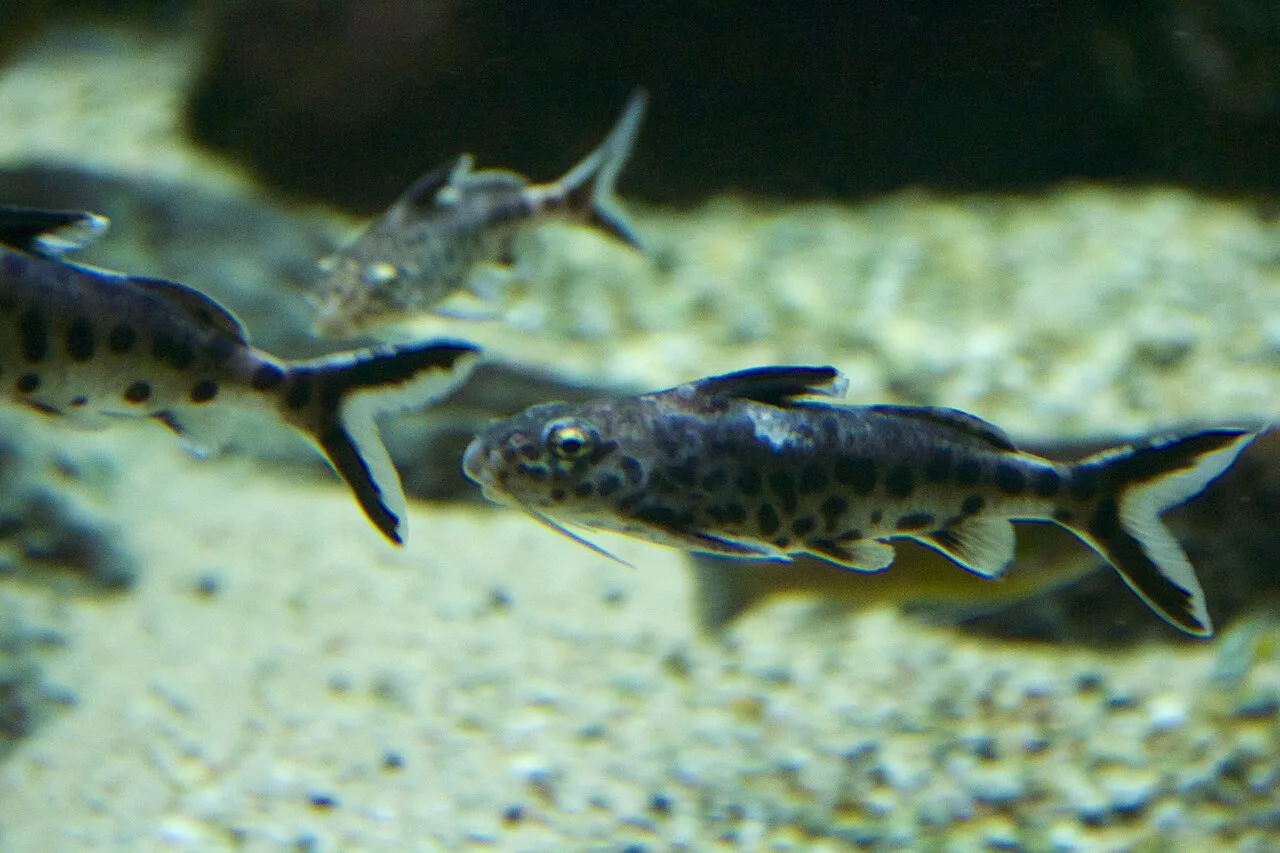
Start with a small group, not a single pair on one shell. The colony then decides how many fish stay. Tankmates only in the upper water, and only if they leave the sand and the shells alone. Corydoras that overturn every shell end the keeping.
Diet
Small animal food. Brine shrimp, cyclops, fine frozen food and a granule that reaches the bottom. The fish feed in front of the shell and retreat with a bite. Food that only drifts at the surface reaches the colony poorly.
A fixed feeding spot beside the shells stops every male from closing the whole area as a feeding territory.
Behavior
A colony of mini-territories. Males patrol between their shells. Females stay closer to their own shell. Fights stay short and ritualised as long as spare shells exist. Without shells the ritual becomes real injury.
The fish work the sand all day. A freshly smoothed sand bed is a field of craters the next morning. That is the species, not a sign that the substrate was chosen wrongly.
Reproduction
A cave spawner inside the shell. The female lays on the inner wall, the male fertilises the clutch. The brood stays in the shell until the young swim out and remain in the crater at first. In a species tank the colony grows. Too many young for too few shells have to be moved on, not packed tighter.
The eggs are invisible inside the shell. Lifting shells to look destroys the brood.
Gallery
More species in this group

Similar water needs
Species with a similar temperature, a similar pH and a comparable adult size. Whether their behaviour fits as well is what the compatibility check is for.