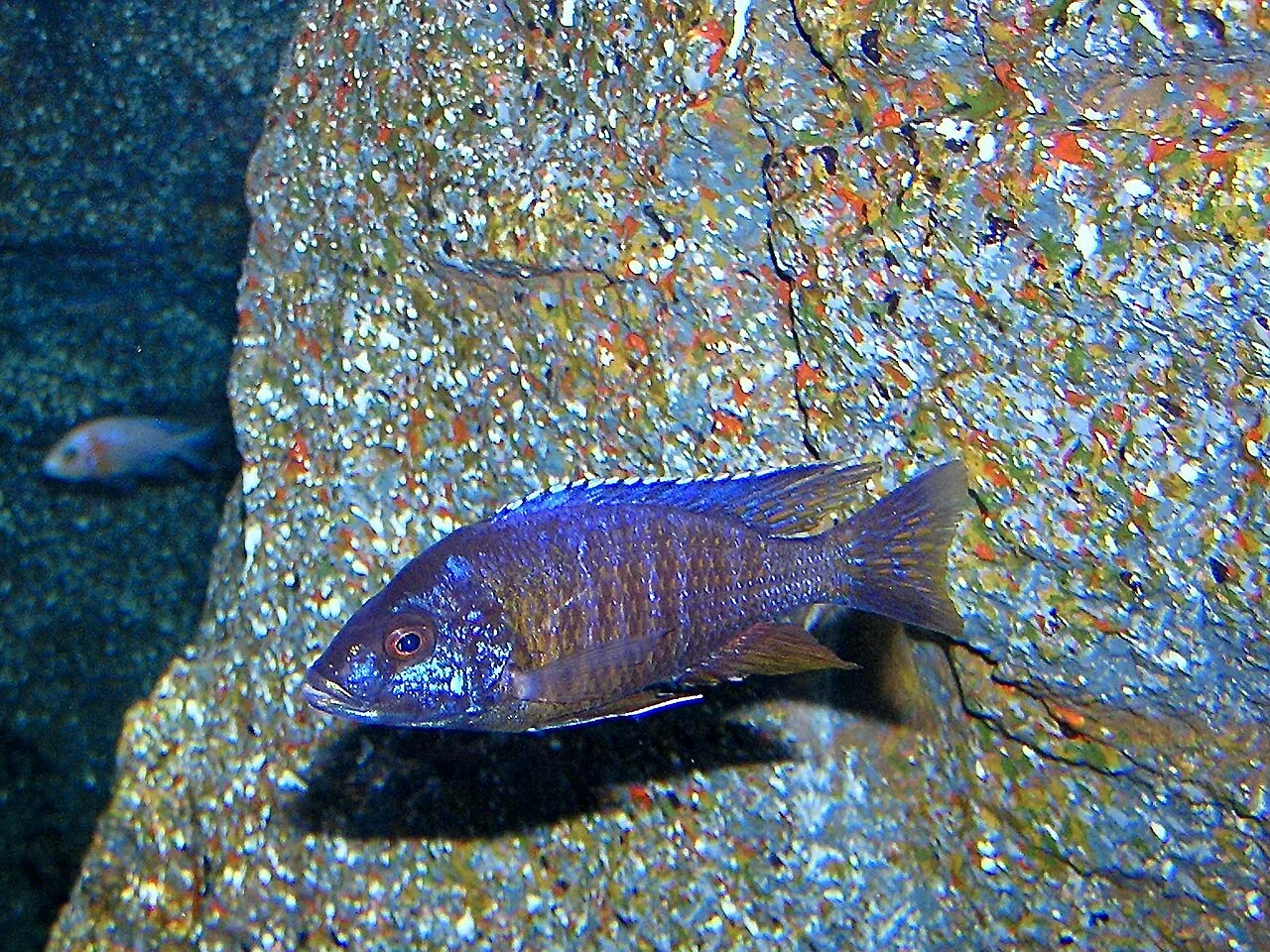
Rusty cichlid
Iodotropheus sprengerae
27 views
A small mbuna from a narrow rock area of Lake Malawi. For a Malawi cichlid it stays more tolerant, but it is not a community fish for tetras.
- Temperature
- 24 – 28 °C
- pH
- 7.5 – 8.5 pH
- General hardness
- 8 – 25 °dH
- Maximum size
- 8 cm
- Minimum tank size
- 150 L
4 min read · 590 words
Fresh water
Quick facts
Place in the aquarium
Highlighted are the water layer and the spots where the species usually stays in the tank.
- Middle water Usually stays in the middle of the tank, between bottom and surface.
- Near the bottom Mostly stays just above the bottom. Food has to reach the substrate.
- Rocks and caves Needs caves, crevices or rockwork as hiding place, territory or spawning site.
Shrimp in the tank
Dwarf shrimp at risk
- Not shrimp safe
- Dwarf shrimp at risk
- Shrimplets at risk
- Shrimp safe
- Adult dwarf shrimp
- At risk
- Shrimplets
- Get eaten
- Safe from shrimp size
- about 4 cm
The rusty cichlid is not safe for dwarf shrimp. It grows to about 10.8 cm and is an opportunistic omnivore that takes not only biofilm but also small animals on the rocks.
Neocaridina and Caridina are found among the stones and eaten, and their young anyway. Larger shrimp from about 4 cm stand a better chance. Because the hard, alkaline water of Lake Malawi tanks does not suit most dwarf shrimp anyway, a separate tank makes sense. A small separate tank with moss and leaf litter is the most reliable solution for a stable shrimp colony and needs little effort to run.
Home & range
Overview
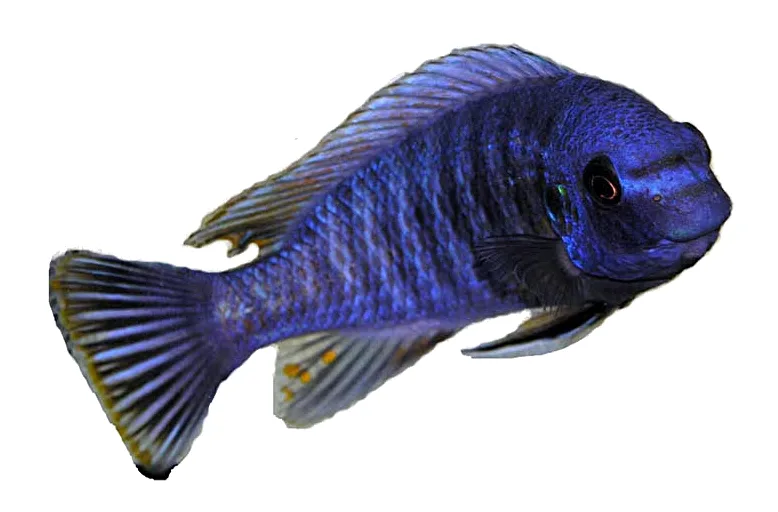
Iodotropheus sprengerae reaches about 8 cm. The colour lies between rusty red and violet, males stronger, females often just as colourful and therefore hard to separate. The species is stocky and not elongate like many other mbuna. Juveniles are paler.
It rasps aufwuchs and also searches the sand between the rocks. A pure aufwuchs food without any animal side is too one-sided, and so is a pure meat diet. The narrow natural area is a reason to keep only captive-bred fish.
Features
The rusty cichlid grows to about 10.8 cm, and females stay smaller. The body is more compact than in most mbuna, strongly compressed, with a steep head profile and a slightly protruding lower jaw. Juveniles and females are rusty brown, and mature males take on a lavender-purple tone. The flanks are bluish violet, the back and head red to rusty brown. The anal fin is violet with an orange edge and carries one to five egg spots without a dark ring. Oliver and Loiselle described the species in 1972 as a new genus. The name honours the Californian aquarist and artist Kappy Sprenger, whose work showed that the fish were an undescribed species.
Origin & habitat
This describes the origin, not how to furnish the aquarium.
The rocky islet Chinyankwazi and the immediate neighbourhood in Lake Malawi. Clear, alkaline water. Malawi is the coarse origin. The small area is not drawn here as an exact shoreline.
The species is endemic to Lake Malawi and lives on the rocky shores of the islands and reefs in the southeastern arm, known for example from Boadzulu, Makokola Reef and the Chinyankwazi and Chinyamwezi islands. The IUCN lists it as near threatened because of its small range, and the effects of aquarium collection and siltation are unknown.
Care
Layout
24 to 28 °C, pH 7.5 to 8.5, hard. From about 150 litres and 100 cm for a group with one male and several females. Rocks with gaps, some sand. Several males only if the tank is longer and each has a field of its own.
Company
Other mbuna that are not overly aggressive, different in colour. Auratus in a short tank is the poorer partner. Tetras and shrimp do not belong. Plants are nibbled. Water changes stay regular.
A temperature of 24 to 26 °C is preferred. Unlike many mbuna the species is hardly territorial and not very aggressive, and is therefore regarded as a good starter. It is not entirely peaceful and needs hiding places and space, or it will be harassed by more aggressive tankmates.
Diet
Plant-based, with a small animal share. Spirulina, flakes, blanched vegetables, now and then brine shrimp or fine frozen food. Several small feeds through the day. One large feeding is held by the male.
In the wild it is an opportunistic omnivore, not only a biofilm grazer. In aquaria it takes many foods, but too much meaty food can cause serious digestive problems.
Behavior
A mouthbrooder with a territory, but less persistently aggressive than many other mbuna, as long as hiding places exist. A female that stands in an upper corner and does not feed still has too little way out. Then rock is missing, not a different food.\n\nThe rusty colour comes with quiet and water quality. Constant fighting makes the fish dark and pale at once.
Reproduction
The female carries for about three weeks and then releases free-swimming young. In the group few survive if hungry adults are in the tank. Do not chase a carrying female behind the glass. The young need fine plant food at once.
The females carry eggs and larvae in the mouth for a few weeks before releasing the young.
Gallery
More species in this group


Similar water needs
Species with a similar temperature, a similar pH and a comparable adult size. Whether their behaviour fits as well is what the compatibility check is for.