Moorii
Tropheus moorii
14 views
Endemic to Lake Tanganyika, 12 to 14.5 cm. More than 20 local colour varieties are not separate species.
- Temperature
- 25 – 28 °C
- pH
- 7.5 – 9 pH
- General hardness
- 8 – 25 °dH
- Maximum size
- 14.5 cm
- Minimum tank size
- 400 L
3 min read · 501 words
Fresh water
Quick facts
Place in the aquarium
Highlighted are the water layer and the spots where the species usually stays in the tank.
- Near the bottom Mostly stays just above the bottom. Food has to reach the substrate.
- Rocks and caves Needs caves, crevices or rockwork as hiding place, territory or spawning site.
Shrimp in the tank
Shrimplets at risk
- Not shrimp safe
- Dwarf shrimp at risk
- Shrimplets at risk
- Shrimp safe
- Adult dwarf shrimp
- Safe
- Shrimplets
- Get eaten
- Safe from shrimp size
- about 2 cm
Tropheus moorii is an algae scraper but not a good shrimp partner. It grows 12 to 14.5 cm and scrapes growth off the rock with flat teeth. It does not deliberately hunt adult shrimp from about 2 cm, but juvenile shrimp on the grazed stone are eaten along with the algae.
The water is decisive: the species needs the very high pH of Lake Tanganyika and a densely stocked, busy rock tank. Dwarf shrimp hardly find peace there. Keeping them together is therefore not recommended.
Home & range
Hatched countries are where the species occurs. It lives in particular waters there, not across the whole country. The points name known waters for orientation, not collection sites.
- Country of origin
- Water for orientation
Native
- Mpulungu
- Type locality at the south end of Lake Tanganyika.
Overview
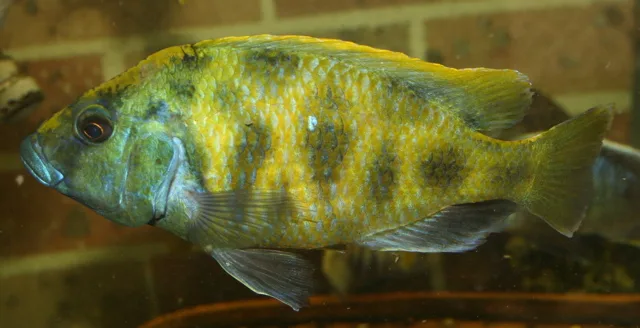
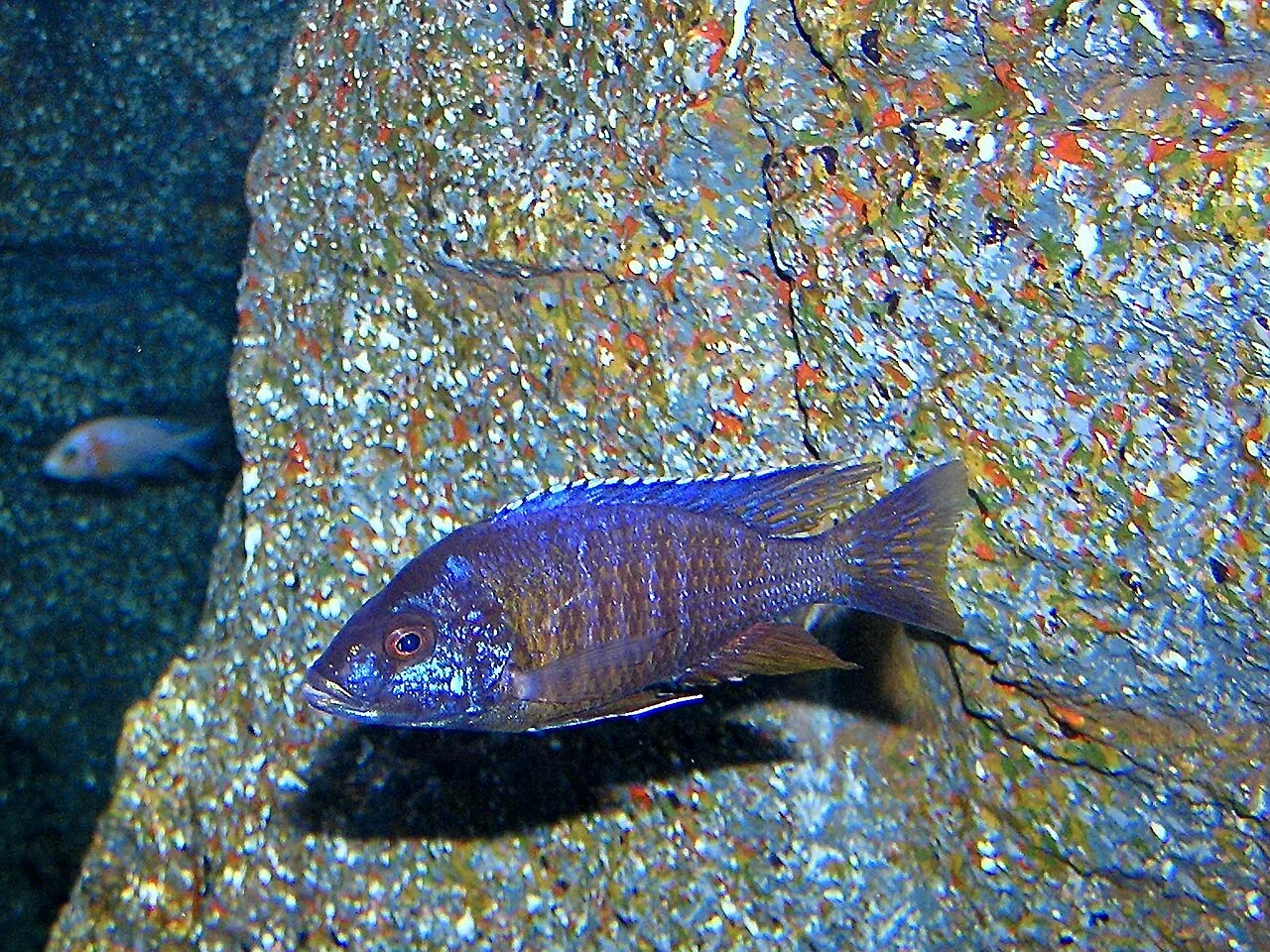
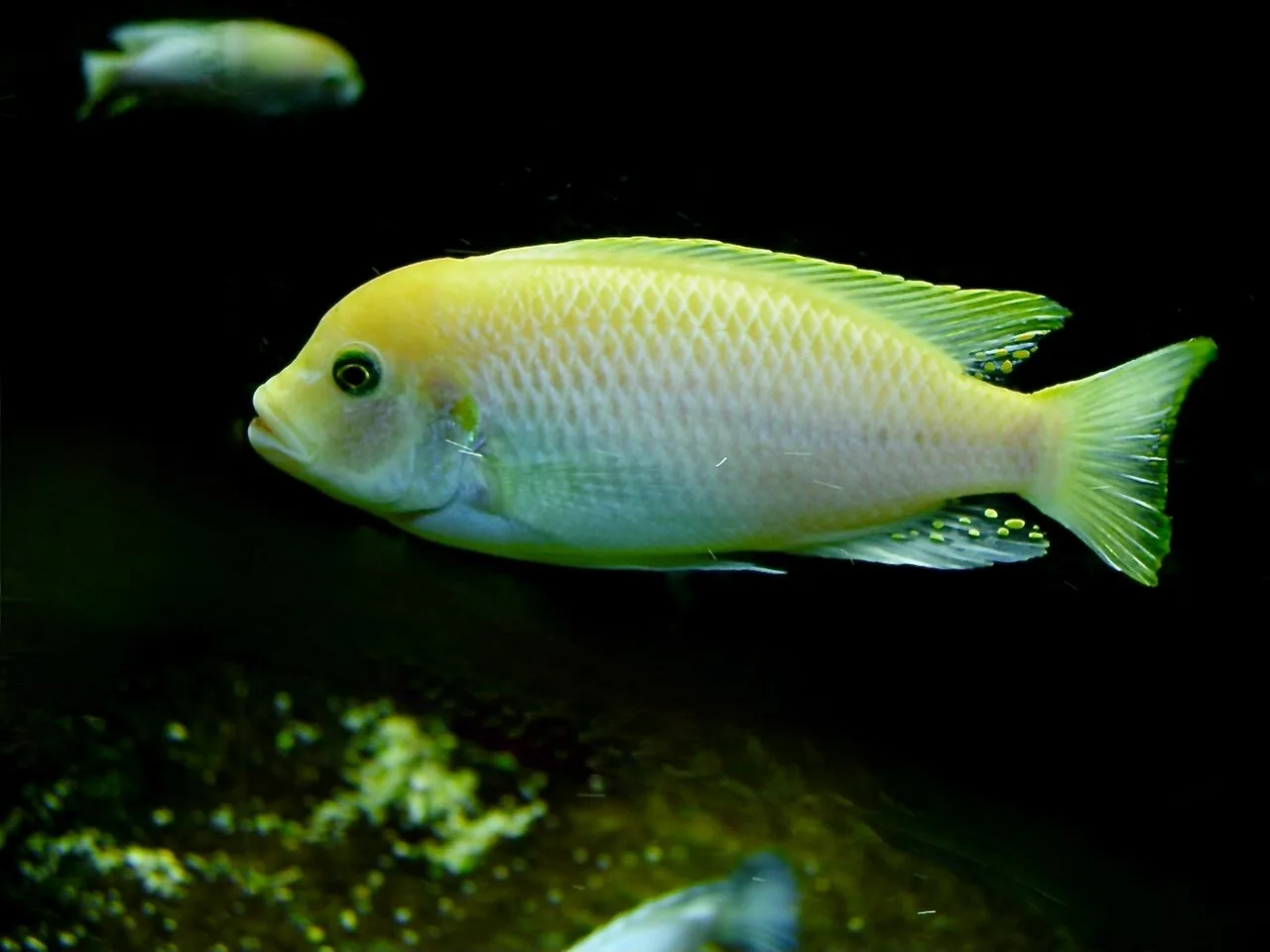
Deep-bodied, inferior mouth, steep profile. The type locality at Mpulungu in Zambia is yellow-green to grey-green with a yellow to orange spot. North and east coast often blackish, south brownish. Young fish with 7 to 8 pale bands. Sexes hardly different, males often with longer pelvic fins.
Systematics
George Albert Boulenger described the species in 1898. It is named after J. E. S. Moore, who collected the type specimens in 1895 and 1896 for the Natural History Museum in London. The genus Tropheus currently has six recognised species. Many authors drop the species name and label colour forms with names such as Tropheus sp. Kigoma or blood-throat moorii. Whether all colour forms belong to T. moorii is unresolved. The blackish population in the north of the lake could be a species of its own.
Further features
The body is only slightly compressed, the mouth broad and the caudal fin notched. In fish from the type locality the yellow to orange flank patch starts right behind the gill cover. The head of adults is speckled with many small light dots. The iris is silvery, with a black zone at the top edged in red. The dorsal fin is bluish, blue-grey or red-violet. Dark scale margins often form a net pattern. Depending on mood the markings are stronger or weaker. There are usually no intermediates between colour forms. Fin formula: dorsal XIX–XXII/5–8, anal IV–VII/6–7. The middle longitudinal row has 30 to 33 scales.
Origin & habitat
This describes the origin, not how to furnish the aquarium.
Rocky shore to 5 m depth. Zambia is named through Mpulungu and stays coarse.
The species is strictly bound to rocky shores. It avoids sandy zones and surf-moved rubble, even stretches only about 20 m wide. The mouths of inflowing rivers also separate the populations, because their water differs chemically and is usually less alkaline. The lake itself has an unusually high pH of 8.6 to 9.5. Known colour forms come from Tanzania, the Democratic Republic of the Congo and Zambia.
Care
The colour forms must not be counted as further profiles.
In the aquarium the fish react very sensitively when the pH falls below the natural range of the lake.
Diet
It scrapes algae from the rocks. That is the diet, not an omnivore label.
The algae are scraped off the rock with flat teeth on the outer edges of the lipless mouth.
Behavior
Constantly active on the rock.
In small groups or schools the fish move constantly up and down the rock walls and swim in and out of crevices and caves.
Reproduction
Tropheus are known elsewhere as mouthbrooders.
Mouthbrooder
Before spawning the partners clean a stone and make digging movements as if to dig a pit. This is regarded as a relic from a time when the ancestors were substrate spawners. Each spawning releases 8 to 17 large eggs 4 to 7 mm across, which the female usually takes into her mouth one by one while they are still sinking. After about four weeks to 45 days the young, 12 to 16 mm long, leave the mouth for the first time. The mother protects them for a further 12 to 14 days.
More species in this group


Similar water needs
Species with a similar temperature, a similar pH and a comparable adult size. Whether their behaviour fits as well is what the compatibility check is for.