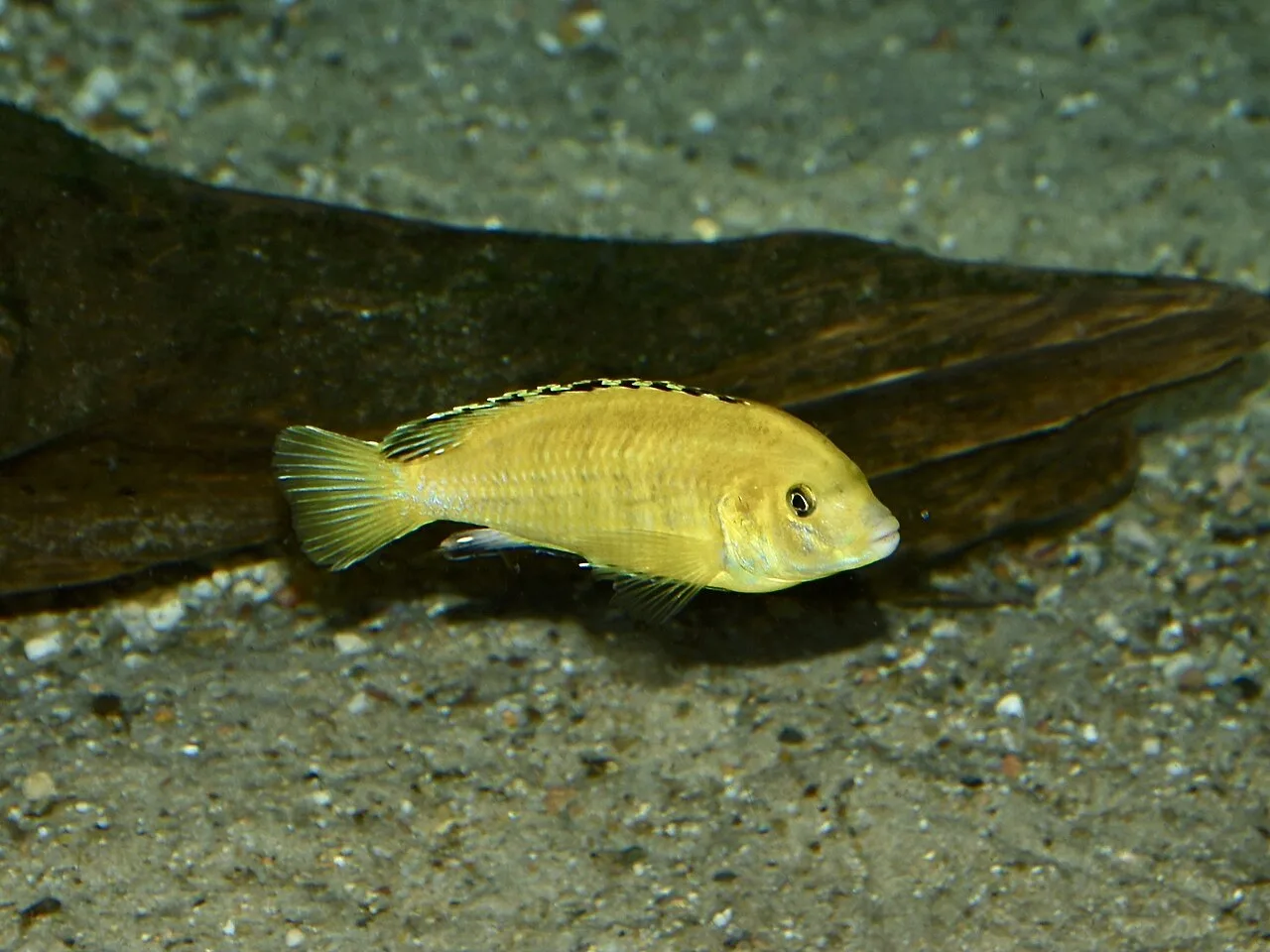
Venustus
Nimbochromis venustus
18 views
A mouthbrooder from Lake Malawi. Haplochromis venustus is the synonym. Females stay smaller than 25 cm.
- Temperature
- 24 – 28 °C
- pH
- 7.5 – 8.5 pH
- General hardness
- 10 – 20 °dH
- Maximum size
- 25 cm
- Minimum tank size
- 500 L
3 min read · 405 words
Fresh water
Quick facts
Place in the aquarium
Highlighted are the water layer and the spots where the species usually stays in the tank.
- Middle water Usually stays in the middle of the tank, between bottom and surface.
- Near the bottom Mostly stays just above the bottom. Food has to reach the substrate.
- Open swimming space Needs an open area without plants or decor to swim at length. Tank length matters more than height.
Shrimp in the tank
Not shrimp safe
- Not shrimp safe
- Dwarf shrimp at risk
- Shrimplets at risk
- Shrimp safe
- Adult dwarf shrimp
- At risk
- Shrimplets
- Get eaten
- Safe from shrimp size
- No size is safe
Venustus is a predator and eats shrimp of any size. It grows to 25 cm, has a wide mouth and feeds mainly on smaller fish and invertebrates. As an ambush hunter it half buries itself in the sand and strikes as soon as prey comes within reach. Dwarf shrimp are a mere bite for it, and Amano or fan shrimp are not safe either. Hiding places help little, because it watches its prey closely. Shrimp do not belong in a tank with this species, and a Malawi tank is unsuitable for most shrimp anyway.
Home & range
Hatched countries are where the species occurs. It lives in particular waters there, not across the whole country. The points name known waters for orientation, not collection sites.
- Country of origin
- Water for orientation
Native
- Lake Malawi
- Range: Lake Malawi, not the whole country.
Overview
Maximum 25 cm. The German name is gold-forehead or peacock mouthbrooder.
Features
At up to 25 cm, Nimbochromis venustus is one of the larger species of its genus. Wild fish reach 25 cm but usually do not exceed 22.5 cm. In English it is called venustus hap or giraffe hap. It is closely related to Nimbochromis livingstonii.
The body is fairly deep: depth is about 38 to 41 percent of standard length, and the head about one third. The mouth is terminal, oblique and wide. The dorsal fin starts early and takes up more than half of the standard length.
Females, males, juveniles
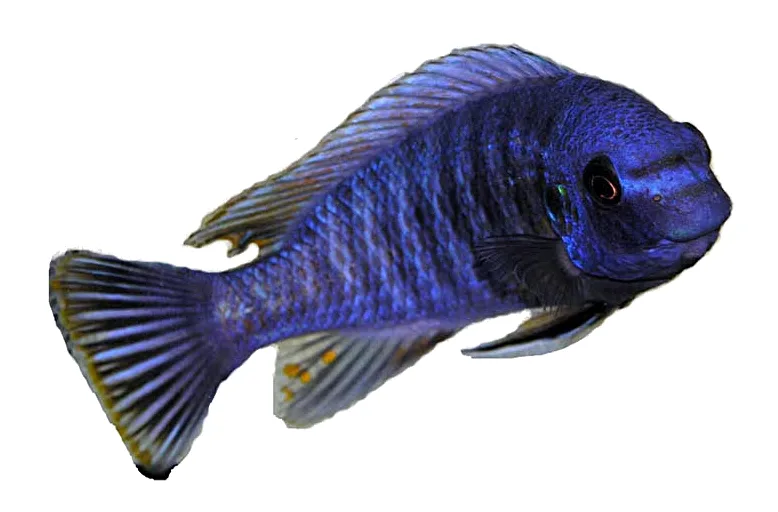
Females are sand-yellow to ivory and carry large olive to fawn-brown blotches that may become diamond-shaped. These blotches recall a giraffe's coat, hence the English name. Males show them faintly or not at all. Their flanks are more or less uniformly curry to lemon yellow, and the head is bright blue. A golden-yellow stripe runs from the upper lip over the snout and forehead into the outer parts of the dorsal fin, and the fin base is bluish. The German name, gold-forehead mouthbrooder, refers to this stripe. Males only gain the blue colouring at sexual maturity. Juveniles look like females.
Origin & habitat
This describes the origin, not how to furnish the aquarium.
Endemic and widespread in Lake Malawi. Malawi stays the coarse origin of the lake name.
Sandy shores and Vallisneria beds
In Lake Malawi the species lives mainly over sand and in beds of the aquatic plant Vallisneria. Juveniles also stay in shallow water near rocks, while adults tend to live below ten metres. Preferred depths are 6 to 23 metres.
Diet
Ambush hunter in the sand
Nimbochromis venustus feeds mainly on smaller fish and also on invertebrates. It hunts especially young cichlids with a technique of its own: once it has spotted prey, it partly buries itself in the sand and lies still until the fish comes close enough. Then it darts out and strikes. Even juveniles have been seen half buried in the sand, which serves as camouflage. For keeping, this means small fish in the same tank are prey.
Behavior
A mouthbrooder.
Males are polygamous and mate with several females. The species is a popular aquarium fish.
Reproduction
Mouthbrooding is the group name, not an egg-count protocol.
Like almost all Lake Malawi cichlids, the species is a mouthbrooder. Females take the eggs into the mouth and later also the young, which can number more than 100. The male takes no part in brood care.
Gallery
More species in this group


Similar water needs
Species with a similar temperature, a similar pH and a comparable adult size. Whether their behaviour fits as well is what the compatibility check is for.