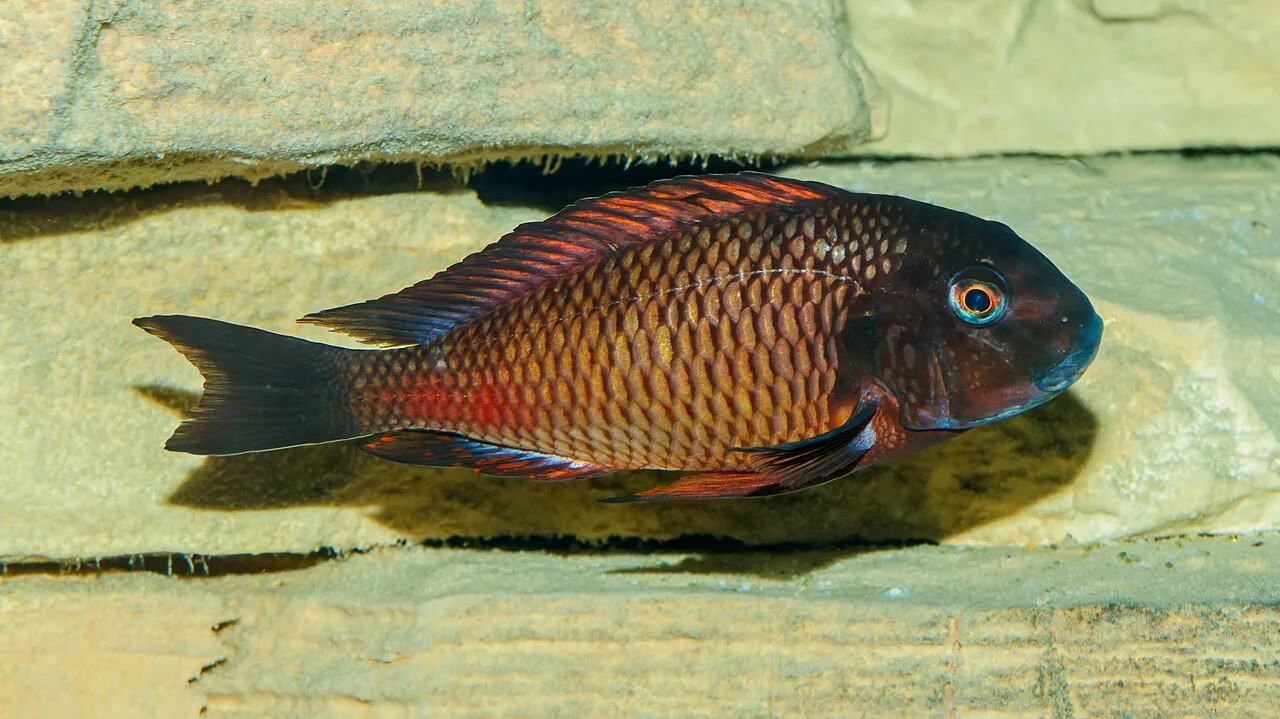
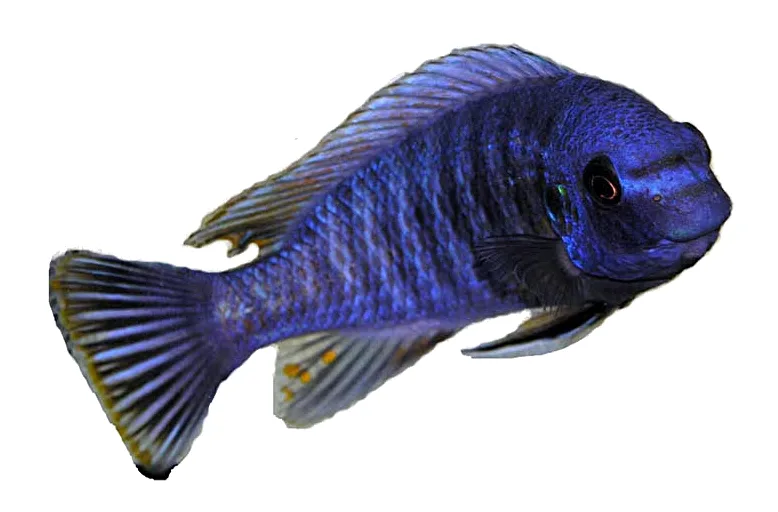
Electric blue hap
Sciaenochromis fryeri
25 views
A mouthbrooding predatory cichlid from Lake Malawi. The males become electric blue and need a long tank, several females, and food that fits the mouth.
- Temperature
- 24 – 28 °C
- pH
- 7.5 – 8.5 pH
- General hardness
- 10 – 20 °dH
- Maximum size
- 16 cm
- Minimum tank size
- 300 L
4 min read · 615 words
Fresh water
Quick facts
Place in the aquarium
Highlighted are the water layer and the spots where the species usually stays in the tank.
- Middle water Usually stays in the middle of the tank, between bottom and surface.
- Rocks and caves Needs caves, crevices or rockwork as hiding place, territory or spawning site.
Shrimp in the tank
Not shrimp safe
- Not shrimp safe
- Dwarf shrimp at risk
- Shrimplets at risk
- Shrimp safe
- Adult dwarf shrimp
- At risk
- Shrimplets
- Get eaten
- Safe from shrimp size
- No size is safe
The electric blue hap is a predator and eats shrimp. In the wild it hunts fish and small invertebrates, and in the aquarium it is a greedy omnivore. Depending on the report it grows to 11.5 to 20 cm, and its mouth is wide enough for dwarf shrimp as well as larger shrimp.
Shrimp do not belong in its tank. It suits a long Malawi tank with other robust cichlids, rockwork and plenty of swimming space. Even Amano shrimp are eaten there.
Home & range
Overview
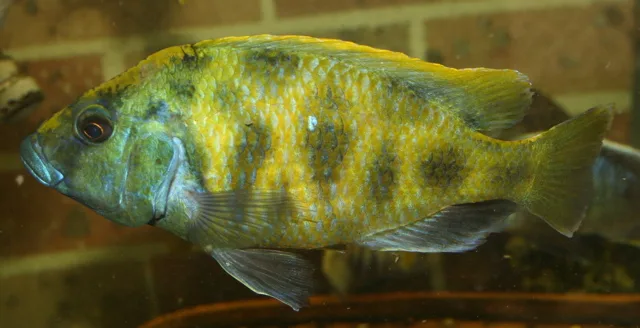
Male Sciaenochromis fryeri reach about 15 to 16 cm and turn intense blue with age, with a metallic forehead. Females stay smaller and silver-grey with a darker pattern. Juveniles all look like females. Anyone who wants to buy three blue fish often buys three future males and then has a permanent conflict, not a stocking.
The species is a haplochromine, not an mbuna. It does not live as an algae rasper in the rock zone. It hunts in open water and over sand. A pure aufwuchs food and a pure rock tank without swimming room do not match that.
Features
A German name is Azurcichlide. Males are steel-blue, females inconspicuously brown. Depending on origin and keeping, young fish start to change colour from 5 cm. A whitish pale aquarium form produced by breeding now exists. Reported sizes range from 11.5 cm standard length to 20 cm body length. In the trade the species is often called electric blue hap, a name also used for the lighter and much rarer Sciaenochromis ahli.
Name
Ad Konings described the species in 1993 in a revision of the genus Sciaenochromis, although it had been imported since the mid-1970s. The name honours Geoffrey Fryer, a fisheries researcher in Northern Rhodesia and Nyasaland.
Origin & habitat
This describes the origin, not how to furnish the aquarium.
Lake Malawi, sandy and rock-edge transition zones, clear, alkaline, oxygen-rich water. Males display over open ground. Females and young stay closer to structure. Malawi is the coarse origin.
In the lake the fish are part of a large predator-prey system. The aquarium lacks that area. The hunter therefore becomes a tank fish that treats small tankmates as prey.
The species is endemic to Lake Malawi and lives along rocky coastal stretches at 10 to 40 m depth. The IUCN lists it as least concern.
Care
Tank
24 to 28 °C, pH 7.5 to 8.5, hard. From about 300 litres and 140 cm long for one male and several females. Sand, a few rock ridges as visual cover, and a long open run. No blackwater, no peat, no soft setup that gives up Malawi hardness.
Stocking
One male, three or more females. Further Malawi cichlids only if they do not show the same blue flank and are themselves large enough not to become food. Tetras, shrimp and dwarf cichlids are prey. Mbuna in a short tank produce a different, equally bad stress.
Diet
Animal food. Granules for carnivores, and frozen food of a fitting size. Not a permanent diet of plants alone. The portions have to fit the mouth. One heavy feed a day is worse than several controlled feeds, because the fish then overwhelm everything by mass and afterwards only dominate the tank.
Live fish as food are unnecessary and a way to bring disease in.
In the wild the electric blue hap eats fish and small invertebrates. In the aquarium it is a greedy omnivore.
Behavior
The male holds a zone and courts every female that passes. Females need distance and cover, or they are courted to exhaustion. Several males without extra metres of length end as one winner and worn-out losers.
The blue colour comes with rank, age and water quality. A pale male in clear, hard water is often the subordinate fish, not a feeding error alone.
Reproduction
Mouthbrooder. The female carries for about three weeks and then releases a finished brood. In a tank of hungry adults little of it survives. A spawning cone or a quiet corner helps the pair. It does not replace a rearing tank if the young are to stay.
Do not chase a carrying female behind the glass. The brood is lost in a panic.
Breeding in the aquarium is possible. The females are mouthbrooders. Because the species is a keen swimmer, a tank at least 150 cm long is recommended.
Gallery
More species in this group


Similar water needs
Species with a similar temperature, a similar pH and a comparable adult size. Whether their behaviour fits as well is what the compatibility check is for.