
Featherfin squeaker
Synodontis eupterus
19 views
A squeaker. Total length figures are 15 or 23 cm.
- Temperature
- 22 – 26 °C
- pH
- 6.5 – 7.5 pH
- General hardness
- 5 – 15 °dH
- Maximum size
- 23
- Minimum tank size
- 100 L
2 min read · 284 words
Fresh water
Quick facts
Place in the aquarium
Highlighted are the water layer and the spots where the species usually stays in the tank.
- Near the bottom Mostly stays just above the bottom. Food has to reach the substrate.
- Rocks and caves Needs caves, crevices or rockwork as hiding place, territory or spawning site.
Shrimp in the tank
Not shrimp safe
- Not shrimp safe
- Dwarf shrimp at risk
- Shrimplets at risk
- Shrimp safe
- Adult dwarf shrimp
- At risk
- Shrimplets
- Get eaten
- Safe from shrimp size
- No size is safe
The featherfin squeaker is not suitable for shrimp. Depending on the figure it grows to 15 to 23 cm, wild fish to 30 cm, and like other squeakers it searches for food mainly at dusk and at night, including among roots.
Shrimp it finds are eaten, and at its size larger species too. There is no safe shrimp size. Shrimp therefore belong in a tank of their own. Even putting them together for a while, for example to clean algae, is not a good idea, because added shrimp are quickly recognised as food.
Home & range
Overview
Described in 1901 as Synodontis eupterus. The name refers to the beautiful fin.
Features
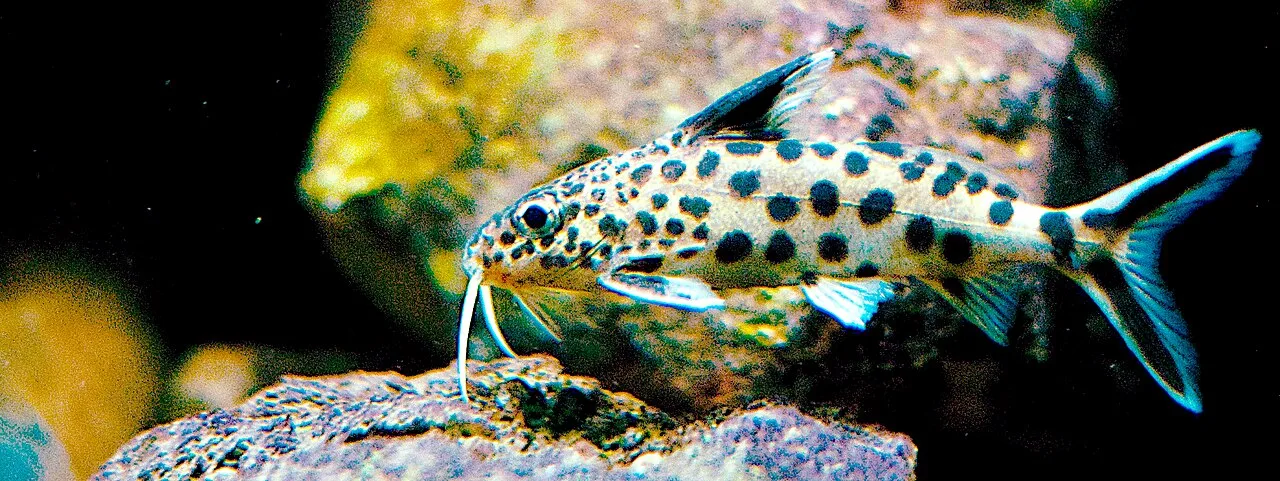
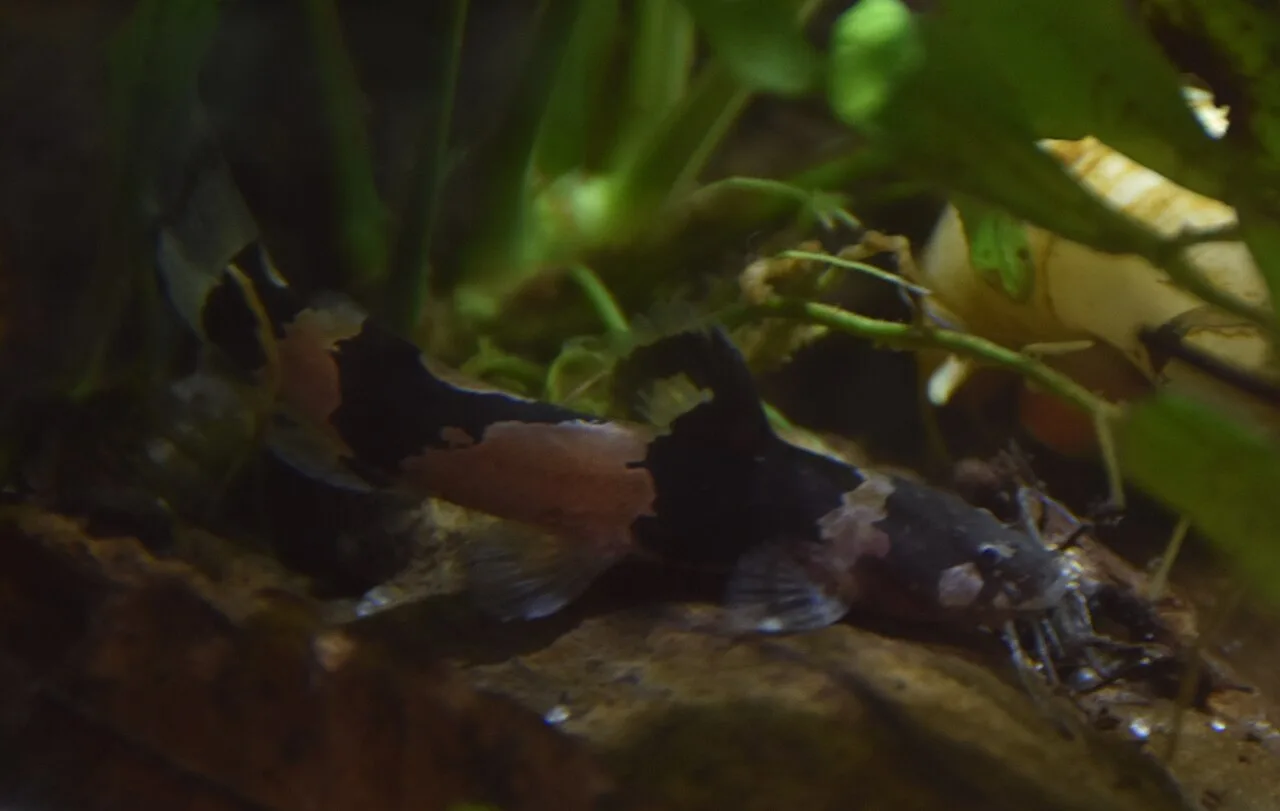
The mark of the species is the strongly elongated rear dorsal rays of adults. Juveniles carry a narrow, slightly wavy, almost white vertical line with dark edges on the caudal peduncle in front of and behind the adipose fin, and their fins are banded. With age the line and edges fade and the bands break up into dots. Adults are covered with small blackish dots on a brownish olive ground. Length figures range from 15 to 23 cm, and wild fish reach 30 cm standard length.
Boulenger described the species in 1901 from the White Nile. The name is Greek: eu means beautiful and pteron fin. Synonyms are Synodontis galinae and Synodontis macrepipterus. The IUCN lists it as least concern.
The species belongs to the Mochokidae, and the genus Synodontis holds over 130 species.
Origin & habitat
This describes the origin, not how to furnish the aquarium.
The species lives from the middle Nile, with Lake No as type locality, across the Chad basin to the Niger and Volta systems.
Care
The length stays disputed and therefore has no trait.
The species is regarded as a peaceful aquarium fish. It should not live with fin nippers, because the elongated dorsal rays attract them. It has been mentioned in the hobby since about 1990, and the date of the first import is unknown.
Behavior
It sometimes swims upside down, especially among roots, which is why the family is called upside-down catfishes. The fish make sounds to communicate.
Reproduction
One of more than 130 Synodontis species, not the upside-down Congo catfish.
Little is known about reproduction, and the fish are presumably egg scatterers. Pure captive breeding has not yet succeeded. In the trade, mainly in Eastern Europe, there are hybrids produced with pituitary hormones.
Gallery
More species in this group

Similar water needs
Species with a similar temperature, a similar pH and a comparable adult size. Whether their behaviour fits as well is what the compatibility check is for.


