Pictus catfish
Pimelodus pictus
18 views
A pictus catfish, maximum 25 cm, from the Peruvian, Colombian and Venezuelan Amazon. Too large for a usual home tank.
- Temperature
- 24 – 28 °C
- pH
- 6 – 7 pH
- General hardness
- 2 – 15 °dH
- Maximum size
- 25 cm
- Minimum tank size
- 400 L
3 min read · 363 words
Fresh water
Quick facts
Place in the aquarium
Highlighted are the water layer and the spots where the species usually stays in the tank.
- Near the bottom Mostly stays just above the bottom. Food has to reach the substrate.
- Open swimming space Needs an open area without plants or decor to swim at length. Tank length matters more than height.
Shrimp in the tank
Not shrimp safe
- Not shrimp safe
- Dwarf shrimp at risk
- Shrimplets at risk
- Shrimp safe
- Adult dwarf shrimp
- At risk
- Shrimplets
- Get eaten
- Safe from shrimp size
- No size is safe
The pictus catfish is not suitable for shrimp. Depending on the report it grows to 11 to 25 cm, searches the bottom for food at night and eats very small fish such as neon tetras as well as insects. With its long barbels it finds prey even in hiding places. Dwarf shrimp and their young are eaten, and larger shrimp are not safe either.
Shrimp belong in a separate tank. The pictus catfish needs a large tank with plenty of swimming space and tankmates too large to eat.
Home & range
Hatched countries are where the species occurs. It lives in particular waters there, not across the whole country. The points name known waters for orientation, not collection sites.
- Country of origin
- Water for orientation
Native
Overview
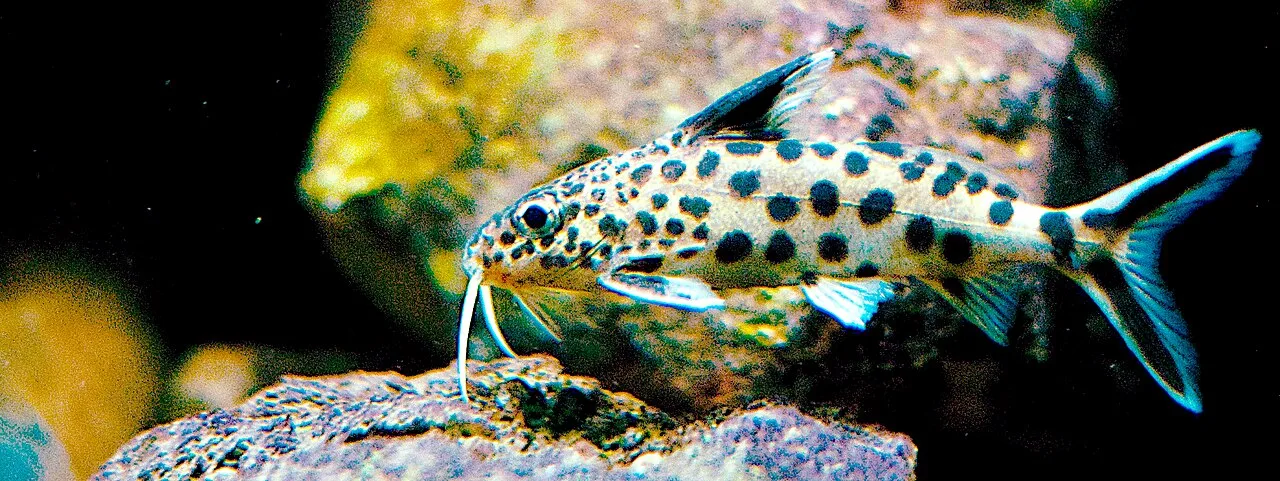
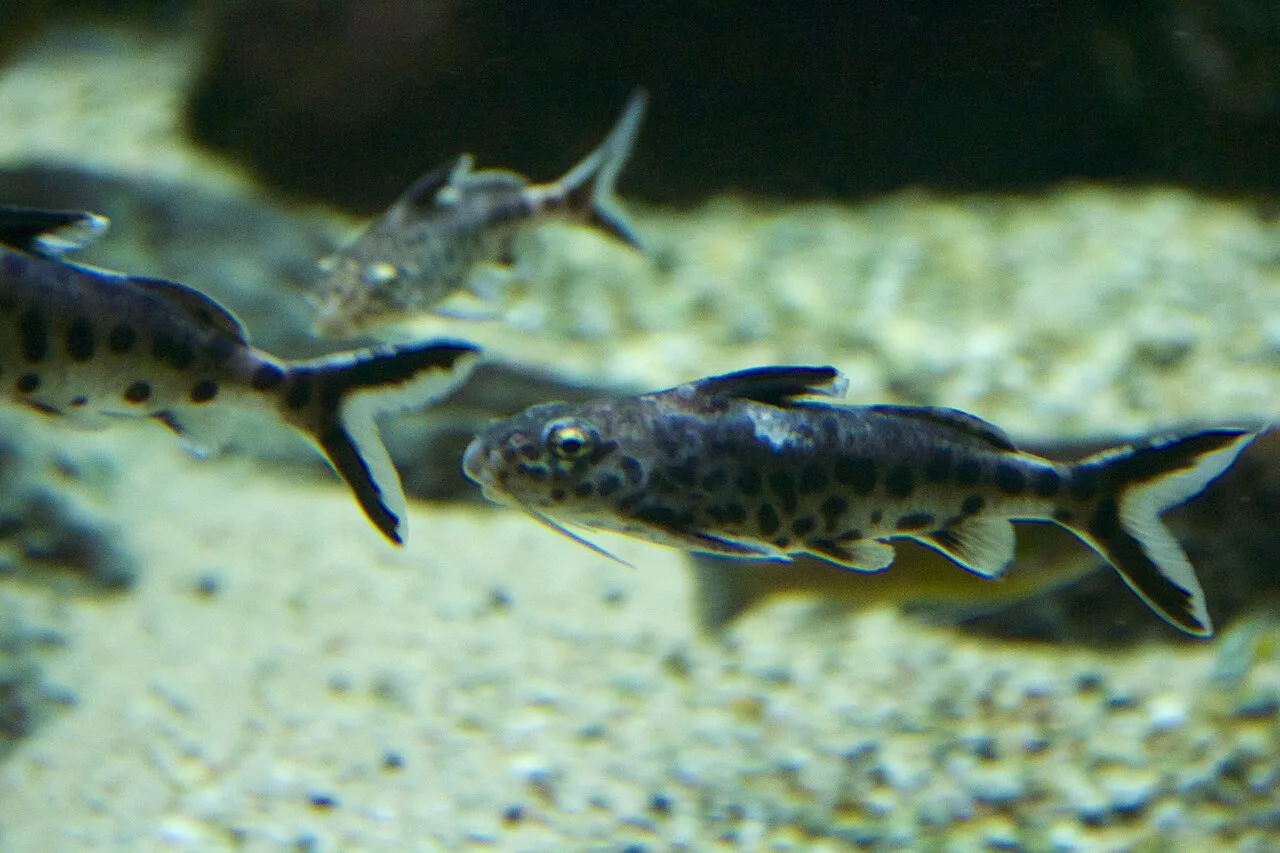
Silvery white, large round dark-brown to black spots, three long pairs of barbels, the lateral line as a white line. Sex differences are not known.
Features
The pictus catfish has a strongly shining silvery white body. The large round spots sit on the flanks, on the dorsal and anal fins and on the triangular adipose fin. On the tail they may merge into bands. The fins are bluish white, and the rear edge of the dorsal fin is black. The barbels can reach the tail fin. The mouth is downturned and the tail forked. The dorsal and pectoral fins carry sharp spines that pierce plastic bags and catch in nets. The dorsal spine can give a mild venomous sting; otherwise the species is harmless to humans.
There is a large-spotted and a small-spotted form. Almost only the large-spotted form is traded, and it stays smaller. Sizes range from 11 to 25 cm. Females are slightly larger than males. The species is sometimes confused with the African Synodontis angelica, which is occasionally sold under a similar trade name, and with the much larger Leiarius pictus.
Name
Franz Steindachner described the species in 1876. The Latin pictus means painted.
Origin & habitat
This describes the origin, not how to furnish the aquarium.
Western and northern Amazon, including the Marañón and the Ucayali. Peru, Colombia and Venezuela stay coarse.
The native range covers the Amazon and Orinoco basins. The IUCN lists the species as least concern.
Care
All fish in the trade are wild-caught.
Keeping notes
In the aquarium the pictus catfish prefers soft water. Because it is an agile, fast swimmer it needs a larger tank. It is not territorial and can be kept with others of its kind. It leaves fish alone that are too large to eat, but very small species such as neon tetras may be eaten depending on size. The trade relies on wild-caught fish, imported to Europe for their colour and liveliness.
Diet
Omnivore.
Captive fish are fed bloodworms, beef heart, insects, vegetables and prepared food. Like many catfish the species searches for food mainly at night on the bottom.
Behavior
Lively, mainly active at dusk and at night, a schooling fish without a stated minimum.
Reproduction
Captive breeding has not succeeded so far.
Gallery
More species in this group

Similar water needs
Species with a similar temperature, a similar pH and a comparable adult size. Whether their behaviour fits as well is what the compatibility check is for.