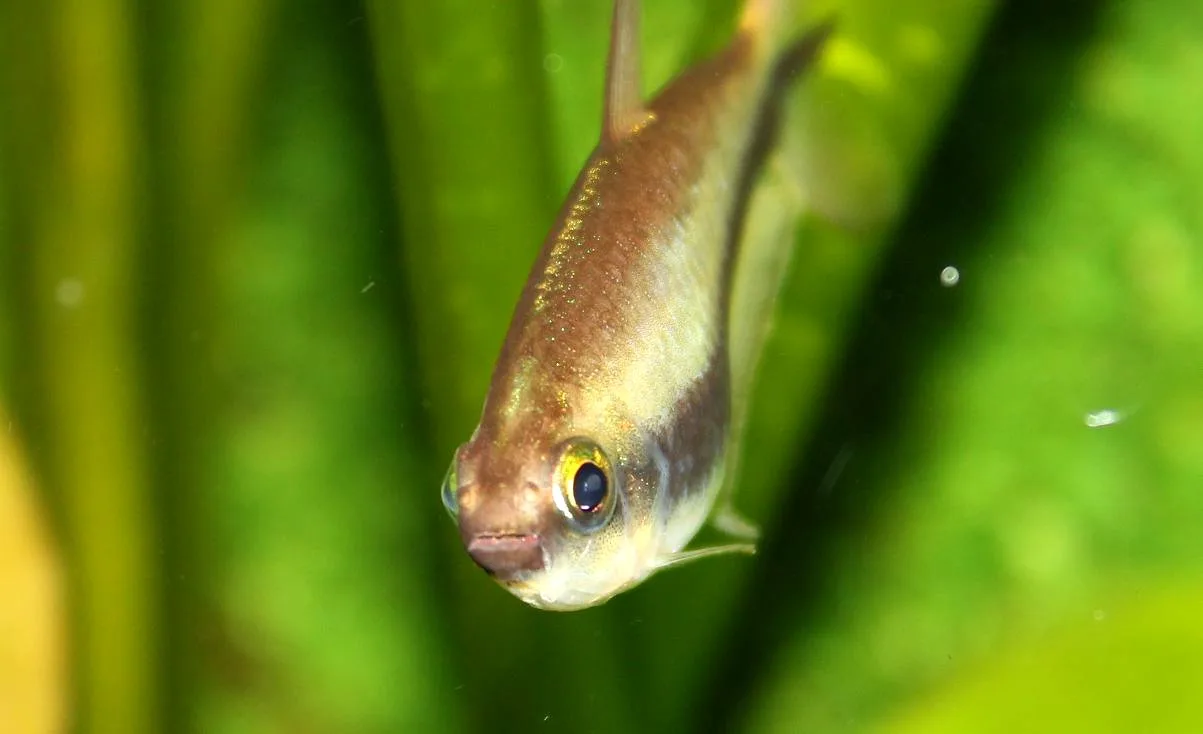
Congo tetra
Phenacogrammus interruptus
20 views
An African tetra from rainforest rivers of the middle Congo. Males carry extended fins, females stay plain.
- Temperature
- 24 – 27 °C
- pH
- 6 – 7.5 pH
- General hardness
- 2 – 12 °dH
- Maximum size
- 12 cm
- Minimum group size
- 6
- Minimum tank size
- 100 L
4 min read · 551 words
Fresh water
Quick facts
Place in the aquarium
Highlighted are the water layer and the spots where the species usually stays in the tank.
- Middle water Usually stays in the middle of the tank, between bottom and surface.
- Open swimming space Needs an open area without plants or decor to swim at length. Tank length matters more than height.
Shrimp in the tank
Dwarf shrimp at risk
- Not shrimp safe
- Dwarf shrimp at risk
- Shrimplets at risk
- Shrimp safe
- Adult dwarf shrimp
- At risk
- Shrimplets
- Get eaten
- Safe from shrimp size
- about 4 cm
The Congo tetra is risky for dwarf shrimp. Depending on the account it grows to 7 to 12 cm and eats worms, small insects, crustaceans and aquatic plants. At this size, young shrimp and smaller adult Neocaridina or Caridina fit its mouth well. Larger shrimp from about 4 cm, such as Amano shrimp, are usually safe. The lively schooling fish need plenty of swimming space, in which small shrimp find little protection. Anyone who wants to keep dwarf shrimp puts them in a separate tank.
Home & range
Hatched countries are where the species occurs. It lives in particular waters there, not across the whole country. The points name known waters for orientation, not collection sites.
- Country of origin
- Water for orientation
Native
Overview
Older names such as Alestopetersius interruptus and Micralestes interruptus refer to the same species. Mature males show extended middle rays in the tail and an extended dorsal fin. Females stay plain. The species grows to twelve centimetres and lives eight to ten years. That is a species statement, not a promise for every aquarium.
Colour and size
Further synonyms are Hemigrammalestes interruptus and Petersius codalus. The species belongs to the family of African tetras, Alestidae, and has a full-bodied tetra shape with rather large scales. In adults iridescent colours run along the body from front to back: blue on top, red in the middle, then yellow-gold and blue again above the belly. The real hallmark, however, is the tail fin, which in males grows into a greyish violet, white-edged, feathery appendage.
Size figures range from 7.6 cm for males and 7.0 cm for females up to twelve centimetres. Males are larger, more colourful and have more extended tail and dorsal fins. The IUCN lists the species as Least Concern.
Origin & habitat
This describes the origin, not how to furnish the aquarium.
Middle Congo basin in the Democratic Republic of the Congo, in rainforest rivers. The fish live near the bottom in open water. The average water temperature there is 23 to 26 °C. That is the temperature of the home waters.
Care
The fish is often kept for the colour of the males and its adaptability. It gives no tank size, pH or aquarium temperature. With twelve centimetres of body length, a small community tank is the wrong place for adults.
Length and age
The Congo tetra reaches about 8 cm, the males with an extended dorsal and tail. The iridescent colour comes with age and with a group, not on the juvenile in the shop tank. From about 200 litres and 100 cm long, a school from six, 23 to 27 °C, pH 6 to 7.5. Soft to medium-hard water, dim light, open swimming room.
It is peaceful and active. Tiny shrimp and very small fish can be eaten once the tetras are adult. The long fins of the males suffer under barbs.
Diet
In the wild the species eats worms, small insects, crustaceans and aquatic plants.
A substantial prepared food with a share of frozen food. The fish feed in midwater and need portions that also arrive at the back of the group. Flakes alone over months let the colour go flat.
Reproduction
The sex difference is clear.
Breeding
The Congo tetra is an egg scatterer without parental care and spawns in groups or pairs. Breeding usually takes place in soft, slightly acidic to neutral water of pH 6.0 to 7.5 at 24 to 27 °C. Dim light and fine-leaved plants or a spawning mop help, because the eggs are scattered among the plants. During courtship males show stronger colours and spread fins. The female releases several hundred adhesive eggs, which settle among plants or on the bottom. Depending on temperature they hatch after six to seven days.
Because the parents eat their eggs, they are separated after spawning. The young first need infusoria or liquid fry food, later brine shrimp nauplii and finely crushed flakes. Under good conditions they grow fairly fast and develop colour and long fins as they mature. They reach sexual maturity at about nine to twelve months. Breeding in a home aquarium is regarded as demanding and works better in a separate breeding tank with closely monitored water values.
Gallery
More species in this group






Similar water needs
Species with a similar temperature, a similar pH and a comparable adult size. Whether their behaviour fits as well is what the compatibility check is for.